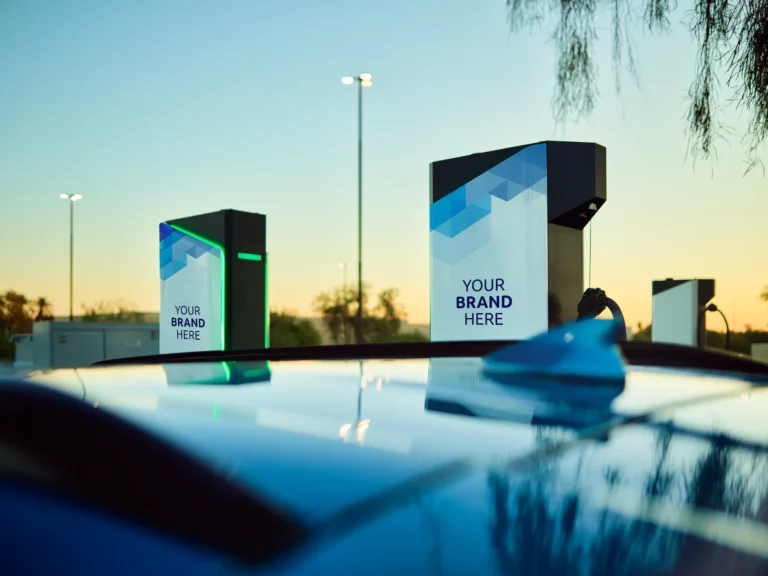

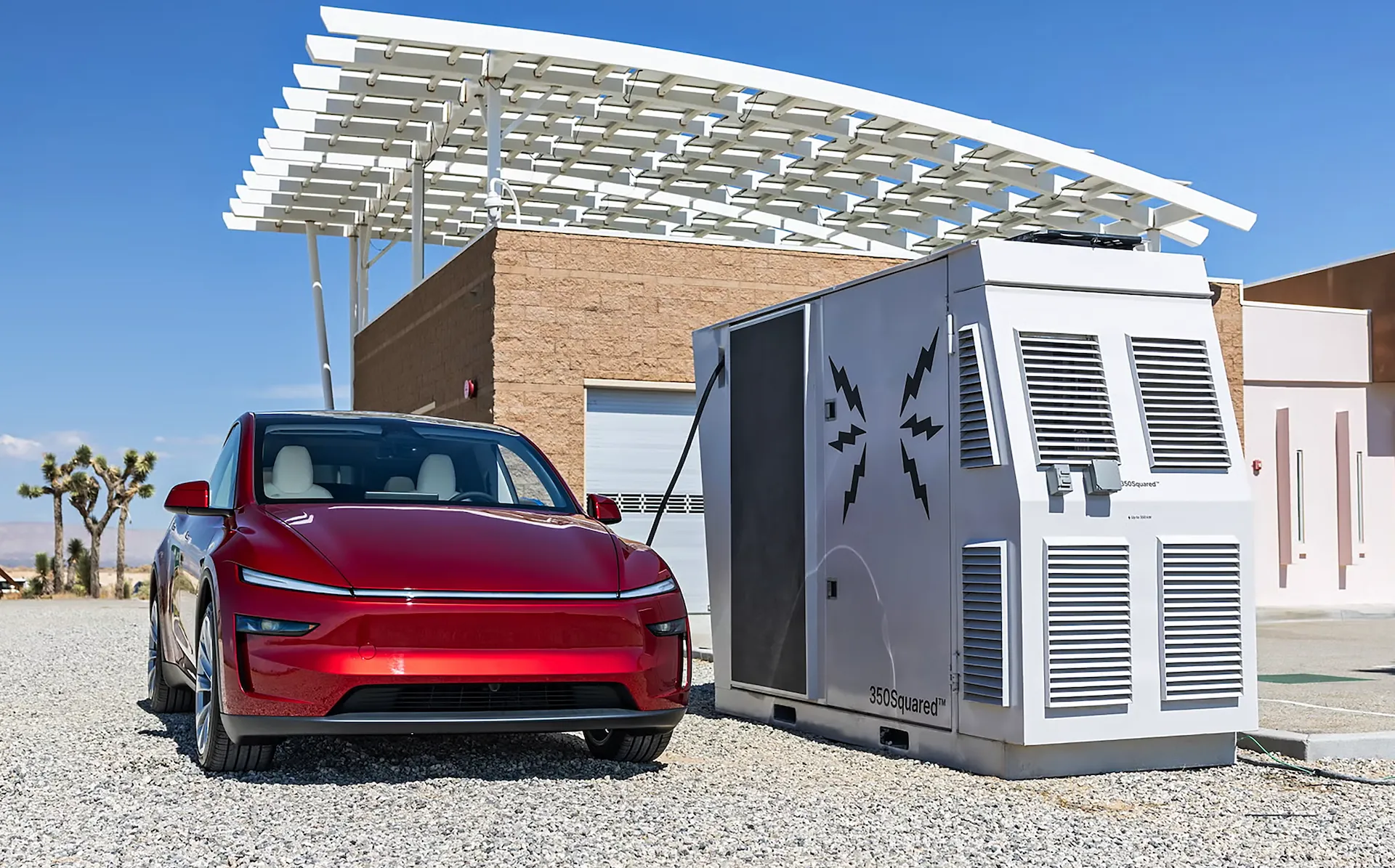
Silicon Valley startup ElectricFish Energy unveiled its Turbo Charge service at CES 2026, positioning the company’s battery-integrated fast charging system as a solution to EV infrastructure deployment bottlenecks. The platform combines a 400 kWh battery-powered charger with AI-driven energy management software, enabling 400 kW charging from grid connections as small as 30 kW.
Highlights
- Rapid deployment model: ElectricFish units install in 4-6 weeks versus 12-18 months for conventional DC fast chargers, eliminating costly utility upgrades
- Revenue-share business model: Gas station operators provide space and modest electrical connections while ElectricFish covers hardware costs and splits charging revenue
- Hyundai validation: Multi-month testing at Hyundai’s California Proving Ground delivered 1,119 kWh across 37 sessions with 313 kW peak output in triple-digit temperatures
- Detroit deployment live: First commercial installation operational in Detroit’s Eastern Market district through Toyota Mobility Foundation’s Sustainable Cities Challenge
Platform Architecture
The ElectricFish ecosystem comprises three integrated components backed by five issued U.S. patents.
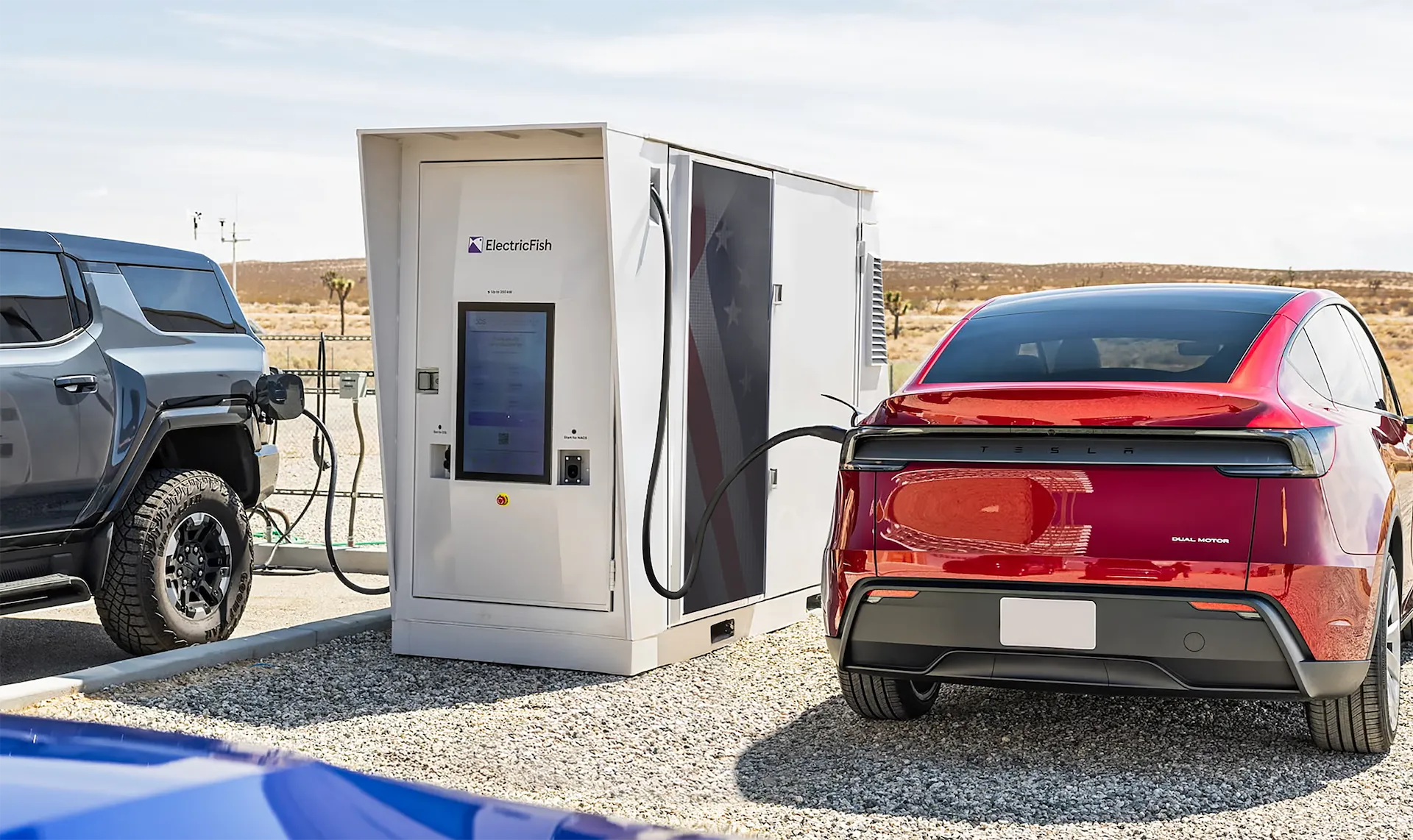
ElectricFish 400squared
The hardware foundation features a 400 kWh lithium iron phosphate (LFP) battery paired with dual 400 kW charging ports. The liquid-cooled system draws from its internal battery reservoir rather than the grid, requiring only one-tenth to one-third of typical DC fast charger power connections.
This architecture addresses what MotorTrend identified as a core industry paradox: abundant electricity but scarce fast charging infrastructure. Conventional installations can exceed $150,000 per port in utility upgrade costs alone.
Reef Charging Station Management System
The Reef CSMS provides operators real-time visibility into charging sessions, energy flow metrics, and station performance data.
Stargazer AI Engine
Five patented intelligent agents power the Stargazer optimization platform:
- Grid Agent: Determines optimal timing for selling energy back to utilities
- EV Agent: Forecasts vehicle arrivals to ensure battery readiness
- Health Agent: Monitors battery and system longevity
- Cost Agent: Tracks time-of-use pricing, weather patterns, and outage data
- Coordinator Agent: Synthesizes inputs and issues real-time system commands
Each deployment learns from a master model before adapting to local site conditions.
Business Model and Target Market
ElectricFish targets America’s 150,000-plus gas stations with a revenue-share program designed to eliminate capital barriers. Station owners provide physical space and a modest electrical connection while ElectricFish handles hardware, installation, and maintenance costs.
“Gas stations are built for short dwell times and high turnover. We designed our new Turbo Charge service to behave like a pump, not a parking space,” said Anurag Kamal, ElectricFish CEO and co-founder.
The Turbo Charge service targets 8-10 minute sessions delivering up to 180 miles of range, differentiating from longer-duration parking lot charging models.
Hyundai Testing Results
Hyundai Motor Company conducted extended validation testing at its California Proving Ground facility throughout 2025. The 350squared charger, predecessor to the 400squared launching at CES, operated through continuous triple-digit temperatures during MotorTrend’s 2026 SUV of the Year evaluations.
“ElectricFish allowed us to fast charge without costly electrical infrastructure upgrades, and installation is quick and simple,” said Dean Vivo Amore, Senior Engineer at Hyundai. “We see this as a way to unlock fast charging at sites that the grid alone can’t support today.”
Tafflyn Toy, Project Lead at Hyundai CRADLE, noted the system “passed with margin” under extreme heat testing, with built-in safety redundancies supporting customer-facing deployment.
Detroit Commercial Deployment
ElectricFish’s first commercial installation is now operational in Detroit’s Eastern Market district, selected through the Toyota Mobility Foundation’s Sustainable Cities Challenge from nearly 100 submissions. The deployment electrifies fleet operations in the historic food and warehouse logistics hub while providing public fast charging access.
The company is in discussions with Michigan contract manufacturers, potentially establishing the state as a second operational hub alongside its San Carlos, California headquarters.
Policy and Market Context
Recent policy developments align with ElectricFish’s expansion strategy. California Governor Gavin Newsom announced $1.1 billion for zero-emission transit and infrastructure in December 2025. Michigan’s Charge Up Michigan program targets two million EVs and 100,000 chargers by 2030.
FERC Order 2222, mandating grid storage programs nationwide, further supports the company’s distributed energy model.
Grid Integration Strategy
ElectricFish positions its network as grid-positive infrastructure rather than additional load. Each unit functions as a distributed energy resource capable of absorbing demand spikes and selling power back during peak periods.
“We don’t sell EV chargers or batteries; we sell time and uptime. We’ve decoupled charging speed from grid limits by actively managing when energy flows in or out, so fast charging strengthens the grid instead of destabilizing it,” said Nelio Batista, ElectricFish CTO and co-founder.
The company’s long-term vision targets community-scale 400 kWh batteries at neighborhood level, creating virtual power plant capability across thousands of networked units.
CES 2026 Presence
ElectricFish is exhibiting at Eureka Park (booth #61306) in the Venetian Expo as part of Hyundai’s ZER01NE Ventures dedicated area. The company is demonstrating the full platform ecosystem including the Reef monitoring dashboard and Stargazer AI.
Sign up for our popular weekly email to catch all the latest EV news!