
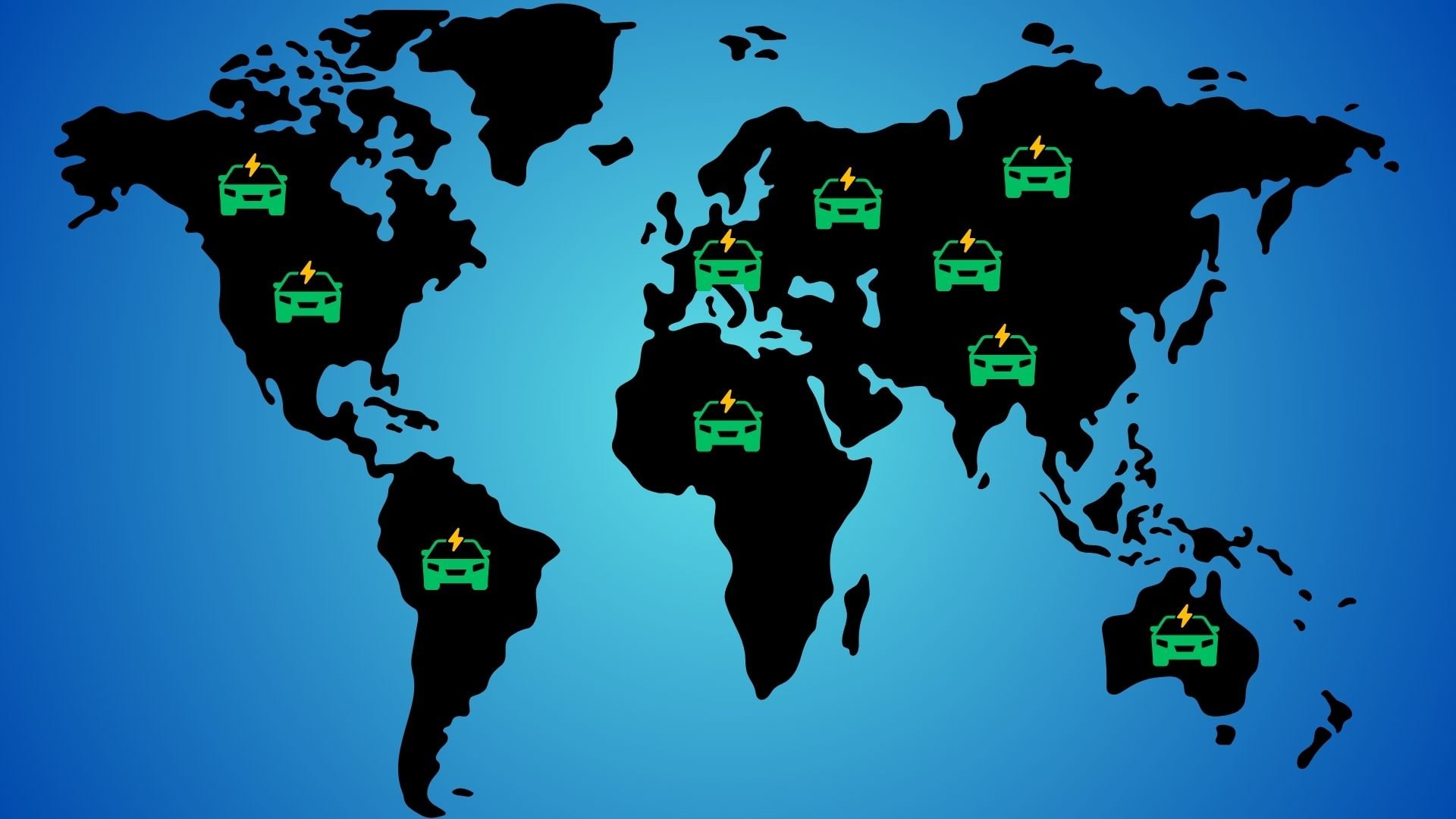
The electric vehicle industry just crossed a threshold that seemed far off not long ago: one in four new cars sold globally in 2025 was electric.
Total global EV sales topped 20.7 million units, representing roughly 25% of all new passenger vehicles. That’s a remarkable achievement for an industry that sold just a few million vehicles annually less than a decade ago. And the growth is happening everywhere—from traditional automotive powerhouses to emerging markets that are writing their own electrification playbooks.
Here’s how the year unfolded across the world’s major markets.
China Crosses the 50% Threshold
China reached a landmark milestone in 2025: more than half of all new cars sold in the country are now electric. Total EV sales hit 12.9 million units, accounting for about 63% of global volume.
BYD led the market with 2.26 million battery-electric vehicles sold globally, making it the world’s top-selling EV brand for the first time. The Shenzhen-based automaker’s total new energy vehicle sales (including plug-in hybrids) exceeded 4.6 million units. Their vertically integrated approach—manufacturing their own batteries, semiconductors, and key components—has enabled competitive pricing across a broad product lineup.
The Chinese market continues to expand rapidly, with Geely posting an impressive 81% year-over-year increase to capture second place. Changan secured third with nearly 790,000 units. New entrants like Xiaomi cracked the top 10 with their SU7 sedan, showing how the market continues to attract fresh competition and innovation.
Tesla sold approximately 625,698 vehicles in China, maintaining a significant presence as the leading international brand in the market.
Europe’s Strong Recovery
The European EV market rebounded in 2025, with sales climbing approximately 27% through November. Battery-electric vehicles reached nearly 2.3 million units sold, pushing regional market share to around 23%.
Germany led Europe with a 41% increase in EV registrations, cementing its position as the continent’s largest electric vehicle market. Over 55,000 units were registered in November alone, demonstrating sustained consumer interest.
The UK delivered one of Europe’s strongest performances, with EV market share reaching 33%. Sales grew approximately 27%, with the country moving over 224,000 EVs in the first half alone.
Norway continues to set the global standard for EV adoption, with 93.7% of new car sales being fully electric. The Netherlands, Denmark, and Sweden all exceeded 50% combined EV and PHEV market share, showcasing the Nordic region’s leadership in the transition.
Spain emerged as Europe’s fastest-growing major market, with EV sales jumping 86% year-over-year. Portugal also showed strong momentum, reaching 23% BEV share through November.
The Tesla Model Y and Model 3 remained Europe’s best-selling EVs, while domestic brands like Volkswagen, Renault, and Skoda posted strong numbers with new models gaining traction.
United States Posts Second-Best Year on Record
The U.S. EV market delivered its second-highest annual sales total, with approximately 1.3 million vehicles sold. The third quarter was particularly strong, setting an all-time quarterly record with over 438,000 EVs and a 10.5% market share.
Tesla maintained its market leadership with roughly 49% of U.S. EV sales. General Motors emerged as a strong second, selling over 150,000 EVs—a 48% year-over-year increase. The Chevrolet Equinox EV proved especially popular, frequently ranking among the top-selling models.
Hyundai, Ford, and Volkswagen all posted gains through the first three quarters, with GM and Hyundai both more than doubling their EV sales year-over-year in Q3. The expanding model lineup—now featuring nearly 90 EV options across all price points—continues to give consumers more choices than ever.
The hybrid segment also reached record levels, with Toyota capturing about 48% of hybrid volume. The growing popularity of both EVs and hybrids signals broadening consumer acceptance of electrified powertrains.
Emerging Markets Lead the Way
One of the biggest stories of 2025 was the rapid EV adoption across emerging markets. Countries that were barely on the EV map a few years ago are now posting adoption rates that rival or exceed traditional automotive markets.
Vietnam reached nearly 40% EV market share, driven by domestic manufacturer VinFast. The company’s VF 3 compact became the country’s best-selling vehicle, demonstrating strong local demand for affordable electric options.
Singapore crossed 40% EV share, maintaining its position as Southeast Asia’s adoption leader.
Thailand broke the 20% threshold for the first time, putting the country well ahead of its “30@30” target (30% EV share by 2030). The country sold more EVs in the first three quarters than Denmark.
Indonesia reached 15% EV penetration, supported by significant manufacturing investments. The country’s abundant nickel reserves—roughly 52% of global supply—have attracted major battery facility investments from companies like BYD and CATL.
Brazil saw EV sales surge, with the market benefiting from increased model availability and competitive pricing. BYD and Great Wall Motor are establishing local production facilities, signaling long-term commitment to the region.
Turkey emerged as Europe’s fourth-largest BEV market by volume, with domestic manufacturer Togg expanding production and market share reaching 17%.
The Southeast Asian market overall grew nearly 50%, with the region’s combined EV sales now representing a significant portion of global volume outside China, Europe, and North America.
Key Takeaways from 2025
Global adoption accelerated. The 25% global market share milestone demonstrates that EVs have moved firmly into the mainstream. What was once a niche is now a quarter of the market.
Growth is worldwide. From Norway’s 94% to Indonesia’s 15%, EV adoption is happening across income levels and geographies. The transition isn’t limited to wealthy markets.
Competition is driving innovation. More than 100 brands now compete globally, pushing improvements in range, charging speed, and affordability. Consumers have never had more options.
Infrastructure is expanding. China leads with the world’s largest charging network, while Europe and North America continue to build out public charging. Thailand aims for 12,000 stations, and Indonesia is rapidly expanding its network.
Batteries keep improving. Falling battery costs and advancing technology—including LFP chemistry and emerging solid-state options—continue to improve the value proposition for consumers.
Looking Ahead to 2026
The momentum from 2025 sets up an exciting year ahead. New affordable models are coming to market, including the return of the Chevrolet Bolt and Rivian’s R2. Battery technology continues advancing, with solid-state and sodium-ion chemistries moving toward commercial viability.
Emerging markets in Southeast Asia and Latin America are expected to continue their rapid growth trajectories. Europe’s regulatory framework will keep pushing adoption higher, while China’s manufacturers expand their global footprint.
The IEA projects EV sales could reach nearly 90 million units annually by 2040, representing over 80% of new vehicle sales. The 2025 milestone—one in four cars sold globally being electric—shows that future is well within reach.
The electric vehicle transition has reached a tipping point. The growth is real, it’s global, and it’s accelerating.
Sign up for our popular weekly email to catch all the latest EV news!