

Sign up for our popular weekly email to catch all the latest EV news!
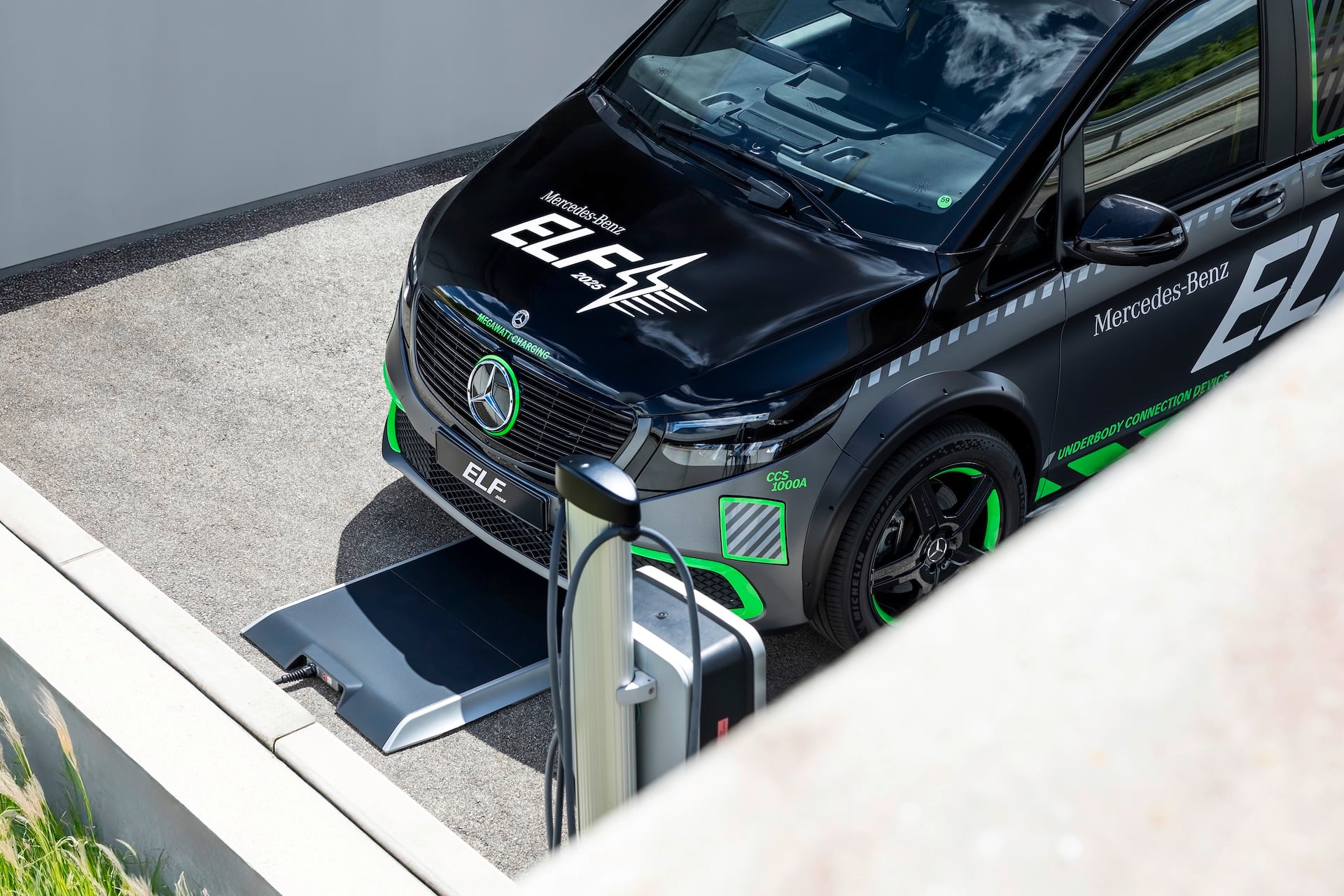
Mercedes-Benz is advancing electric mobility with its ELF experimental charging vehicle, a project focused on creating a seamless and intelligent charging experience. The vehicle, whose name is derived from the German “Experimental-Lade-Fahrzeug,” serves as a mobile laboratory for testing holistic charging solutions that combine vehicle innovations with infrastructure concepts. The project aims to make EV charging more efficient, intelligent, and sustainable, building on the company’s previous initiatives like Plug & Charge and the MB.CHARGE Public charging service.
Key Highlights
- Dual Fast-Charging: The ELF vehicle tests both Megawatt Charging System (MCS) and Combined Charging System (CCS) connectors, exploring performance limits up to 900 kW.
- Bidirectional Capability: Research includes Vehicle-to-Home (V2H), Vehicle-to-Grid (V2G), and Vehicle-to-Load (V2L) functionalities for both AC and DC power.
- Automated Charging: The project explores advanced charging methods, including wireless inductive charging and automated conductive charging via the vehicle’s floor.
- Holistic Development: Findings are integrated into future series production models and the development of high-performance charging infrastructure, such as the Mercedes-Benz Charging Network.

Pushing the Limits of Fast Charging
To improve the everyday usability of electric vehicles, the ELF project explores the technical limits of fast charging for both the vehicle and the charging station. The experimental vehicle is equipped with two distinct fast-charging systems.
The MCS (Megawatt Charging System) connector, originally designed for heavy-duty transport, is used to research the thermal resilience and performance boundaries of high-voltage components under extreme conditions. Insights from this research are intended for future long-distance vehicles and fleet solutions.
The CCS (Combined Charging System) connector, the standard for passenger cars, is used to test near-series components under everyday conditions. With the ELF, Mercedes-Benz is testing the limits of CCS to enable higher charging capacities in the future. The vehicle can achieve a charging capacity of up to 900 kW, which allows for charging 100 kWh in just 10 minutes.
This research directly informs projects like the CONCEPT AMG GT XX technology program. In collaboration with Alpitronic, Mercedes-Benz developed a prototype high-performance charging station that delivered a peak charging power of 1,041 kW during testing. This holistic development approach ensures that findings are incorporated into future high-performance chargers for Mercedes-Benz charging parks.
Bidirectional Charging for a Sustainable Future
Bidirectional charging transforms an electric vehicle into a mobile energy storage device, representing a strategic component of the energy transition. The ELF vehicle tests this key technology’s potential to not only receive electricity but also supply it to homes (Vehicle-to-Home; V2H), the grid (Vehicle-to-Grid; V2G), or individual devices (Vehicle-to-Load; V2L).
The ELF is capable of both AC and DC bidirectional charging. AC charging is more cost-effective for infrastructure, while DC charging offers high efficiency, especially when paired with photovoltaics and home storage. Mercedes-Benz plans to launch its first services for bidirectional charging in Germany, France, and the UK during 2026, with other markets to follow. These services aim to reduce household energy costs and support grid stability by turning electric cars into active energy storage units.
Customer benefits include greater self-sufficiency, with a typical Mercedes-Benz EV battery capable of powering a single-family home for two to four days. It also allows for energy cost savings of approximately 500 euros per year and a reduced carbon footprint by storing and using surplus solar power.
Exploring Wireless and Automated Charging
The ELF project also researches cable-free charging through induction. This technology transfers electrical energy wirelessly via a charging system integrated into the ground. The system currently operates at 11 kW alternating current (AC), similar to a standard wallbox. The research focuses on everyday usability, efficiency, and compatibility for various mobility concepts, including premium vehicles and fleet solutions.
Another innovative method being tested is automated conductive charging through the vehicle floor. This system uses charging plates on the ground that establish a direct physical connection with a connector on the vehicle’s underbody. It offers high user comfort, minimizes cable wear, and is particularly suitable for barrier-free applications or tight parking spaces. The charging power is also currently 11 kW AC.
The Future of Automated Infrastructure
In addition to enhancing charging power, Mercedes-Benz is researching the automation of the charging process using robotics. Robot-assisted charging is a promising solution for fast charging, where high currents and heavy cables are used. These automated systems would allow vehicles to connect to charging infrastructure safely and without manual intervention, a significant step for fleet operators and premium mobility concepts.
These advancements are linked to the work of the company’s in-house Charging Unit, which is also managing the global rollout of the Mercedes-Benz Charging Network, a brand-owned fast-charging network open to drivers of all electric vehicle brands.
About Mercedes-Benz AG
Mercedes-Benz AG is part of the Mercedes-Benz Group AG and is responsible for the global business of Mercedes-Benz Cars and Mercedes-Benz Vans. The company focuses on the development, production, and sales of passenger cars, vans, and vehicle-related services, aspiring to be a leader in electric mobility and vehicle software. The product portfolio includes the Mercedes-Benz brand with Mercedes-AMG, Mercedes-Maybach, G-Class, and the smart brand. As one of the world’s largest manufacturers of high-end passenger cars, Mercedes-Benz AG is expanding its worldwide production network while gearing itself to meet the requirements of electric mobility. Sustainability is the guiding principle of the company’s strategy, aiming to create lasting value for all stakeholders.
More information is available at https://www.mercedes-benz.co.uk/.
Sign up for our popular weekly email to catch all the latest EV news!