
MG has become the first automaker to achieve mass production of semi-solid-state batteries. The company unveiled its SolidCore Battery technology alongside updates to its Hybrid+ powertrain system at the opening of a new European Engineering Centre in Frankfurt, Germany.
Highlights
- SolidCore Battery uses a 95% solid electrolyte composition, replacing most liquid content found in conventional lithium-ion cells, with European deployment planned for late 2026
- MG Hybrid+ sold 137,000 units in Europe in 2025, a 300% increase over 2024, with upgrades now including a segment-first 3-speed hybrid transmission and microsecond-level powertrain response
- New European Engineering Centre in Frankfurt supports MG’s “in Europe, for Europe” development strategy, joining existing facilities in Longbridge, UK, and London
- All-solid-state battery development is already underway, targeting a potential 1,000 km range in future EVs
SolidCore Battery Technology
The SolidCore name refers to MG’s manganese-based semi-solid-state battery architecture. Conventional EV batteries use liquid electrolyte to shuttle lithium ions between electrodes. The SolidCore design replaces most of that liquid with a 95% solid electrolyte, forming a protective barrier around the electrodes.
MG said this structure enables three-dimensional lithium-ion mobility. That contrasts with one-dimensional movement in LFP cells and two-dimensional movement in NCM cells. The result, according to MG, is measurably better performance across several metrics.
Performance Claims
- Charging speed: 15% faster in low-temperature conditions compared to conventional cells
- Power delivery: 20% improvement in transient response (HPPC), enabling stronger acceleration
- Cold-weather discharge: Retains over 90% capacity at -20°C, with 3.9C discharge power at that temperature
- Full-temperature performance: 100% improvement in power output across climate extremes compared to LFP batteries
- Reliability: 20% improvement over current-generation battery technology
Safety Architecture
The semi-solid-state composition substantially reduces liquid content, which MG said lowers thermal risk. The cells passed both needle penetration and three-way extrusion tests without thermal runaway. The battery has been tested across a range from -30°C to over 1,000°C.
A solid-state electrolyte coating on the cathode adds a further protective layer. MG also cited an exclusive manganese-capture technology that ensures Euro 7 compliance at the cell level.
Dr. Li Zheng, MG Global Chief Battery Scientist, leads the development program. He holds 192 invention patents and 623 utility model patents. The solid-state battery technologies developed under his oversight have been adopted in 18 vehicle models within the past year.
The MG4 EV Urban will be the first European vehicle to receive SolidCore Battery technology, with broader rollout planned for additional models.
Hybrid+ System Updates
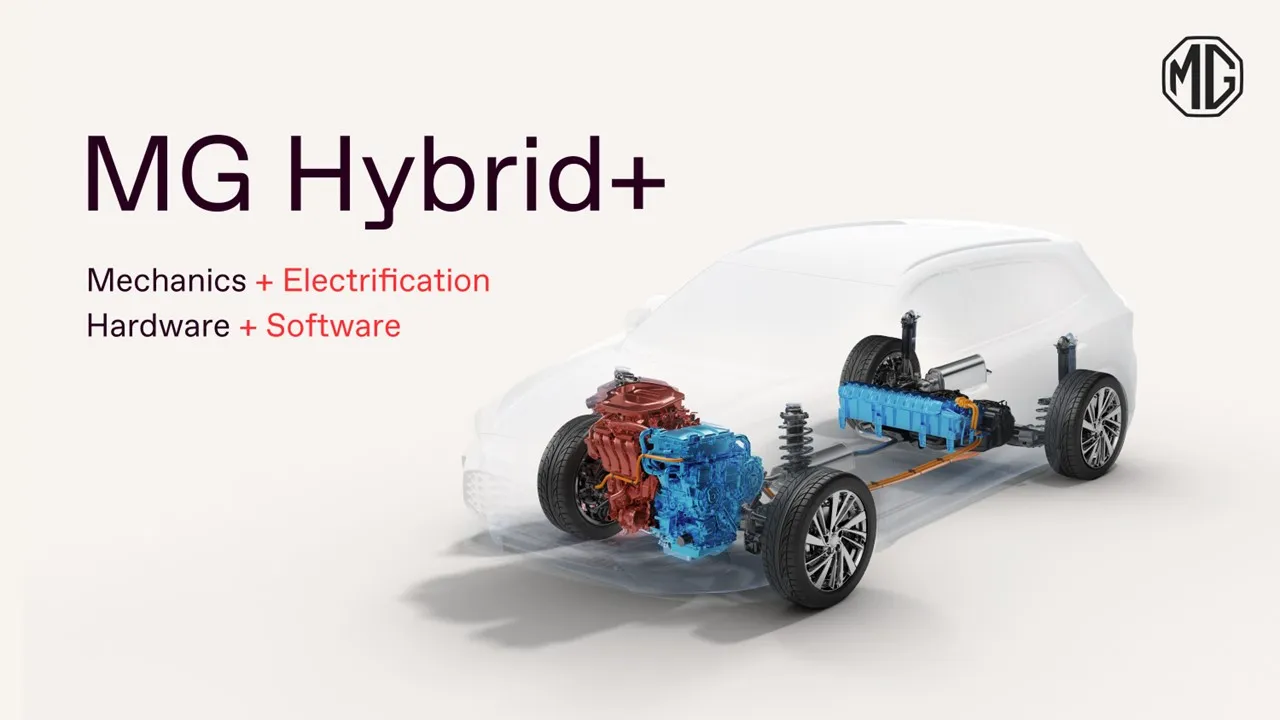
MG’s Hybrid+ powertrain combines a 1.5-liter dedicated hybrid engine with dual electric motors and an integrated software-hardware control architecture. The system has driven significant European sales growth, with the MG HS ranking among the top 10 best-selling hybrid models in most European countries.
Powertrain Specifications
- Engine: 1.5L dedicated hybrid unit with 16.3:1 compression ratio, 75 kW max power, 128 N·m peak torque, and 41% thermal efficiency
- Traction motor: 100 kW / 250 N·m, rated at BEV-level performance
- Battery: 1.83 kWh NCM high-power cell on a 350V platform, with 151 kW max charging power and 138 kW max discharging power
- Transmission: 3-speed automatic hybrid unit — a segment first
- Enclosure: Withstands 1,200°C flame exposure for 30 minutes without burn-through
Integrated Control Unit
The fully integrated Hybrid Control Unit (HCU) operates at microsecond-level response times. MG said this is roughly 1,000 times faster than the millisecond-level response of conventional hybrid systems. The HCU manages eight distinct propulsion modes, including pure EV, series, parallel, direct drive, regeneration, and idle charging configurations.
The system also incorporates real-time terrain detection. This allows the powertrain to adapt its propulsion strategy dynamically, particularly on slopes and varying road surfaces.
Qiu Jie, Vice President of MG Global R&D Innovation Headquarters, oversees the Hybrid+ program. He previously served as Project Lead for China’s 14th Five-Year National Key R&D Program on dedicated hybrid engines. His work on EU-oriented export programs achieved WLTP CO₂ emissions below 100 g/km.
European Engineering Centre
The Frankfurt facility will focus on tailoring vehicles for European conditions, including climate, road environments, and regional regulatory requirements. It joins MG’s existing engineering operation in Longbridge and its London-based Design Hub.
MG’s cumulative European sales now exceed one million vehicles. The brand operates in 34 European countries through approximately 1,300 dealer partners.
Kimi Li, Vice President of MG Europe and the UK, said: “MG’s new SolidCore Battery and Hybrid+ technology provide tangible benefits for our customers and position our vehicles at the forefront of their class. These advancements reinforce MG’s commitment to making cutting-edge technology and electric mobility more intuitive, accessible, and widely available.”
Sign up for our popular weekly email to catch all the latest EV news!