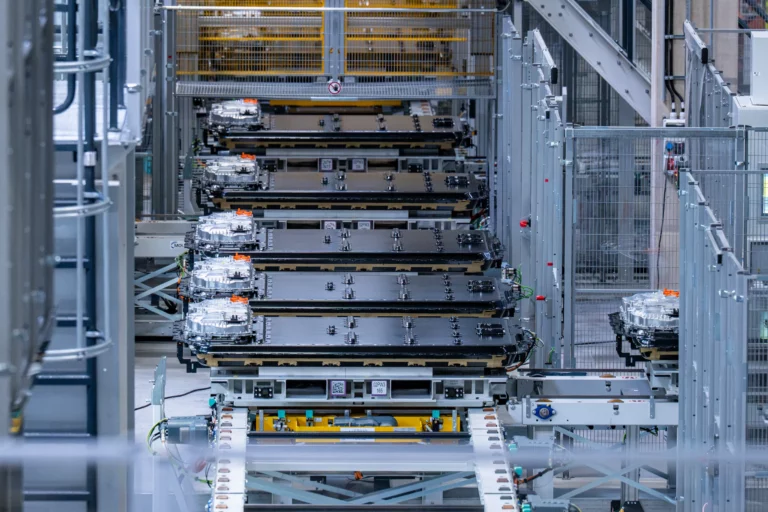


EAS Batteries has begun commercial sales of the UHP-601300-LFP-22, an ultra-high-power lithium-ion LFP cell that delivers 2,550 W/kg under continuous discharge — roughly 60% more than comparable cells using conventional electrolytes. The German manufacturer’s cylindrical 22 Ah cell pairs a lithium iron phosphate cathode with Acetolyte, an acetonitrile-based electrolyte whose high ionic conductivity lowers internal resistance and improves rate capability under demanding temperatures. EAS first launched the cell earlier this spring under a licensing agreement with Japan’s Asahi Kasei signed late last year, and customer samples are now under evaluation across multiple industries.
Highlights
- The UHP-601300-LFP-22 carries a nominal capacity of 22 Ah and delivers 2,550 W/kg (880 A, 40C) under continuous discharge, about 60% above EAS cells built with conventional electrolytes.
- Under a two-second pulse, specific power reaches 3,760 W/kg (1,320 A, 60C), an improvement of roughly 10%.
- The cell sustains 2,400 cycles at 5C/5C and 100% depth of discharge at room temperature before falling to 80% of initial capacity.
- Acetolyte, Asahi Kasei’s acetonitrile-based electrolyte, is licensed to EAS for its cylindrical LFP cells; a 46xxx-format version aimed at low-voltage EV batteries is in prototype testing.
Performance Gains Over Conventional Cells
The cell’s headline numbers come from the electrolyte’s effect on internal resistance. According to the company, continuous-discharge specific power of 2,550 W/kg runs about 60% higher than an equivalent EAS cell using a conventional electrolyte, while the two-second pulse figure of 3,760 W/kg represents an improvement of approximately 10%.
| Metric | UHP-601300-LFP-22 (Acetolyte) | EAS cell, conventional electrolyte |
|---|---|---|
| Continuous discharge | 2,550 W/kg; 880 A (40C) | 1,550 W/kg; 550 A (25C) |
| 2-second pulse discharge | 3,760 W/kg; 1,320 A (60C) | 3,420 W/kg; 1,320 A (60C) |
Over the long term, the company reports the cell holds 2,400 charge-discharge cycles at a 5C/5C rate and 100% depth of discharge at room temperature before dropping to 80% of its initial capacity.
What the Acetolyte Electrolyte Adds
Acetolyte is Asahi Kasei‘s acetonitrile-containing electrolyte, engineered for high ionic conductivity that reduces internal cell resistance and sharpens rate capability. The company says the chemistry raises power output at low temperatures and improves durability at high temperatures, two persistent weak points for current lithium-ion cells. Asahi Kasei also states the electrolyte lowers cost and allows smaller battery packs, which in turn lifts energy density.
Licensing Strategy and the 46xxx Roadmap
The two companies have agreed to sublicense their combined technologies to global OEMs and battery manufacturers, with the goal of expanding into mobility applications. They are also evaluating the electrolyte in the larger 46xxx cylindrical format, with a product launch targeted for later this year; prototypes are already available for testing and are aimed primarily at low-voltage electric vehicle batteries.
“The successful commercialisation of our new cell featuring Asahi Kasei’s Acetolyte™ marks another important milestone in our strategic partnership. Our collaboration on the new 46xxx cell format is also progressing smoothly, underscoring the strength of our joint development approach and our ability to accelerate innovation from concept to market readiness.”, said EAS Managing Director Michael Deutmeyer.
For Asahi Kasei, the launch fits a broader licensing push. The company is pursuing what it calls Technology-value Business Creation, an effort to monetize patents, know-how, and data through licensing, and it aims to conclude at least 10 new license agreements across its current medium-term plan, targeting a cumulative profit contribution of ¥10 billion (about $63 million) or more by around 2030.
“The short time from signing our license agreement in November 2025 to the start of serial production in March 2026 reflects the focused and highly collaborative efforts between EAS Batteries and Asahi Kasei. Together, we have translated advanced electrolyte technology into a commercially viable high-power cell within just a few months. Building on this momentum, we are already working on the next cell format and look forward to further advancing high-performance battery solutions.”, said Osamu Matsuzaki, Senior Executive Officer of Asahi Kasei and Head of Corporate R&D and IP.
Sign up for our popular weekly email to catch all the latest EV news!