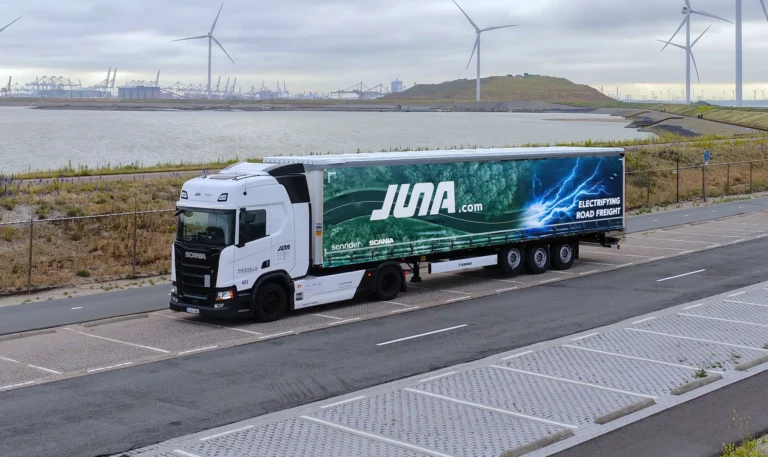
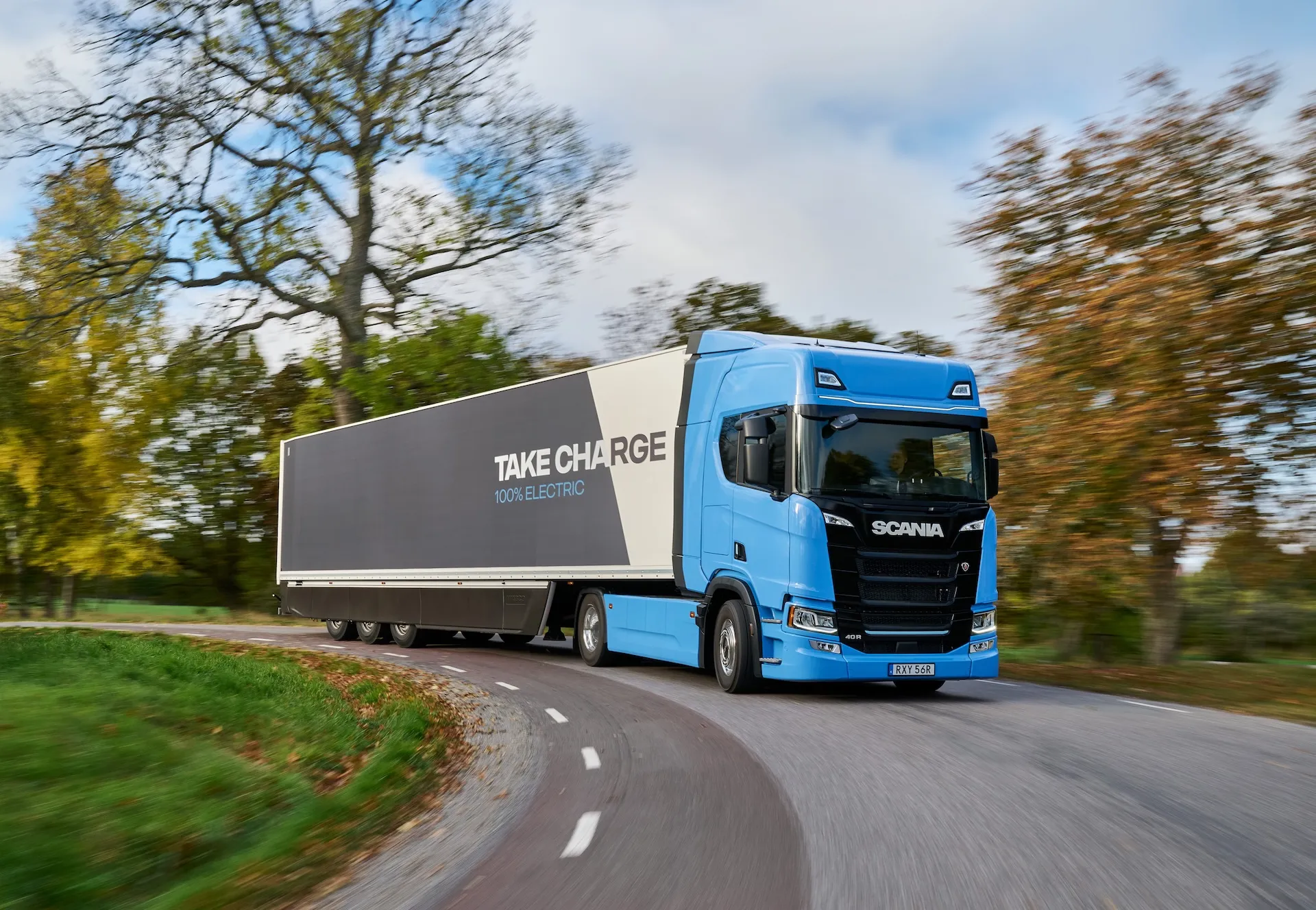

Scania has begun the global sales rollout of a new under-cab battery module that enables some electric truck configurations to exceed 800 km of range on a single charge. The Swedish manufacturer paired the announcement with the commercial availability of its Megawatt Charging System (MCS), positioning the two as a combined route to electrifying heavy-load, long-haul, and complex bodywork applications. Operators can configure Scania’s battery-electric trucks and charging solutions through both options now, the Södertälje-based company said.
Highlights
- New under-cab battery module enables range well beyond 800 km in some applications on a single charge
- A 400-kWh usable capacity option delivers 360 km of typical range without reducing payload, up to the legal maximum
- MCS allows mid-journey charging from 20 percent to 75 percent during legally required driver rest breaks
- Charging infrastructure access provided through Scania-owned Erinion and Scania Charging Access networks
Why the Under-Cab Position Matters
Repositioning the battery module under the cab frees chassis space that would otherwise be consumed by side-mounted packs, opening the truck to bodywork configurations that previously forced operators to choose between range and payload. The company reports that the configuration can be adapted across different bodywork types and applications, with battery placement varying by use case.
The 2025 increase in the European Union’s Gross Train Weight allowance is what makes the math work at the legal upper bound. According to Scania, a 400-kWh usable capacity option delivers roughly 360 km of typical range without forcing the operator to give up payload — a constraint that has slowed electrification in heavy-haul segments where every kilogram of battery mass directly displaces revenue freight.
Why the Megawatt Charging System Changes the Range Calculation
Scania’s argument against oversized batteries reframes the standard electric-truck specification debate. The company contends that operators specifying battery capacity for the worst-case route — say, 500 km when the typical assignment runs 300 km — pay a payload penalty on every trip for range they rarely use. With MCS available, a mid-journey top-up during a legally mandated rest break becomes the operational fix rather than a larger pack.
The charging window Scania describes — 20 percent to 75 percent during a single rest break — is enough to complete a delivery and return toward base with additional top-ups at depots or along the return leg. The economic argument follows from the engineering one: smaller batteries cost less to buy and free more weight for cargo, and MCS makes the smaller battery viable.
Quoted Executives on the Combined Offering
“The new under-cab battery module optimises the placing of the truck batteries to transporters’ advantage,” said Tobias Ejderhamn, Global Manager, Transformation & New Business at Scania. “Thus, with the right battery set-up, MCS and a good charging strategy — using Scania’s own charging company Erinion or Scania Charging Access out on the road — our customers can easily solve the range versus payload question.”
Ejderhamn added that haulage companies running Scania electric trucks “are transporting goods, not kilowatt hours, and reducing their total cost of operation.”
Lars Gustafsson, Head of Solutions Management at Scania, framed the order opening as a single integrated path rather than two separate product launches. “Scania can now offer transport operators a comprehensive path to electrification and sustainable transport; one that is reliable, seamless, and commercially viable,” he said. “With these two new additions to customers’ armoury it has become even easier and more attractive to make the change to electric transport.”
Sign up for our popular weekly email to catch all the latest EV news!