
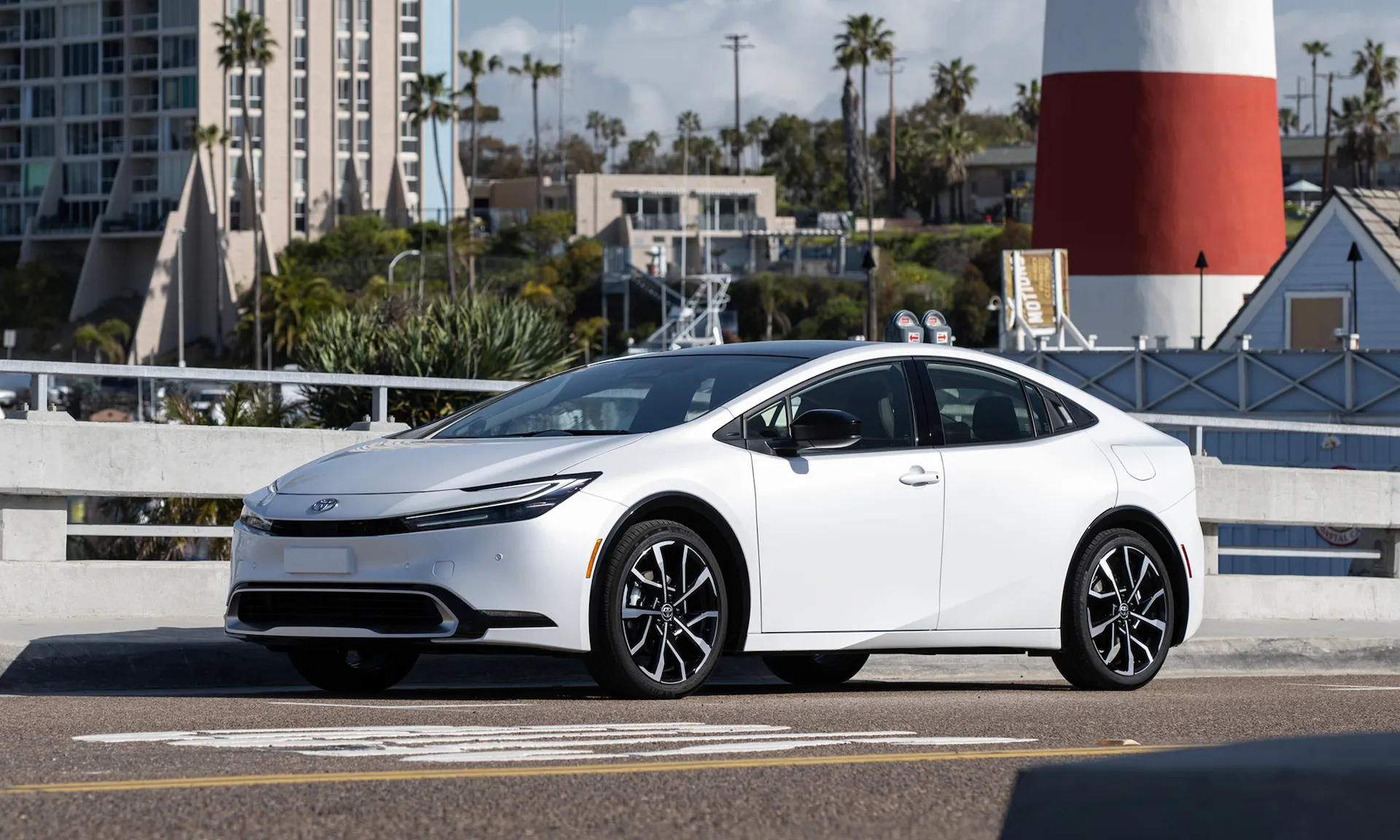
The 2027 Toyota Prius Plug-in Hybrid delivers an EPA-estimated 44-mile all-electric range on the SE grade and starts at $33,980, Toyota announced this week. Available in SE, XSE, Nightshade and XSE Premium grades, the Prius Plug-in Hybrid is powered by Toyota’s fifth-generation Hybrid System, pairing a 2.0-liter engine with electric motor-generators for 220 net-combined horsepower and an EPA-estimated 0-60 mph time of 6.6 seconds. A 13.6-kWh lithium-ion battery delivers up to 39 miles of EPA-estimated electric range on XSE, Nightshade and XSE Premium grades; once depleted, the hybrid system takes over for an EPA-estimated 51 MPG combined on the SE grade. Every grade adds Dual-Zone HVAC for 2027, and buyers get a five-year trial of Toyota’s Connected Services suite.
Highlights
- EPA-estimated all-electric range reaches 44 miles on the SE grade and 39 miles on XSE, Nightshade and XSE Premium grades
- The fifth-generation Hybrid System produces 220 net-combined horsepower and an EPA-estimated 0-60 mph time of 6.6 seconds
- Home charging takes about 11 hours on a standard 120V outlet or about four hours on a Level 2 charger, with no special equipment required
- Pricing starts at $33,980 for the SE grade, excluding a $1,295 dealer processing and handling fee
Plug In, Power On
No special equipment is needed for home charging — the Prius Plug-in Hybrid uses a standard household outlet with its supplied dual-voltage cable, recharging in about 11 hours on 120V or about four hours on a Level 2 charger. If it isn’t plugged in, the car continues to run as a conventional hybrid.
The car operates in three selectable modes depending on driving conditions and battery charge. EV Mode uses the battery only, functioning like a battery-electric vehicle. Auto EV/HV Mode primarily draws on battery power but switches to hybrid mode when more power is needed, such as on steep hills or at higher speeds. Hybrid Mode automatically blends the gasoline engine and electric motors.
Hybrid System and Braking
The Toyota Hybrid System pairs a 2.0-liter inline four-cylinder gas engine with two motor-generators (MG1 and MG2) through a planetary-type continuously variable transmission. The engine and MG2 work together for responsive performance, while both motor-generators help charge the lithium-ion battery; in Hybrid mode, engine and battery power contribute together to acceleration.
An Electronically Controlled Brake system coordinates regenerative and hydraulic braking to provide stopping power while recovering electrical energy. Three drive modes let drivers tailor the experience: Normal balances fuel economy and acceleration, Eco limits power in response to light or moderate pedal input, and Sport sharpens performance and acceleration.
Technology and Connectivity
Standard equipment across all grades includes wireless Apple CarPlay and Android Auto compatibility, a 7-inch digital gauge cluster and Toyota Safety Sense 3.0. SE, XSE and Nightshade grades use an 8-inch Toyota Audio Multimedia touchscreen with over-the-air update support, while a 12.3-inch screen is standard on XSE Premium and available on XSE and Nightshade.
A six-speaker audio system is standard on SE, Nightshade and XSE; the XSE Premium grade steps up to an eight-speaker JBL Premium Audio system with Clari-Fi technology, which restores sound quality lost during digital compression. Connected Services trials include five years of Safety Connect, Service Connect and Remote Connect, a 30-day, 3-GB Wi-Fi Connect trial, and a three-month Drive Connect trial.
Features by Grade
- SE: dark grey 17-inch alloy wheels, fabric-trimmed front seats with red trim, leather-trimmed heated steering wheel, driver-door Smart Key, six USB-C ports, Electronic Parking Brake, rain-sensing wipers
- XSE: adds 19-inch alloy wheels, heated power driver’s seat, black SofTex seating with red trim, front-door and liftback Smart Key, Qi wireless charger, standard Parking Assist with Automatic Braking, available fixed glass roof
- Nightshade: based on XSE, adds black 19-inch wheels, black bumper trim, blackout badging, black SofTex seats with gray stitching and carbon fiber dashboard accents
- XSE Premium: based on XSE, adds JBL Premium Audio, a 12.3-inch touchscreen, a fixed glass roof, heated/ventilated front seats, driver memory and a power rear liftback; available options include Panoramic View Monitor, Digital Rearview Mirror, heated rear seats, Advanced Park and a limited-availability 185W solar roof that can charge the drive battery while parked
Safety
Toyota Safety Sense 3.0 is standard on every grade, combining a Pre-Collision System with Pedestrian Detection, Full-Speed Range Dynamic Radar Cruise Control, Lane Departure Alert with Steering Assist, Lane Tracing Assist, Road Sign Assist, Automatic High Beams and Proactive Driving Assist. Additional standard features include a Blind Spot Monitor with Rear Cross-Traffic Alert and a Safe Exit Alert.
Pricing and Availability
Built at Toyota’s Tsutsumi Plant in Japan, the 2027 Prius Plug-in Hybrid is priced as follows, excluding a $1,295 dealer processing and handling fee:
| Model # | Grade | Base MSRP |
|---|---|---|
| 1235 | Prius SE | $33,980 |
| 1237 | Prius XSE | $37,230 |
| 1233 | Prius Nightshade | $38,000 |
| 1239 | XSE Premium | $40,675 |
The Prius Plug-in Hybrid carries Toyota’s 36-month/36,000-mile basic warranty, plus 60-month/60,000-mile powertrain coverage and unlimited-mileage corrosion protection. ToyotaCare covers factory-scheduled maintenance for one year or 10,000 miles and includes two years of 24-hour roadside assistance.
Sign up for our popular weekly email to catch all the latest EV news!