
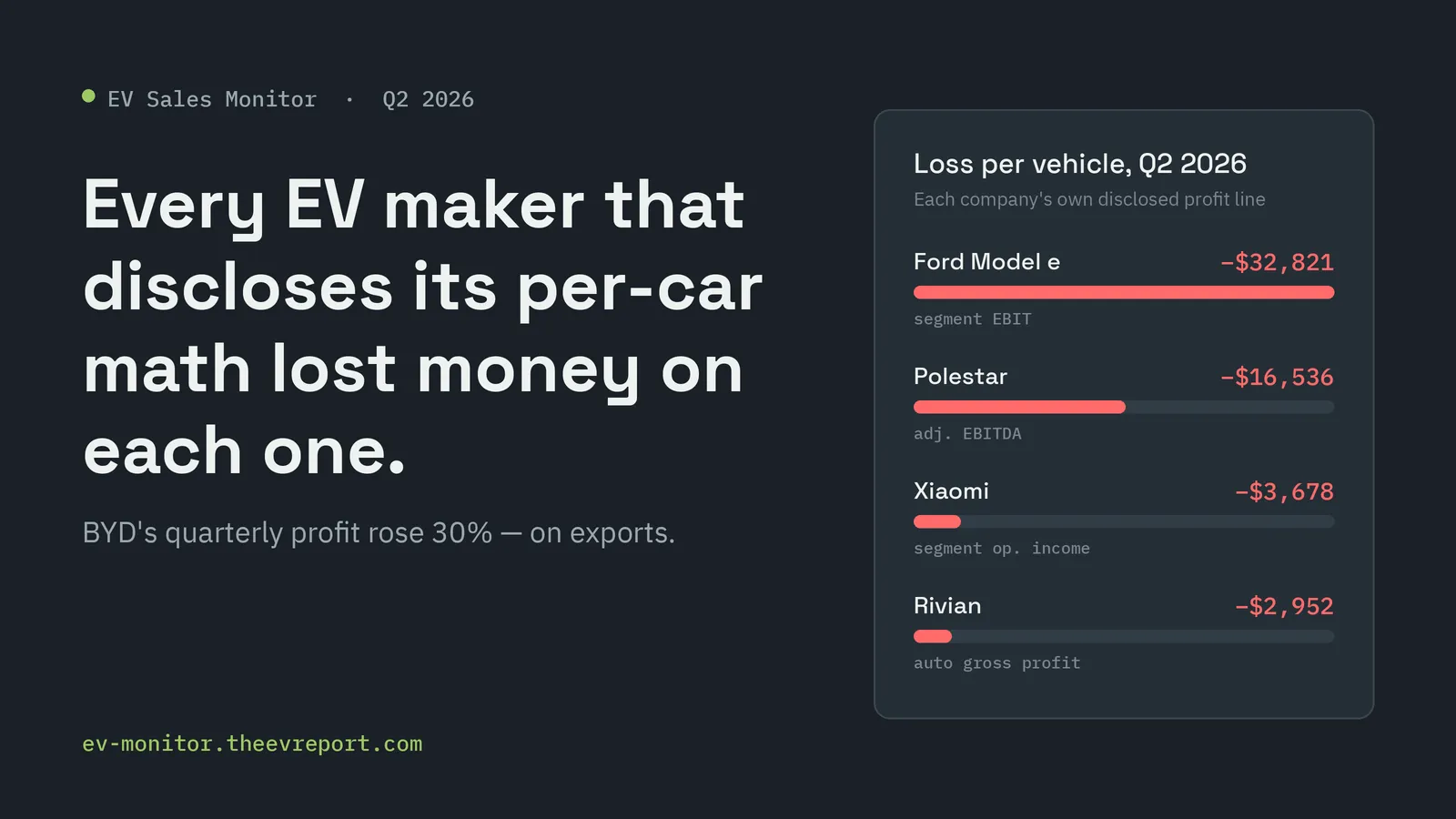
Every EV maker that discloses per-vehicle numbers lost money on each car it sold. The two that made money did it overseas.
The second quarter’s financial disclosures are now all in — the last of the Chinese earnings landed in early September — and they complete a picture the delivery numbers only hinted at in July. Volume came back across most of the industry. Profit mostly didn’t. And the handful of companies that did make money share one trait: they are selling a rapidly growing share of their cars outside their home market.
BYD: fewer sales, more profit
BYD delivered 1,108,048 new energy vehicles in Q2, down 3.2% from a year earlier but up 58% from a weak first quarter. Counting battery-electric vehicles only, it delivered 557,090 — well ahead of Tesla’s 480,126.
The more important number arrived with BYD’s interim report on August 28. Second-quarter net profit rose about 30% year over year to RMB 8.2 billion (roughly $1.2 billion), BYD’s first quarterly profit increase in five quarters — on revenue that actually slipped about 3%. BYD made more money on fewer sales because of where those sales happened: overseas shipments hit a record 471,091, up 82.5%. At home, the price war kept doing damage; first-half NEV sales fell 15.7%. Abroad, BYD sells at prices it can’t get in China, and first-half gross margin rose to 18.85% as a result.
Tesla: record volume, vanishing margin
Tesla had its best second quarter ever — 480,126 deliveries, up 25% and its first year-over-year growth in roughly two years. Automotive revenue was $20.5 billion, an average selling price of about $42,700.
But operating income fell 57% to $398 million, a 1.4% operating margin. Automotive gross margin excluding regulatory credits dropped to 16.3%, credit revenue fell to $146 million from $439 million, and free cash flow went negative as AI and robotics capital spending more than doubled. The $1.11 billion net income figure leaned on a roughly $1.0 billion unrealized gain on Tesla’s SpaceX stake. Tesla doesn’t disclose automotive operating income, so it has no per-vehicle profit figure in our table — but the direction is not in doubt.
The per-vehicle scoreboard
Four companies disclose a segment- or company-level profit line we can divide by deliveries. All four are negative, and the metric differs for each, so the numbers show direction and scale rather than a like-for-like ranking:
- Ford Model e: about −$32,800 per vehicle (segment EBIT). The loss narrowed $410 million year over year to $919 million, but only because Ford cut wholesales 53% to roughly 28,000. Fixed costs spread over far fewer units make each one far more expensive. Ford is shrinking toward a smaller loss, not scaling toward profit.
- Polestar: about −$16,500 per vehicle (adjusted EBITDA). Revenue fell 8.1% to $727 million, and the forced U.S. exit — Polestar was denied authorization under the Connected Vehicle Rule from model year 2027 — added about $170 million to the quarter’s operating loss.
- Xiaomi: about −$3,700 per vehicle (segment operating income). Deliveries rose 28% to 104,199, and the RMB 2.6 billion segment loss was smaller than Q1’s — but that segment also carries Xiaomi’s AI spending, and revenue per car fell about 10% year over year.
- Rivian: about −$3,000 per vehicle (automotive gross profit, before any operating costs). That’s a big improvement from −$335 million a year ago, even with about $100 million of R2 ramp costs in the quarter. Rivian’s company-level gross profit of $179 million came from software and services — mostly its Volkswagen joint venture — not from selling vehicles.
Chinese startups: closer to break-even than they’ve been
NIO delivered 107,658 across its NIO, Onvo and Firefly brands, up 49.4%, and posted the best financials in its history: vehicle margin of 18.5% versus 10.3% a year ago, and a non-GAAP operating profit of RMB 207 million, its third straight adjusted operating profit. It still lost money on a GAAP basis.
Leapmotor was the growth story of the quarter at 246,332 deliveries, up 83.7%, and it reported a first-half net profit of RMB 210 million on RMB 38.1 billion of revenue — one of only two Chinese EV makers profitable in the half, alongside BYD. Exports made up 27% of its first-half sales. Even so, management cut its full-year profit target to about RMB 3 billion from RMB 5 billion as raw-material costs rose.
XPeng delivered 103,295, flat year over year, and narrowed its net loss to RMB 1.34 billion. Li Auto fell 11.5% to 98,330 and lost RMB 1.7 billion, with vehicle margin at 9.4% — half what it earned a year ago — as Huawei-backed rivals keep squeezing the extended-range family SUVs it used to own.
The rest of the board
SAIC Motor’s group NEV sales — a total that includes plug-in hybrids and its joint-venture brands — reached 526,000 in Q2, derived from SAIC’s own first-half and first-quarter figures. VW Group delivered 238,400 BEVs, down 4.2%, as European strength couldn’t offset collapses in North America and China. BMW rebounded to 116,837 on Neue Klasse demand in Europe. Mercedes-Benz grew BEV car sales 51% on the electric GLC and CLA. VinFast nearly doubled to 70,085.
In the U.S., GM’s EV sales fell a third after the tax credit’s expiration, with Cadillac the only grower. Lucid grew deliveries 19.5% to 3,953 but posted a −105% gross margin under a new CEO who has suspended guidance. Porsche’s derived BEV total of about 10,300 came in a quarter where the combustion 911 outsold the Taycan five to one.
A note on comparing rows: several Chinese makers report combined figures that include plug-in hybrids or range-extenders. The database tags those “NEV,” and a battery-electric-only view is one click away. In BEV terms, the Q2 top five were BYD, Tesla, VW Group, Hyundai/Kia and BMW.
What’s not on the board — and why
Stellantis, Toyota, Honda, Nissan and Genesis still publish no clean global BEV total; all five were re-checked and all five statuses hold. Jaguar Land Rover’s Range Rover Electric is on sale, but JLR hasn’t disclosed a single delivery count, so it stays “First BEV launching.” Mitsubishi still has no BEV on sale.
Two brands with EVs on sale also read “Not disclosed” this quarter. Renault states its EV share for Europe but its unit total worldwide, and multiplying mismatched scopes would invent precision; the clean worldwide figure it gave in Q1 didn’t recur. Avatr has stopped publishing monthly deliveries, leaving only a January–May total in its IPO prospectus.
One figure is still pending: VinFast’s Q2 financials, delayed by the divestment of its Vietnam manufacturing entity. The company hasn’t set a date. We’ll add them when they’re published.
Dig into the data
Every figure above — with its source, its scope, and every derivation flagged — is in the live database at ev-monitor.theevreport.com. Tap any row for the source and notes, switch between Q1 and Q2, and filter to battery-electric only.
Next issue: Q3 2026, November 15.
Every number in this report comes directly from company disclosures — shareholder letters, SEC filings, official sales bulletins. Nothing is estimated. Where a brand doesn’t disclose, we say so.