
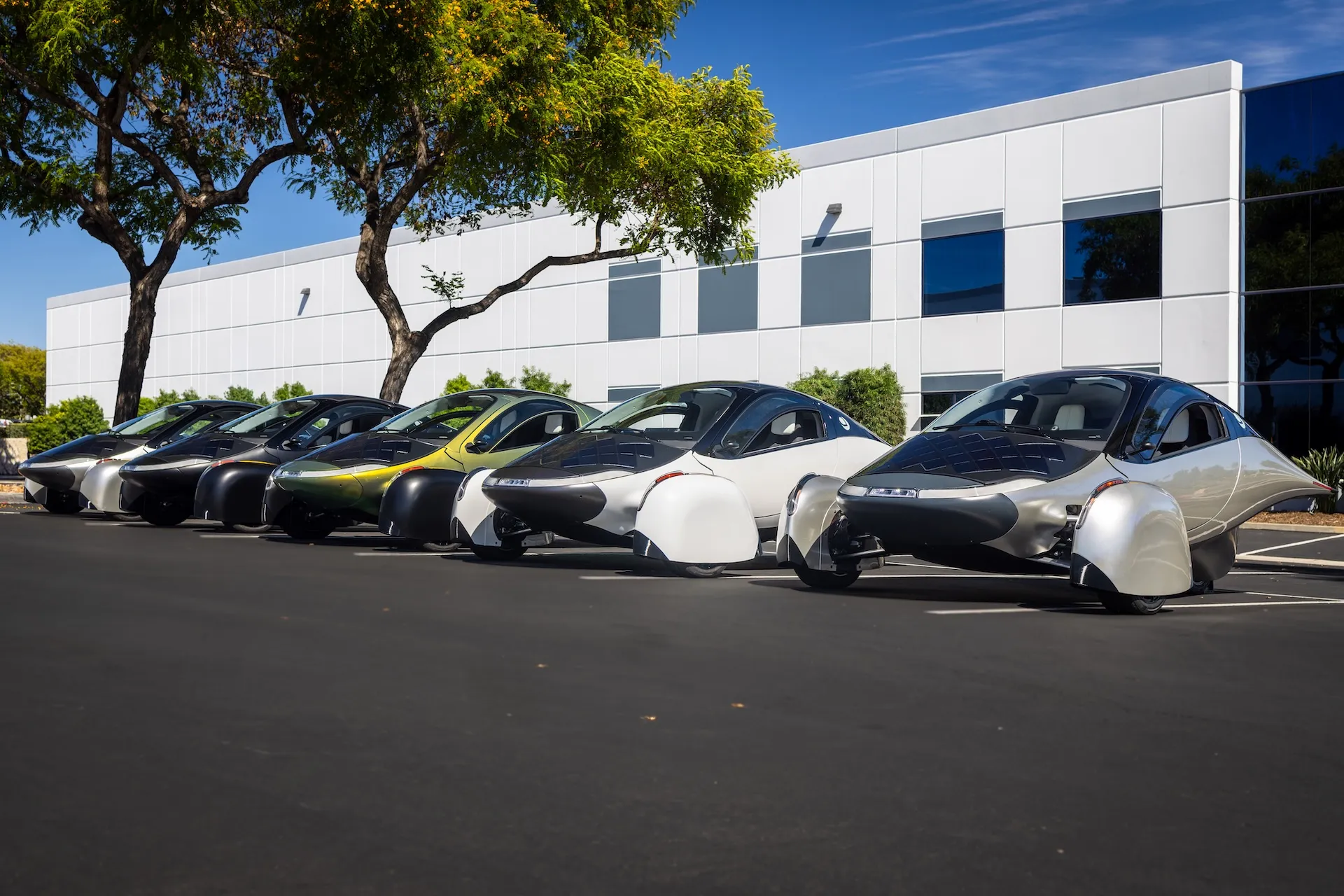
Aptera Motors Corp. (Nasdaq: SEV) has driven five validation vehicles off its low-volume assembly line in Carlsbad, California, roughly ten weeks after completing the first build on the same 14-station line. The solar electric vehicle maker announced the milestone as the second production-progress disclosure of the year, working toward customer deliveries against nearly 50,000 reservations on its books. Vehicles assembled on the line are allocated to validation testing rather than sale.
Highlights
- Five validation vehicles have rolled off Aptera’s Carlsbad assembly line, up from one on March 3, 2026.
- The 14-station low-volume line is being used to validate both the vehicles and the repeatable processes required to scale production.
- Nearly 50,000 reservations remain on Aptera’s books, representing over $2 billion in potential revenue per the company’s most recent disclosures.
- Validation fleet testing now covers road performance, durability, safety verification, software and firmware integration, and real-world solar energy collection.
Line Cadence Accelerating
The five-vehicle milestone arrives roughly ten weeks after Aptera completed its first validation build on March 3, 2026, and roughly six months after the company began building out the assembly line itself in November 2025. The company reports continuous improvements to cycle times and workflows with each successive build.
“Every vehicle we run through this line teaches us something,” said Chris Anthony, Co-CEO of Aptera Motors. “With five vehicles now off the line, we have a growing foundation of data, a team that is getting sharper with every build, and a process that is proving itself in real time. That is what gives us confidence as we move toward our goal of customer deliveries.”
The 14-station configuration is the same one introduced in March. According to the company, running multiple vehicles through the line in sequence validates not only the vehicle itself but the assembly system required to build it consistently.
Validation Fleet Testing Scope
The validation fleet will continue to expand through a comprehensive testing program covering road performance, durability, safety verification, software and firmware integration, and real-world solar energy collection. Aptera previously identified thermal validation, brake performance, and destructive testing as primary uses for early line output, with the results feeding into the company’s path toward regulatory self-certification and EPA approval.
“What we are building here is not just vehicles, but the system to build them well,” said Steve Fambro, Co-CEO of Aptera Motors. “Each cycle through the line improves precision, efficiency, and repeatability. This is how we plan to meet our customers’ expectations when they finally get their hands on their own Aptera vehicle.”
Production Context
The current cadence — first vehicle in early March, fifth by mid-May — works out to roughly one validation build every two weeks. That pace remains well short of series-volume requirements but is consistent with the company’s previously stated strategy of using the low-volume line to refine processes ahead of higher-rate assembly.
Aptera estimated in November 2025 that it would require approximately $65 million in additional funding to complete validation and initiate low-volume production. The company has since drawn on a $75 million equity line of credit and closed a $9 million public offering in early 2026 to support the program.
Sign up for our popular weekly email to catch all the latest EV news!