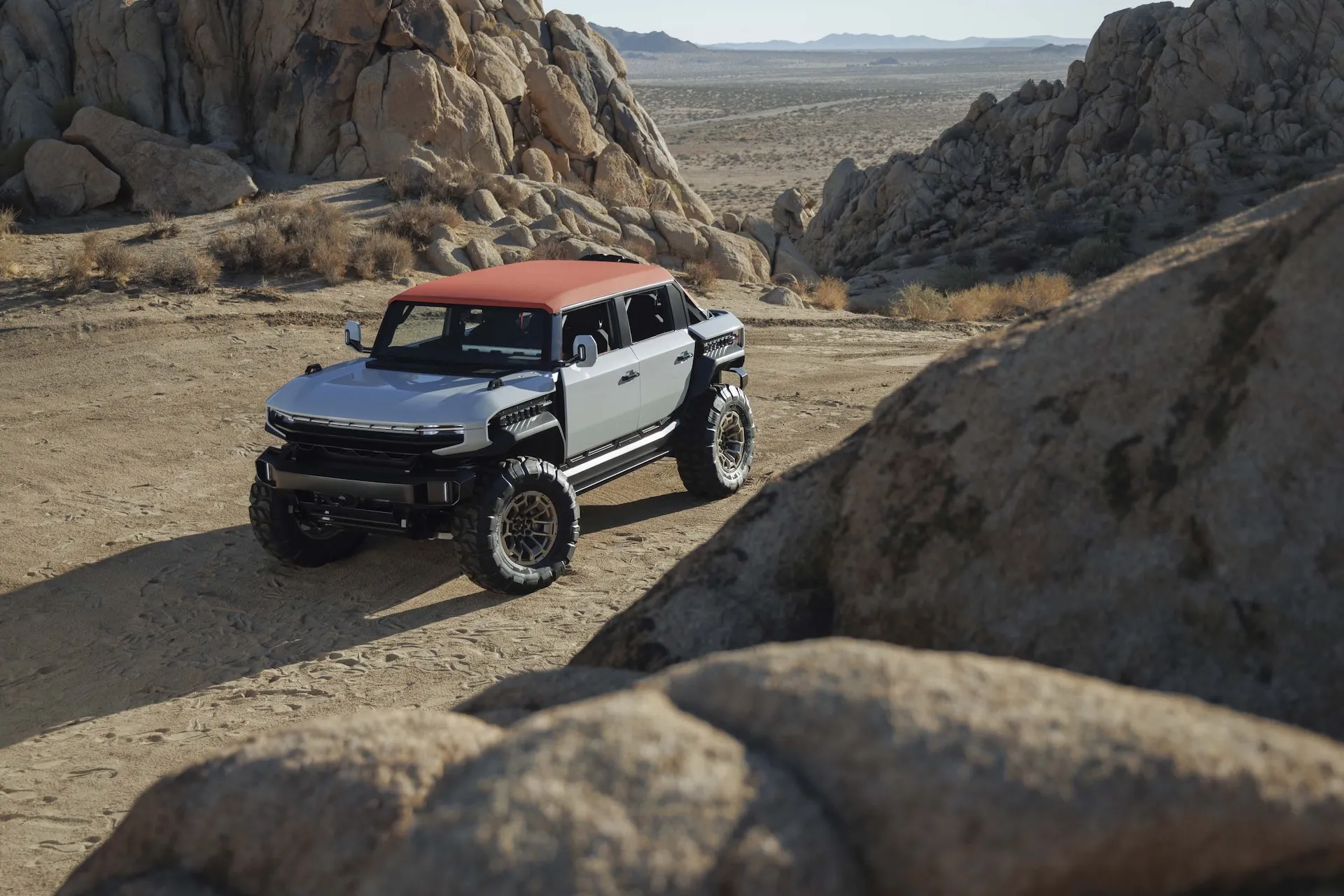

General Motors has revealed the GMC HUMMER X, a reconfigurable mid-size electric truck and SUV concept, at the opening of its new 148,000-square-foot Advanced Design studio in Pasadena, California. Neither body style is intended for production; the pair anchored the studio’s debut as a testbed for manufacturing, off-road, and sustainability ideas. General Motors frames the Pasadena campus as the latest chapter in nearly 40 years of design work in Southern California and a key node in a global Advanced Design network that also spans Detroit, the UK, and Shanghai.
Highlights
- The Pasadena studio spans 148,000 square feet across three buildings and houses about 100 designers, sculptors, and fabricators.
- The GMC HUMMER X debuts as a mid-size electric truck and SUV concept, with neither version intended for production.
- FLEX FAB, an on-demand metal fabrication process GM compares to 3D printing, accounts for 57% of each concept’s build, according to the company.
- Off-road hardware includes up to 37-inch Goodyear tires, beadlock wheels, Multimatic shocks, and up to 13.2 inches of ground clearance.

Inside the Pasadena Studio
The campus spans three buildings equipped for full-size clay modeling, fabrication, and digital collaboration, and is home to about 100 team members across design, sculpting, fabrication, and artisan roles. The studio concentrates on conceptual design studies meant to push ideas across the company rather than current production programs.
“Southern California isn’t just a place where we work, it’s a place of unfiltered inspiration. Film, art, architecture, aerospace, technology and the remarkably diverse topography create an unparalleled canvas of experiences that drives an incredibly unique vehicle culture,” said Bryan Nesbitt, VP of Global Design, GM. “These sources of inspiration influence how our designers see the world to envision what mobility could offer 10 or 20 years into the future, exploring new designs, technology and experiences for GM customers.”
GM’s design roots in the region run to Harley Earl, the company’s first design director, appointed in 1927, who pioneered the clay modeling still central to automotive design. The company established its first permanent advanced design presence in Southern California in the 1980s, and its studios there have since produced concept work ranging from experimental Corvettes and Camaros to autonomous studies such as the Cadillac Halo portfolio. The global network also includes a studio in the UK, which last year revealed its own Corvette design study.
Hussein Al Attar has been named director of the Pasadena studio. He succeeds Brian Smith, who returns to the Chevrolet Corvette design team in Michigan after four years leading the studio.
HUMMER X Concept: Four Design Pillars
Developed jointly by GM Advanced Engineering, Advanced Manufacturing, and the Pasadena studio, the HUMMER X is built around four pillars — reconfigurability, capability, community, and sustainability — and is positioned as a rock crawler on a modular platform.
“Every great concept starts with a belief. Ours was this: the courage to get lost leads us to new discoveries,” said Brian Smith, outgoing GM Advanced Design Pasadena studio director. “The team rallied around a working mantra of ‘Take nothing but pictures, leave nothing but footprints,’ and let that philosophy guide every decision. That’s not just a tagline – it’s the design brief.”
What Is FLEX FAB?
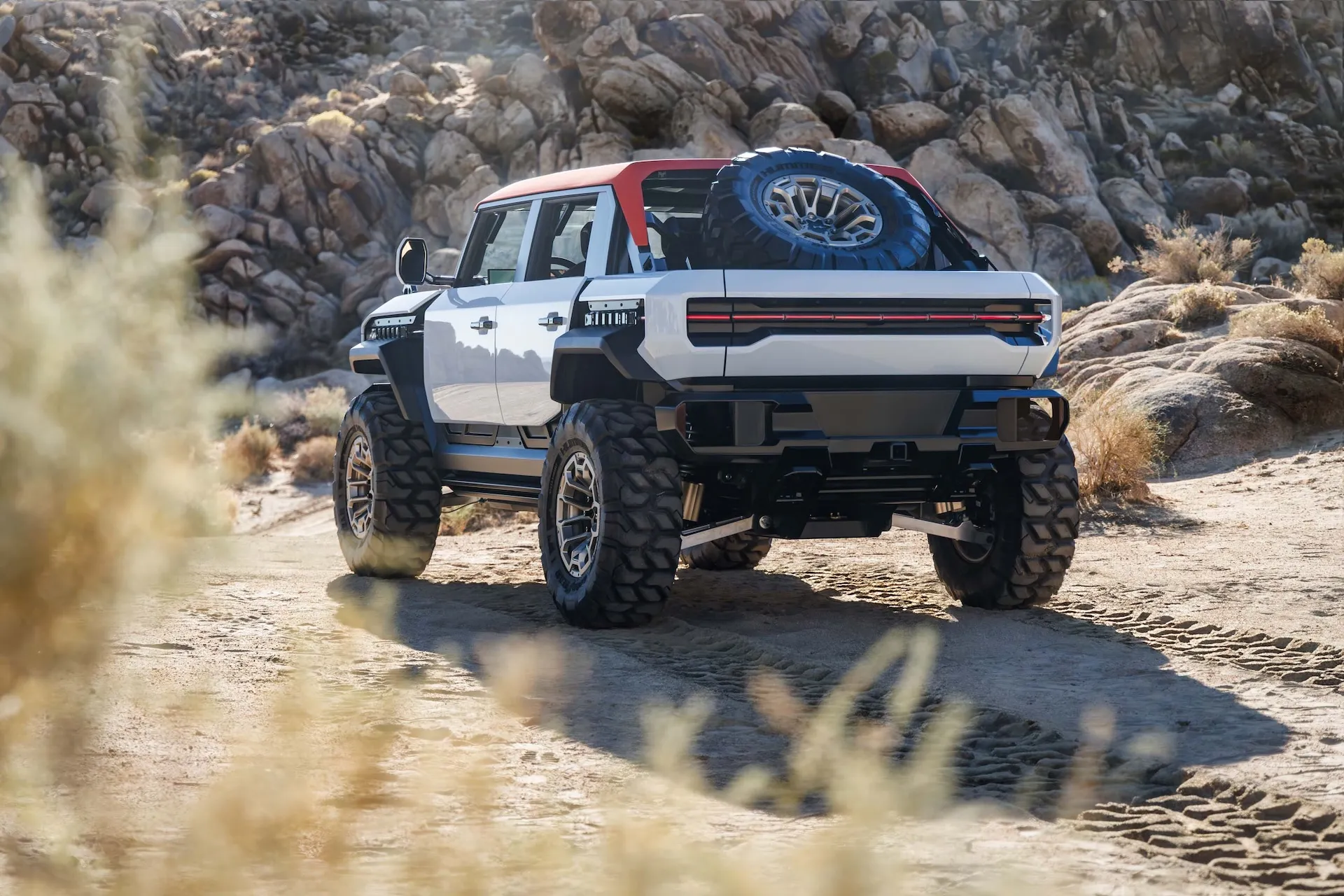
FLEX FAB is the flexible manufacturing process behind the concept’s reconfigurability. GM describes it as fast, small-batch, on-demand production — comparable to 3D printing but for metal — that needs no specialized stamping tools and can produce multiple designs from the same machines. The company says the process unlocked a new HUMMER aesthetic: a flat-topped silhouette with radiused edges, laser-welded seams, and visible precision bolts. Inside, stackable displays let drivers reconfigure the cockpit for different terrain.
Off-Road Capability
GM positions the HUMMER X as a mid-size EV built for off-road use, citing a low center of gravity, on-demand acceleration, 35-to-37-inch Goodyear tires, beadlock wheels, Multimatic shocks, removable fender flares, and underbody protection.
Community and the HUMMER HUB
The concept targets a “builder maker” customer who modifies and shares the vehicle within a community. To serve that user, the team conceptualized the HUMMER HUB, a suite of connected apps. According to GM, a scout drone can fly ahead on the trail, relay real-time terrain data to the vehicle, and dock itself when idle.
Sustainability
The concept leans on mono-materials, replacing adhesives with snap fits and mechanical fasteners so single-material parts can be recycled. Seatbacks, headrest backs, and instrument-panel ends are made from recycled vehicle fascias, and parts are designed for easy disassembly so owners can swap and recirculate them. GM also hid a few Easter eggs, including the team’s mantra rendered in Morse code on the floor and a phrase about getting lost worked into the tire treads.
HUMMER X Concept Specifications
GM provided the following dimensions and hardware for the two concepts, with metric figures converted to inches as supplied.
| Specification | SUV | Truck |
|---|---|---|
| Wheelbase | 2,945.5 mm (116″) | 3,318.6 mm (130.7″) |
| Length | 4,782.5 mm (188.3″) | 5,264.5 mm (207.3″) |
| Height | 1,852.6 mm (72.9″) | 1,854.4 mm (73.0″) |
| Width | 2,032 mm (80″) | 2,032 mm (80″) |
| Approach angle | 44° | 41.5° |
| Departure angle | 46° | 29.7° |
| Breakover angle | 30.9° | 24.9° |
| Ground clearance | 334.3 mm (13.2″) | 316.7 mm (12.5″) |
| FLEX FAB content | 57% | 57% |
| Tires (Goodyear) | 315/75R18, 37″ OD | 305/55R22, 35″ OD |
| Wheels | 18″ aluminum | 22″ aluminum |
Sign up for our popular weekly email to catch all the latest EV news!