
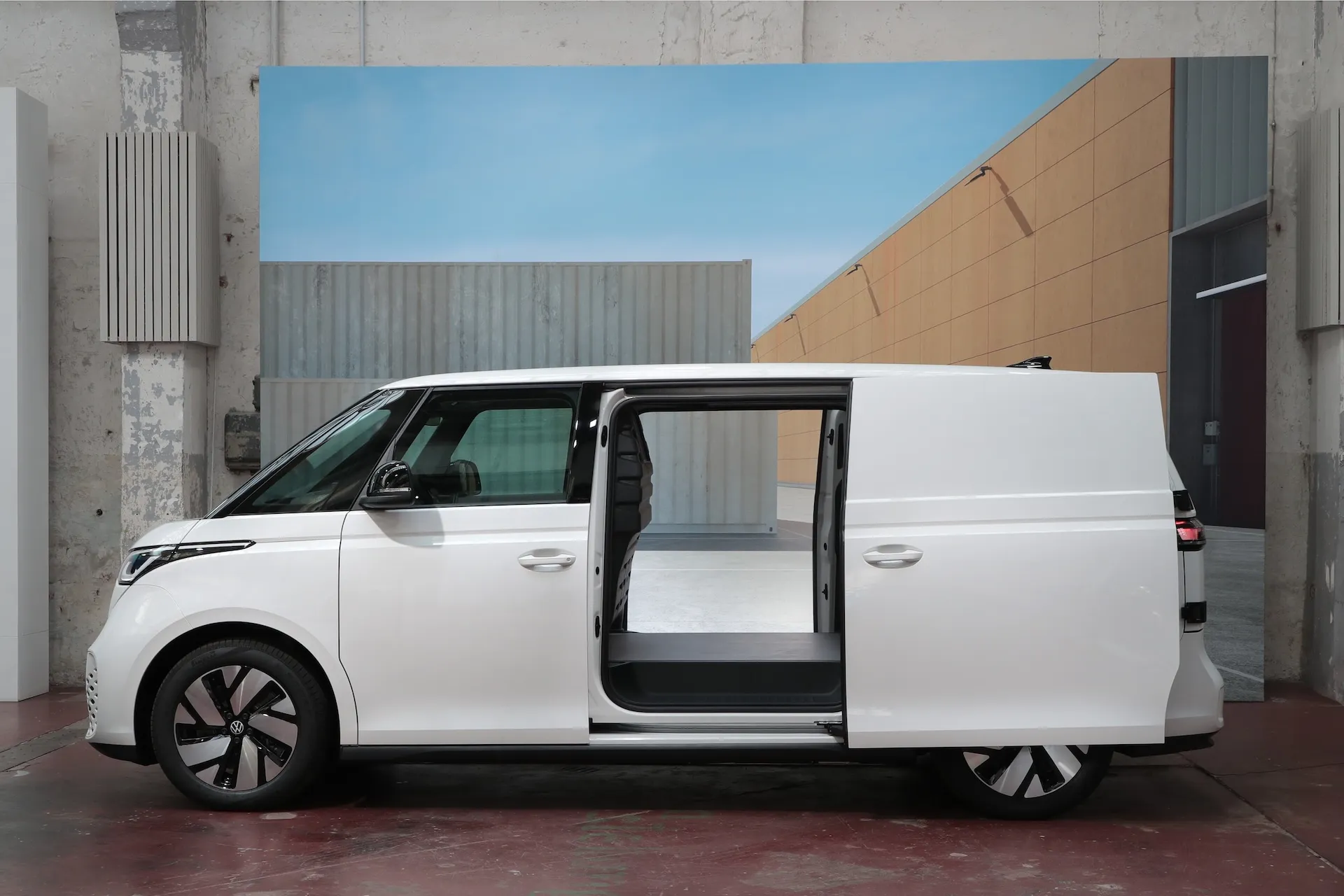
Volkswagen Commercial Vehicles has opened pre-sales for a long-wheelbase ID. Buzz Cargo. The 250 kW all-wheel-drive version starts at $57,617 (€50,630) net in Germany. According to Volkswagen Commercial Vehicles, the stretched electric van has 155.4 cubic feet (4.4 m³) of load compartment volume and a second sliding door as standard. A rear-wheel-drive version follows next week from $55,182 (€48,490) net. UK order books open in early 2027, with market introduction planned for spring.
Highlights
- Load volume: 155.4 cubic feet (4.4 m³), which is 17.7 cubic feet (0.5 m³) more than the normal-wheelbase Cargo.
- Battery and power: 86 kWh battery, with 210 kW in rear-wheel drive or 250 kW with 4MOTION all-wheel drive.
- Towing: Up to 3,968 lb (1,800 kg) braked, on 8% and 12% gradients.
- Pricing: From $55,182 (€48,490) net in Germany. The long-wheelbase surcharge is around $2,663 (€2,340).
How Much Larger Is the Long-Wheelbase ID. Buzz Cargo?
The load area is 96.8 inches (2,458 mm) long. That is 9.8 inches (250 mm) longer than in the normal-wheelbase ID. Buzz Cargo, and it adds 17.7 cubic feet (0.5 m³) of stowage space. The width between the wheel housings is 48.4 inches (1,230 mm).
Unlike the normal-wheelbase model, the long-wheelbase Cargo comes standard with a second sliding door. The door is 7.5 inches (19 cm) wider, and the company says a Euro pallet now fits through the sliding door opening. Other standard and optional equipment includes:
- Load floor: A wooden floor is standard.
- Rear access: A large tailgate is standard, and rear swing doors are optional.
- Cab seating: Two- or three-seat layouts are offered. A manually adjustable lumbar support was recently added.
Volkswagen puts the added cost of the extended version at around $2,663 (€2,340) net list price in Germany.
Pricing, Power, and Payload by Drivetrain
| Drivetrain | System power | Maximum payload | Starting price (net, Germany) | Pre-sales |
|---|---|---|---|---|
| Rear-wheel drive | 210 kW (282 hp) | 1,543 lb (700 kg) | $55,182 (€48,490) | Opens next week |
| 4MOTION all-wheel drive | 250 kW (335 hp) | 1,336 lb (606 kg) | $57,617 (€50,630) | Open now |
Both versions use an 86 kWh battery, compared with 79 kWh in the normal-wheelbase model. Both are rated for a maximum braked towing capacity of 3,968 lb (1,800 kg) on 8% and 12% gradients. Prices apply to the German market and exclude VAT, transfer, and registration costs.
Travel Assist Adds Traffic Light Recognition
Like all ID. Buzz models, the extended Cargo leaves the Hanover plant with Volkswagen’s latest ID. software. For the first time, the optional Travel Assist system responds to traffic lights. At a red light, it brakes the van to a standstill automatically, within system limits, according to the company.
The software also adds one-pedal driving. Drivers can decelerate and use regenerative braking to a full stop with the accelerator alone.
How Does Vehicle-to-Load Work on the ID. Buzz Cargo?
The new software introduces a Vehicle-to-Load function to the ID. Buzz. External tools such as circular saws and other devices can run directly from the high-voltage battery.
An adapter called the PowerSocket connects to the Mode 3 connection of the charging socket. It supports continuous operation or charging at 3.0 kW, with peak power of 3.6 kW. The PowerSocket comes in two versions: one with a Schuko plug for domestic power outlets, and a CEE 230 V version for camping sockets.
Infotainment and Controls
The ID. Buzz Cargo gets the new Innovision infotainment system with an app store. Owners can activate or extend functions and services digitally on a vehicle-specific basis. Available downloads include audio, video streaming, parking, charging, and gaming apps. A multifunction steering wheel with redesigned buttons controls key vehicle, cockpit, and infotainment functions.