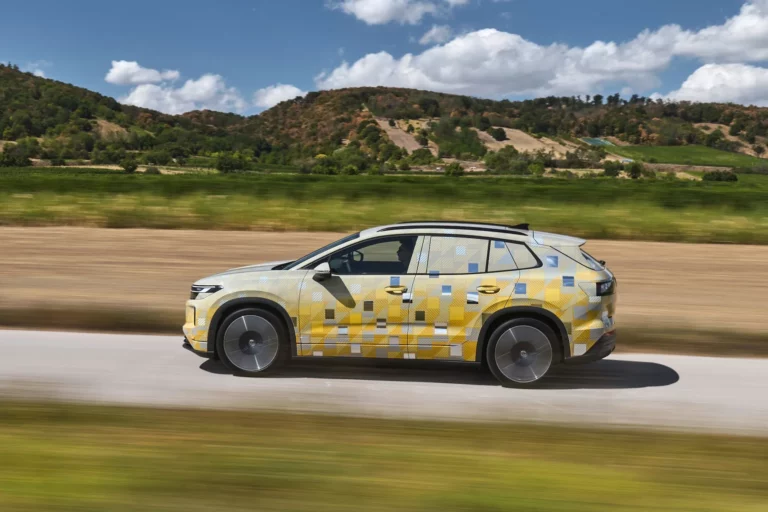


Geely has launched the Monjaro EM-i in Egypt, opening the global rollout of its first D-segment hybrid SUV with fuel consumption the company reports at 5.4 L/100 km (43.6 mpg) under low battery charge. The model pairs the EM-i Super Hybrid system with the automaker’s GEA Evo architecture and arrives in three versions covering both front- and all-wheel drive. Following Egypt, Geely plans launches in the UAE, Mexico, and Kazakhstan before expanding into European markets.
Highlights
- Acceleration: The all-wheel-drive Ultra reaches 62 mph (100 km/h) in 5.83 seconds, according to the company.
- Fuel consumption: The front-wheel-drive Pro and Max are rated as low as 5.4 L/100 km (43.6 mpg) with the battery at a low state of charge.
- Braking: Geely reports a 100–0 km/h stopping distance of 33 meters (108 feet) and a moose test speed of 79 km/h (49 mph).
- Dimensions: The SUV measures 189 inches (4.8 meters) long on a 112.0-inch (2,845 mm) wheelbase.
How Does the EM-i Super Hybrid System Work?
The EM-i Super Hybrid system combines electric drive with a 1.5TD dedicated hybrid engine. Geely positions the pairing as a balance between throttle response and fuel efficiency rather than a performance-first configuration.
The company reports that the Ultra all-wheel-drive version accelerates from zero to 62 mph (100 km/h) in 5.83 seconds, with the stated use cases being highway merging, overtaking, and driving under heavier loads. For the front-wheel-drive Pro and Max, Geely puts fuel consumption at 5.4 L/100 km (43.6 mpg) when the battery sits at a low state of charge — a figure the company frames around markets where charging access is limited.
| Version | Drive layout | Company-stated figure |
|---|---|---|
| Pro | Front-wheel drive | 5.4 L/100 km (43.6 mpg) at low battery charge |
| Max | Front-wheel drive | 5.4 L/100 km (43.6 mpg) at low battery charge |
| Ultra | e-AWD all-wheel drive | 0–62 mph (100 km/h) in 5.83 seconds |
Chassis hardware includes a Continuous Damping Control (CCD) suspension system that Geely says adjusts damping in milliseconds to reduce impact from speed bumps and damaged road surfaces. The e-AWD Intelligent Electric AWD System handles traction changes on wet, uneven, or loose surfaces.
Architecture and Safety Content
The Monjaro EM-i is built on the GEA Evo architecture, which Geely describes as supporting flexible interior packaging and multiple energy systems across performance, driving dynamics, safety, comfort, and intelligent technology.
Occupant protection rests on a core body structure made entirely from high-strength steel, paired with six standard airbags. A 540-degree panoramic camera view with transparent chassis visualization runs through the central display, intended for tight parking spaces, curbs, and obstacles outside the driver’s sightline.
On dynamic safety, the company reports a 100–0 km/h braking distance of 33 meters (108 feet) and a moose test speed of 79 km/h (49 mph). Geely does not identify a third-party test body for either figure.
Interior Packaging and Cabin Technology
At 189 inches (4.8 meters) long with a 112.0-inch (2,845 mm) wheelbase, the Monjaro EM-i sits in D-segment territory on dimensions. Seating uses an 11-layer composite construction Geely markets as Marshmallow SPA, aimed at reducing fatigue on longer drives.
Cabin technology centers on the Flyme Auto in-vehicle infotainment system and the Flyme Sound audio system, arranged in a symmetrical layout with ambient lighting. The Flyme Auto platform also appears in other Geely models sold in international markets, including the Starray EM-i and E5 launched across five European countries earlier this year.
Where the Rollout Goes Next
Egypt is the first market for the Monjaro EM-i, with the UAE, Mexico, and Kazakhstan named as the next launches ahead of a European market entry. Geely has not disclosed timing for any of those markets, or pricing for any version in any market.
The Monjaro EM-i extends a hybrid lineup that already includes the Starray EM-i, which the company campaigned to a Guinness World Record for fuel efficiency on a long-distance drive in Australia.