
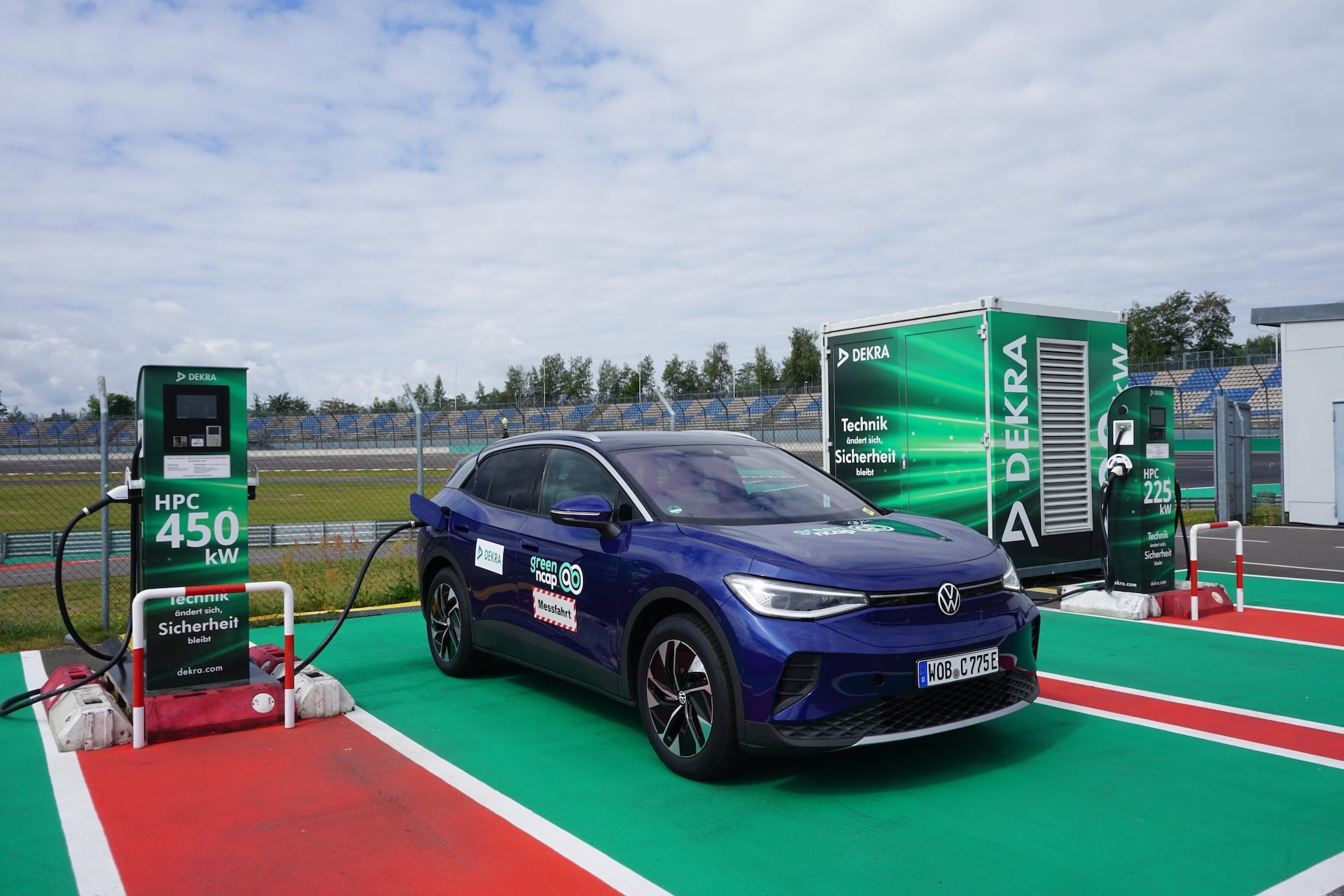
Green NCAP’s latest assessment provides a detailed look into how today’s electric vehicles perform beyond lab tests—measuring real-world range, charging time, and efficiency in challenging conditions.
Highlights
- Cold-weather testing reveals major range losses across all tested EVs.
- VW ID.4 demonstrates balanced long-range and charging performance.
- Dacia Spring achieves top sustainability score but poor cold-weather range.
- Hyundai Inster shows efficient versatility with strong environmental results.
Real-World EV Performance Under Winter Conditions
Green NCAP’s ‘Cold Winter Performance’ testing, conducted at –7°C (19°F), examined how cold weather affects energy efficiency and driving range. The Dacia Spring, with its small 27.6 kWh battery, proved ideal for city driving but saw its mixed-weather range fall from 180 km to 133 km in freezing conditions, dropping to just 119 km on the motorway.
The Hyundai Inster, featuring a 49 kWh battery, maintained stronger usability, achieving 322 km in warm weather and 219 km in cold. The Volkswagen ID.4 Pure, equipped with a 52 kWh battery, offered a practical 304 km warm-weather range, decreasing to 196 km in cold mixed driving—still sufficient for daily commuting.
Heating Systems Show Significant Efficiency Differences
Cabin heating proved a decisive factor in range loss. The Dacia Spring’s simple PTC heater quickly warmed upper cabin areas but failed to heat footwells effectively, consuming a disproportionate share of its small battery.
By contrast, the Hyundai Inster’s heat pump system and remote seat and steering-wheel heating provided greater comfort with minimal battery impact. The VW ID.4 excelled in this area, achieving rapid cabin heating and gaining up to 79 km of additional range from preconditioning before trips.
Charging Speed and Vehicle-to-Load Capability
Fast-charging analysis showed clear distinctions among models. The Dacia Spring, limited to 34 kW DC, required 40 minutes to charge from 10–80 %, offering modest range recovery. Both the Spring and Inster support Vehicle-to-Load (V2L) functionality up to 3.7 kW for powering external devices.
The Hyundai Inster’s 81 kW peak charge enabled a 10–80 % recharge in 31 minutes, while the VW ID.4 reached 155 kW, completing the same cycle in 27 minutes—provided the battery was preconditioned.
Benchmarking Against Internal Combustion
Green NCAP tested the SEAT Ibiza 1.0 MPI as a conventional benchmark. Its 6.0 L/100 km fuel use in warm weather rose only slightly in winter, illustrating consistent performance thanks to the use of waste engine heat—an area where EVs still face challenges.
Sustainability Ratings and Life-Cycle Emissions
The Dacia Spring achieved a five-star Sustainability Rating with the lowest life-cycle CO₂ equivalent emissions of 90 g/km, followed by the Hyundai Inster (96 % rating, 114 g/km). The VW ID.4 Pure scored 84 %, reflecting higher mass and energy use. The SEAT Ibiza, while efficient for an ICE model, could not match EV sustainability scores due to inherent combustion emissions.
Industry Implications
Dr. Aleksandar Damyanov, Technical Manager at Green NCAP, noted:
“Our test results show that the ‘Driver Experience’—especially in winter—varies greatly among electric cars. Manufacturers must continue optimizing heating and charging systems to reduce range anxiety and enhance everyday usability.”
Sign up for our popular weekly email to catch all the latest EV news!