

Stellantis announced FaSTLAne 2030, a €60 billion ($69.6 billion) five-year strategic plan built around 60-plus new vehicle launches and a powertrain mix of 29 battery-electric vehicles, 15 plug-in or range-extended hybrids, 24 hybrid electric vehicles, and 39 ICE or mild-hybrid models by 2030. CEO Antonio Filosa presented the plan’s six pillars at the morning session of Investor Day at the company’s North America headquarters in Auburn Hills, Michigan. The framework concentrates 70% of brand and product investment on four global brands — Jeep, Ram, Peugeot, and FIAT — plus the Pro One commercial vehicle business, with the balance distributed across regional and specialty brands.
Highlights
- €60 billion ($69.6 billion) total investment, with €24 billion ($27.8 billion) — 40% of R&D and capital expenditure — directed to global platforms, powertrains, and new technologies
- 60-plus new vehicle launches by 2030 across 29 BEVs, 15 PHEV/REEV, 24 HEV, and 39 ICE/mild-hybrid models
- 50% of global annual volumes to ride on three global platforms by 2030, including the all-new STLA One architecture
- North America targeted for 25% revenue growth and 8–10% adjusted operating income margin, with 60% of the €36 billion ($41.8 billion) brand and product investment allocated to the region
A Refocused Brand Portfolio
Stellantis identified Jeep, Ram, Peugeot, and FIAT as the four global brands with the greatest scale and profitability potential, designating them as the natural first launchers for global vehicle programs. Five regional brands — Chrysler, Dodge, Citroën, Opel, and Alfa Romeo — will draw on the same global assets while leaning into market-specific distinctiveness. DS and Lancia move to specialty status, managed by Citroën and FIAT respectively. Maserati is positioned for a luxury reset, with two new E-segment vehicles and a detailed roadmap scheduled for Modena in December 2026.
Filosa framed the portfolio approach as a discipline shift. “Every brand in Stellantis will play a clear role in delivering our FaSTLAne 2030 commitments,” he said.
Platforms, Powertrains, and a 2027 Technology Stack
Stellantis will direct over €24 billion ($27.8 billion) into global platforms, powertrains, and new technologies over the five-year window — 40% of total R&D and capital expenditure. Three global platforms, including the all-new STLA One, are expected to underpin 50% of global annual volumes by 2030. STLA One joins the previously announced family of architectures, which includes the STLA Frame multi-energy platform for full-size pickups and SUVs.
Powertrain coverage will broaden across hybrids, BEVs, and what the company describes as highly efficient internal combustion engines, with nearly 50% of global annual volumes equipped with multi-regional powertrain solutions by 2030. Three software-defined technologies will launch in 2027:
- STLA Brain: scalable central compute and software architecture
- STLA SmartCockpit: in-vehicle interaction layer
- STLA AutoDrive: scalable autonomous driving system
By 2030, 35% of global annual volumes will carry at least one of these technologies, rising to more than 70% by 2035.
Partnerships Anchor the Plan
Stellantis listed an expanding partnership stack as a core pillar. The company plans to deepen its alliance with Leapmotor — already operating through the 51%-owned Leapmotor International joint venture — by combining purchasing, sharing supplier bases, and cooperating industrially at the Madrid and Zaragoza plants in Spain in line with Made-in-Europe requirements. That work builds on the recently announced Opel BEV C-SUV plan for Zaragoza in 2028 alongside Leapmotor’s B10 model.
The Dongfeng partnership expands into a new chapter via the DPCA joint venture in China, producing two Peugeots and two Jeep models for China and other regions. Stellantis and Dongfeng also intend to create a 51%-Stellantis-owned European joint venture covering distribution, engineering, sourcing, and capacity sharing, beginning at the Rennes plant in France. The Tata partnership extends competitiveness across Asia Pacific, the Middle East and Africa, and South America. Stellantis and Jaguar Land Rover plan to explore collaboration on product and technology development in the United States.
On the technology side, Stellantis named Applied Intuition, Qualcomm, Wayve, NVIDIA, Uber, Mistral AI, and CATL among partners across computing, software, ADAS, AI, and battery technology.
Manufacturing Footprint and Execution Targets
Capacity utilization is targeted to climb materially. In Europe, capacity will be reduced by more than 800,000 units through plant repurposing — Poissy in France is named — and capacity sharing with partners at Madrid, Zaragoza, and Rennes, lifting utilization from 60% to 80% by 2030. U.S. capacity utilization is also targeted at 80% by 2030 on increased production. The Middle East and Africa is targeted for full utilization driven by product localization.
On execution, the company is compressing vehicle development cycles to 24 months from up to 40 months today, targeting top-quartile quality across all regions, and pursuing €6 billion ($7.0 billion) of annual cost reduction by 2028 versus a 2025 baseline through its Value Creation Program. Stellantis said more than 120 AI applications are currently deployed across operations.
Regional Targets
Each region carries discrete revenue and margin commitments under FaSTLAne 2030:
- North America: 25% revenue growth and 8–10% AOI margin, with 50% market coverage expansion, 11 all-new vehicles, 35% more volume, seven new products under $40,000, and two under $30,000. The region receives 60% of the €36 billion ($41.8 billion) earmarked for brands and products.
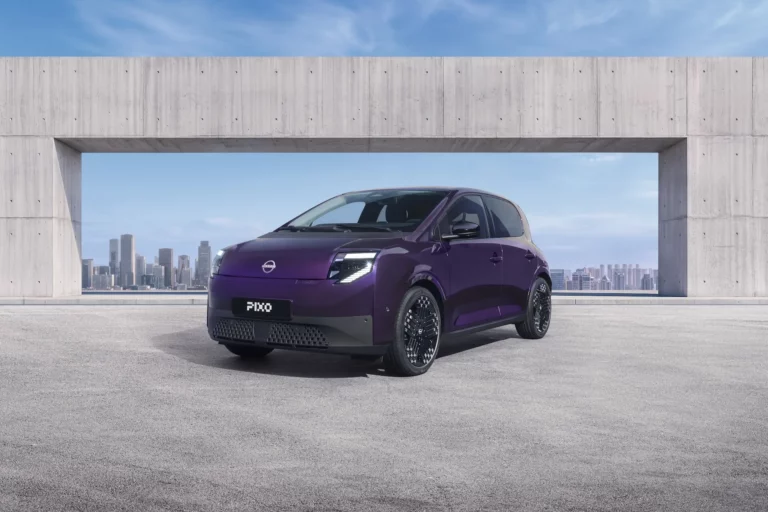
- Enlarged Europe: 15% revenue growth and 3–5% AOI margin, anchored by a C-segment offensive and the new E-Car — a generation of affordable city-friendly electric vehicles launching from the Pomigliano d’Arco, Italy plant.
- South America: 10% revenue growth and 8–10% AOI margin, building on leadership in Brazil and Argentina with a pickup offensive.
- Middle East and Africa: 40% revenue growth and 10–12% AOI margin, driven by product localization and imports from Asian partnerships.
- Asia Pacific: 4–6% AOI margin via asset-light growth through strategic partnerships.
Stellantis will present its detailed financial framework, including financial services performance and FaSTLAne 2030 financial targets, during the financial session of Investor Day later today.
Sign up for our popular weekly email to catch all the latest EV news!