
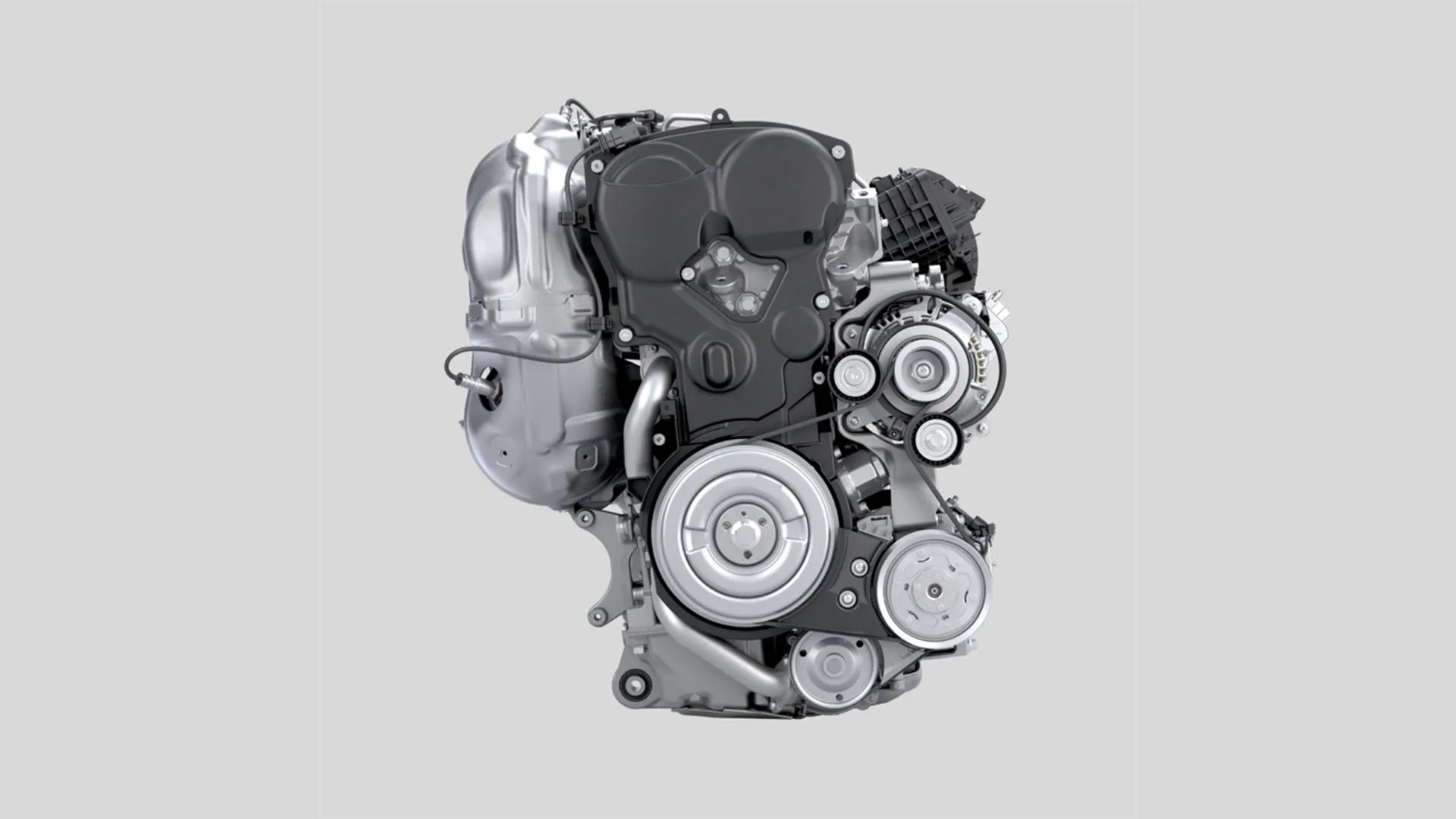
Horse Powertrain has launched an upgraded HORSE V20, a 2.0-liter four-cylinder gasoline engine offered on a single architecture in two electrified variants: a 400-volt plug-in hybrid and a 48-volt mild hybrid. Production started this spring at the Aurobay Technologies plant in Skövde, Sweden, with exports going to customers in Europe, the US, and Asia. The company says the plug-in variant reduces fuel consumption by seven percent compared with the engine it replaces, and that both variants are certified to meet tightening 2026 and 2027 emissions rules across the three regions.
Highlights
- Engine: 2.0-liter, four-cylinder gasoline unit, available as a 400V plug-in hybrid or 48V mild hybrid on a single architecture
- Efficiency: Plug-in variant cuts fuel consumption by seven percent versus the previous-generation engine
- Compliance: Both variants meet stricter emissions rules in the US, Europe, and China for 2026 and 2027
- Production: New dedicated assembly line at the Skövde, Sweden plant, installed without halting current output
A Single Architecture for Three Regulatory Regimes
The shared platform between the plug-in and mild-hybrid variants is the central engineering bet. By keeping the base engine common across both electrification levels, Aurobay reduces material cost and exposes a wider OEM customer base to the same investment in tooling and validation.
Ingo Scholten, Managing Director of Aurobay Technologies Sweden and Deputy Chief Technology Officer of Horse Powertrain, said: “Designing one engine to meet three different regulatory regimes is harder than designing three separate engines. As the regulatory map is fragmenting, one engine that meets all three sets of rules delivers greater value to our customers, ensuring we can offer greater economies of scale. Pulling that off requires serious engineering. Further, the Skövde team also successfully changed production lines while keeping current production running.”
What Changed on the Plug-In Variant?
The plug-in version carries the bulk of the hardware revisions. Horse Powertrain lists three changes that distinguish the new PHEV variant from the engine it replaces:
- Crankshaft-mounted starter-generator — modified for the upgraded engine
- High-position mechanical water pump — repositioned to support the revised layout
- Re-routed cooling system — redesigned alongside the new pump position
Beyond the PHEV-specific hardware, the latest V20 also adopts a new multi-injection fuel system, a new engine management system, and a redesigned air induction system to fit the upgraded engine.
Assembly Line Transition Without a Production Stop
The Skövde plant kept the base assembly line from the previous generation and added a new, straight final assembly line that the company says improves material flow. The transition was completed while existing production continued running, avoiding the gap that a full retooling shutdown would have created for OEM customers currently taking the prior-generation engine.
Skövde will increase HORSE V20 output through 2026 and 2027 as customer demand grows, according to Horse Powertrain.
A Hybrid Bet at the Joint Venture’s Swedish Hub
The V20 launch sits inside a broader product cadence from Horse Powertrain, the Renault-Geely joint venture that formalized in 2024 and now spans 18 plants and five R&D centers. The Aurobay division houses the Swedish powertrain operations inherited from Volvo Cars, while the Horse division houses the Renault-origin manufacturing footprint. The company lists 25 customers, including Renault Group, Geely Auto, Volvo Cars, Proton, Nissan, and Mitsubishi Motors Corporation, and recently debuted the X-Range C15 Direct Drive hybrid system at Beijing Auto Show 2026 — a separate product line aimed at converting BEV platforms into hybrid or range-extended models.
The V20 program is positioned differently. Rather than retrofitting an EV platform, it gives existing combustion and hybrid programs a single upgraded engine that clears the higher emissions hurdles arriving in 2026 and 2027 in the company’s three biggest customer regions. It is also the latest output from the Horse Powertrain in-house engine development program that began producing fully integrated hybrid units last year.
Sign up for our popular weekly email to catch all the latest EV news!