
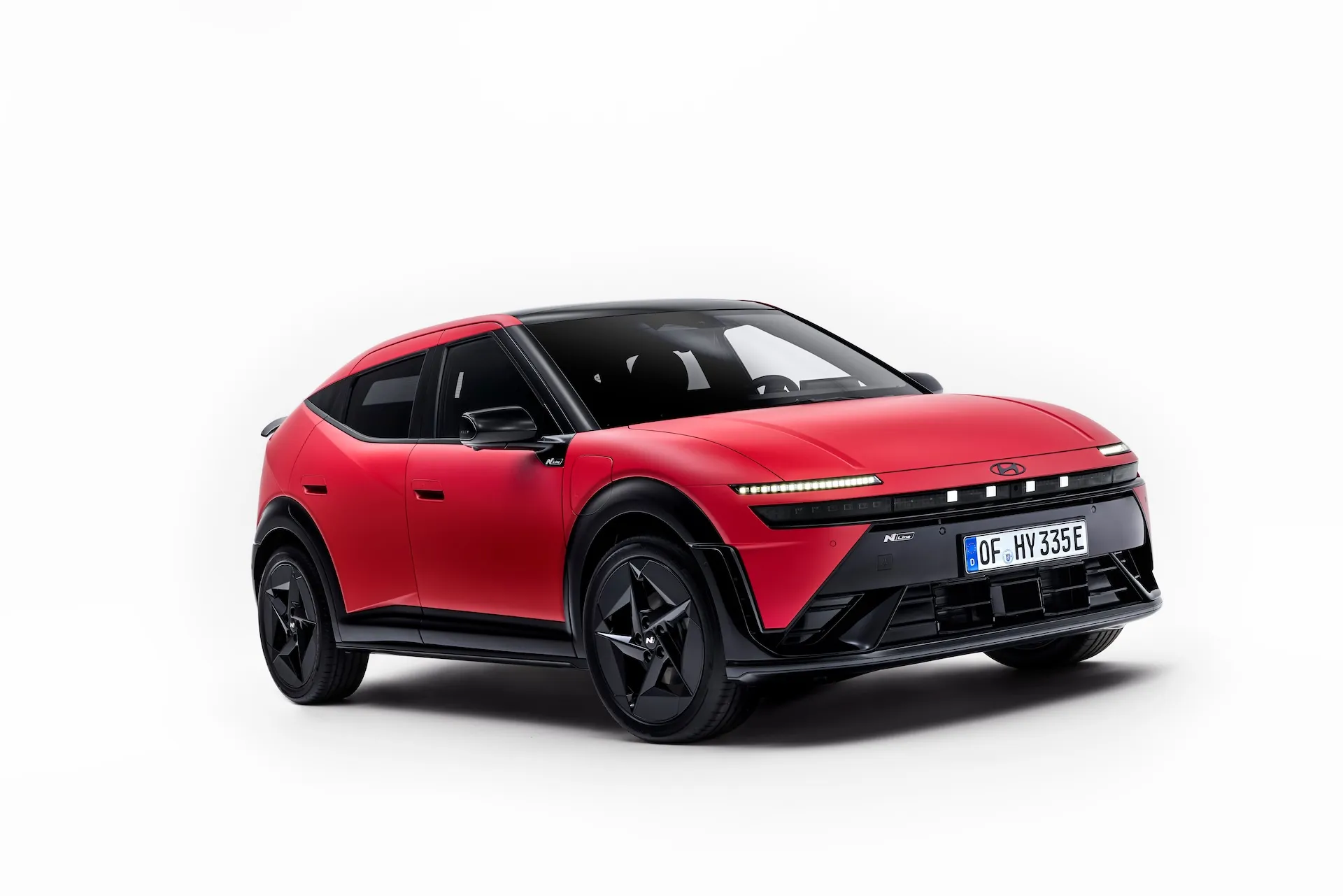
Hyundai Motor has introduced the IONIQ 3, a fully electric compact hatchback built for European buyers and targeting a WLTP range of up to 496 km (308 miles) in Long Range form. Unveiled on April 20 in Offenbach and Milan, the model slots in below the IONIQ 5 as the entry point to the brand’s dedicated EV lineup. It rides on the Hyundai Motor Group Electric-Global Modular Platform with a 400-volt architecture and introduces the Pleos Connect infotainment system to a European Hyundai for the first time.
Highlights
- Two battery options: 42.2 kWh Standard Range (WLTP 344 km / 214 miles) and 61 kWh Long Range (WLTP 496 km / 308 miles)
- Target drag coefficient of 0.263, described by Hyundai as class-leading for the segment
- DC fast charging from 10 to 80 percent in approximately 29 minutes; AC charging up to 22 kW optional
- Pleos Connect infotainment based on Android Automotive OS, debuting on a European Hyundai model
Platform and powertrain
The IONIQ 3 uses a 400-volt variant of Hyundai Motor Group’s Electric-Global Modular Platform, a step down from the 800-volt architecture deployed on the larger IONIQ 5, IONIQ 6, and IONIQ 9. The lower-voltage setup helps Hyundai bring E-GMP economics into a smaller, more affordable segment while retaining DC fast-charging capability.
A front-mounted motor produces up to 107.8 kW (147 PS) with 250 Nm of torque, driving the front wheels. Top speed is quoted at 170 km/h (106 mph), with 0–100 km/h (0–62 mph) acceleration in 9.0 seconds for the Standard Range and 9.6 seconds for the Long Range. The Long Range battery delivers 61 kWh of usable capacity; the Standard Range pack is 42.2 kWh.
Curb weight ranges from 1,550 to 1,580 kg (3,417 to 3,483 pounds), and wheel sizes span 16 to 19 inches depending on trim.
Design and packaging
Hyundai has labeled the silhouette an “Aero Hatch.” The company is targeting a drag coefficient of 0.263 — achieved through a low front end, a flat roofline over the passenger compartment, and a tail that descends into an integrated rear spoiler. Design cues follow the brand’s “Art of Steel” language already seen on recent IONIQ models, with signature pixel lighting and four central dots that spell the letter “H” in Morse code.
Overall length is 4,155 mm (163.6 inches) for the base car and 4,170 mm (164.2 inches) for the N Line variant, on a 2,680 mm (105.5-inch) wheelbase. Trunk capacity is 441 liters (15.6 cubic feet), which includes a 119-liter (4.2-cubic-foot) under-floor Megabox.
Infotainment and driver assistance
The Pleos Connect system runs on Android Automotive OS and is offered with either a 12.9-inch or 14.6-inch display. Supporting features include Hyundai Digital Key 2, Plug & Charge, an integrated EV route planner, and interior and exterior Vehicle-to-Load (V2L) functionality.
Hyundai SmartSense driver assistance features include Highway Driving Assist 2, Remote Smart Parking Assist, Memory Reverse Assist, Surround View Monitor, and Blind-Spot View Monitor. Seven airbags are standard.
Production and market position
The IONIQ 3 is designed in Europe and assembled at Hyundai Motor Türkiye’s İzmit plant. The launch aligns with Hyundai Motor Europe’s stated plan to electrify its entire European lineup by 2027. Hyundai has not disclosed pricing or on-sale dates for individual markets.
Excerpt (~30 words):
Meta description (158 chars):