

Sign up for our popular weekly email to catch all the latest EV news!
The Insurance Institute for Highway Safety (IIHS) has released new evaluations for seven electric vehicles, focusing on crash protection, pedestrian avoidance, and headlight performance. These tests highlight varying levels of safety across popular models, with some excelling in protecting occupants while others show room for improvement.
Key Highlights
- Five vehicles earn strong ratings in the moderate overlap front test, but two lag in rear passenger safety.
- Pedestrian crash prevention ratings range from good to acceptable for most tested models.
- Headlight performance is a weak point, with no vehicle achieving a good rating.
- Award eligibility is limited, as only two models have completed all required tests, yet neither qualifies for TOP SAFETY PICK.
The moderate overlap front test simulates a 40 mph offset crash, striking 40% of the vehicle’s front end against a barrier. This evaluation emphasizes rear passenger protection, which IIHS began assessing in 2022 to differentiate vehicle performance beyond front-seat safety.
Among the standout performers, the 2025 BMW i4, Chevrolet Blazer EV, Tesla Cybertruck (built after April 2025), and Volkswagen ID.Buzz all receive good ratings in this test. These models provide excellent protection for the driver and solid protection for rear passengers. The Tesla Model 3 earns an acceptable rating, with measurements indicating a somewhat elevated risk of chest injuries for the rear dummy due to high belt forces.
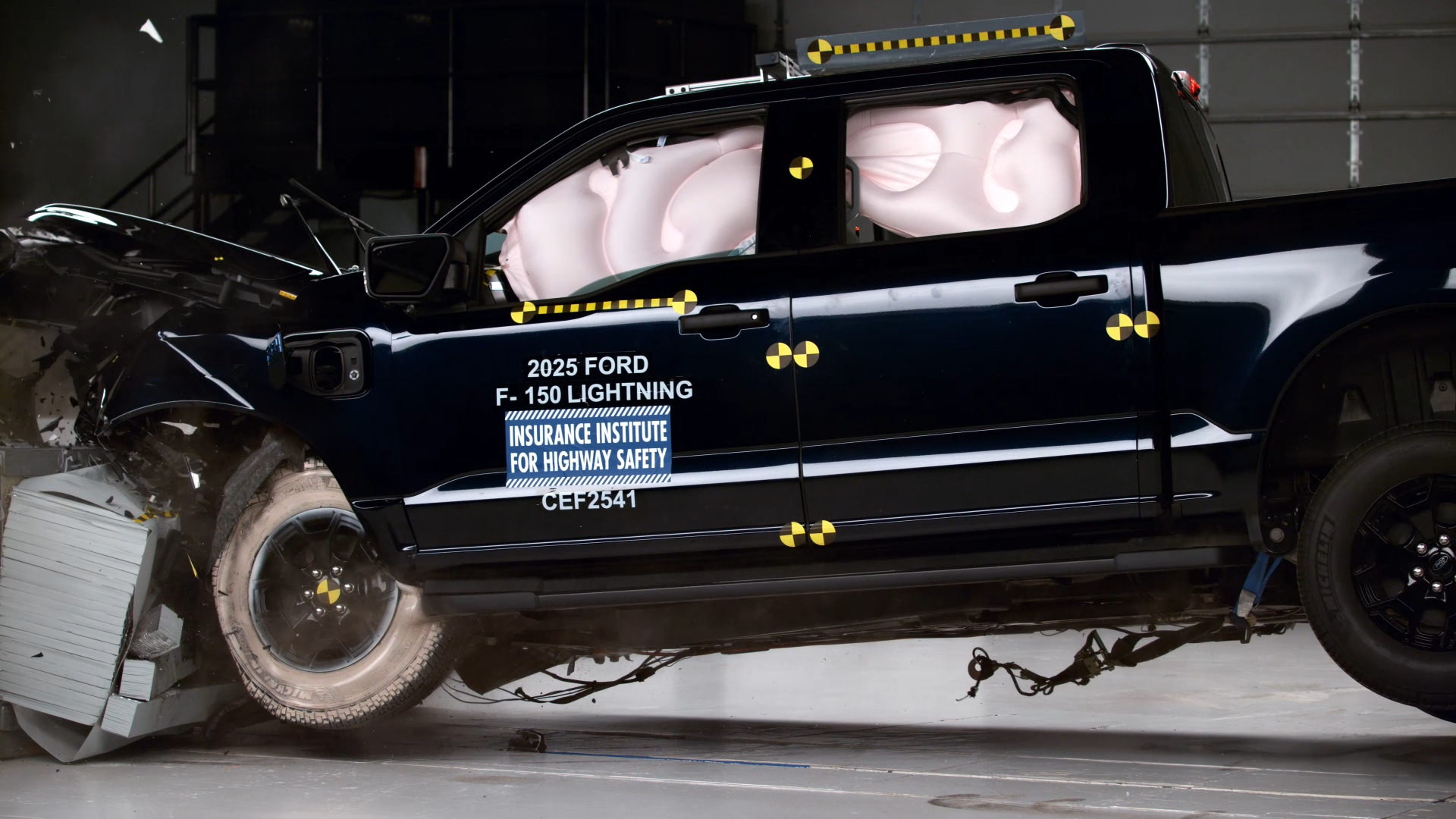
In contrast, the Ford F-150 Lightning rates poor, showing high risks of chest, head, or neck injuries for rear passengers, along with improper lap belt positioning that could lead to internal injuries. The Nissan Ariya receives a marginal rating, offering good driver protection but high chest injury risks for those in the back seat.
Pedestrian crash prevention evaluations also vary. The BMW i4, Ford F-150 Lightning, Tesla Cybertruck, and Tesla Model 3 achieve good ratings, while the Volkswagen ID.Buzz and Chevrolet Blazer EV are rated acceptable. The Nissan Ariya previously earned good ratings for both its standard and optional systems.
Headlight assessments reveal consistent shortcomings. None of the seven vehicles earn a good rating, though five come with acceptable-rated headlights as standard. The BMW i4 offers marginal or poor options, failing to provide adequate high-beam illumination and creating excessive low-beam glare in some trims. The Tesla Cybertruck is equipped only with poor-rated headlights due to excessive low-beam glare.
Regarding IIHS awards, both the TOP SAFETY PICK and TOP SAFETY PICK+ require strong performance across multiple tests, including small overlap front, side crashes, headlights, and pedestrian avoidance. An acceptable moderate overlap rating qualifies for the base award, while good is needed for the plus designation.
Only the Nissan Ariya and Chevrolet Blazer EV have undergone all necessary evaluations, but neither meets the criteria. The Blazer falls short with an acceptable small overlap rating, and the Ariya’s marginal moderate overlap prevents qualification. Poor headlight or moderate overlap results eliminate the BMW i4, Tesla Cybertruck, and Ford F-150 Lightning from contention, despite missing some tests.
Additional ratings cover vehicle-to-vehicle front crash prevention, seat belt reminders, and LATCH ease of use. For instance, the Chevrolet Blazer EV earns good in side crash and seat belt reminders, while the Volkswagen ID.Buzz rates good+ for LATCH.
Full details are available on the IIHS website.
The IIHS, an independent nonprofit, conducts these tests to reduce motor vehicle crash deaths, injuries, and property damage through research and education, supported by auto insurers.
Sign up for our popular weekly email to catch all the latest EV news!