
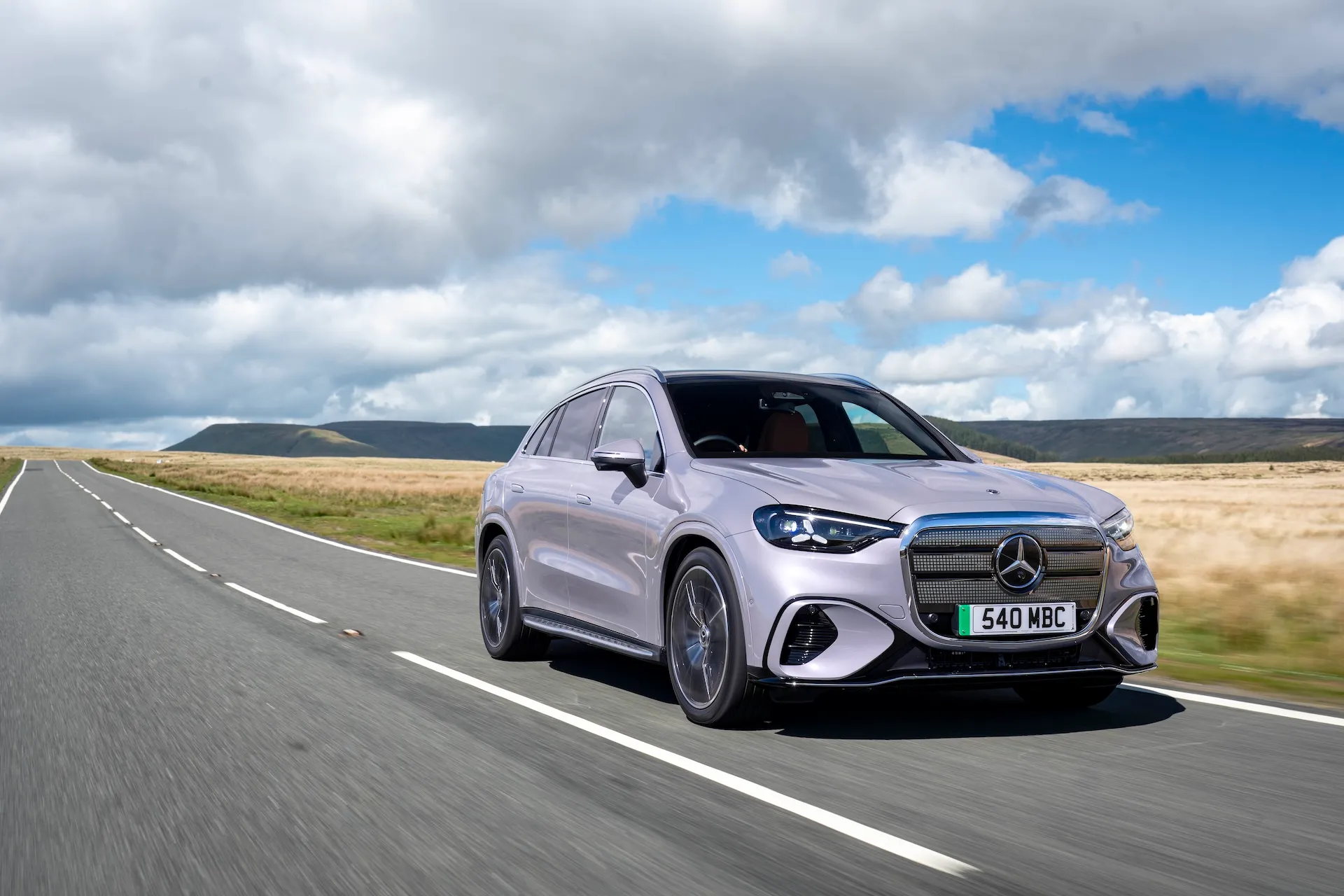
The electric Mercedes-Benz GLC is now available to order in a new rear-wheel-drive GLC 250 variant, priced from £55,495 (about $74,400) in Sport specification. The 250 slots in beneath the existing GLC 400 4MATIC as the new entry point to the all-new electric GLC line in the UK. It pairs an 85 kWh usable battery with a single rear-axle motor rated at 354 hp (260 kW), and Mercedes-Benz reports a maximum range of up to 389 miles on the WLTP cycle.
Highlights
- The GLC 250 starts at £55,495 (about $74,400) in Sport trim, positioned below the £60,350 (about $80,900) GLC 400 4MATIC.
- An 85 kWh usable battery drives a 260 kW (354 hp) rear-axle motor, with a claimed 389 miles of WLTP range.
- A 10–80% DC charge takes 22 minutes at up to 320 kW, and the company quotes 0–62 mph in 5.9 seconds.
- Five trim levels span Sport to Premier Edition, with a 128-liter frunk and up to 2.2 tonnes of braked towing capacity.
A Rear-Wheel-Drive Entry to the Electric GLC
Where the GLC 400 4MATIC uses a dual-motor all-wheel-drive layout, the GLC 250 drives the rear axle through a single permanent-magnet motor. That motor produces 354 hp (260 kW) and 550 Nm of torque, against the 400’s 360 kW and 800 Nm. Mercedes-Benz quotes a 0–62 mph time of 5.9 seconds for the 250 and 4.3 seconds for the 400 4MATIC, with both variants limited to 130 mph.
The 250 carries an 85 kWh usable battery, compared with 94 kWh in the 400 4MATIC, and the company cites WLTP range of up to 389 miles versus 405 miles for the dual-motor car. On DC fast charging, the 250 peaks at 320 kW and the 400 at 330 kW, with both completing a 10–80% charge in 22 minutes, according to Mercedes-Benz. UK figures follow the WLTP test cycle, which typically returns higher numbers than the U.S. EPA standard.
When Mercedes-Benz first revealed the electric GLC, the line launched with the GLC 400 4MATIC alone, making the 250 the first expansion of the range. The company says the electric GLC has drawn more orders than any electric vehicle in its history, and is building the SUV at its Bremen plant on a three-shift schedule.
How the GLC 250 and GLC 400 4MATIC Compare
| Specification | GLC 250 | GLC 400 4MATIC |
|---|---|---|
| Drive system | Rear-wheel drive | All-wheel drive |
| Peak power | 260 kW (354 hp) | 360 kW |
| Peak torque | 550 Nm | 800 Nm |
| Usable battery | 85 kWh | 94 kWh |
| WLTP range | 370–389 miles | 388–405 miles |
| Max DC charging | 320 kW | 330 kW |
| 10–80% DC charge | 22 minutes | 22 minutes |
| 0–62 mph | 5.9 seconds | 4.3 seconds |
| Top speed | 130 mph | 130 mph |
| Braked towing | 2.2 tonnes | 2.4 tonnes |
| Frunk volume | 128 liters | 128 liters |
| OTR price (from) | £55,495 (~$74,400) | £60,350 (~$80,900) |
Both variants are offered in Sport, AMG Line, AMG Line Premium, AMG Line Premium Plus and Premier Edition specifications. An optional Refinement Package adds AIRMATIC air suspension and 4.5-degree rear-axle steering. Luggage capacity runs from 520 to 1,740 liters behind the seats, with the 128-liter frunk shared across the range.
Interior, Software and Driver Assistance
Inside, the MBUX Hyperscreen is fitted to AMG Line Premium, AMG Line Premium Plus and Premier Edition cars. It runs on the Mercedes-Benz Operating System (MB.OS), which links infotainment, comfort, charging and driver-assistance functions and supports over-the-air updates through the Mercedes-Benz Intelligent Cloud.
Driver-assistance features are grouped under MB.DRIVE. DISTRONIC Distance Assist and Parking Assist are standard, while optional packages extend to SAE Level 2 assisted driving and a 360-degree camera view for parking. The redesigned chrome grille can be specified with illumination and animation.
Sign up for our popular weekly email to catch all the latest EV news!