
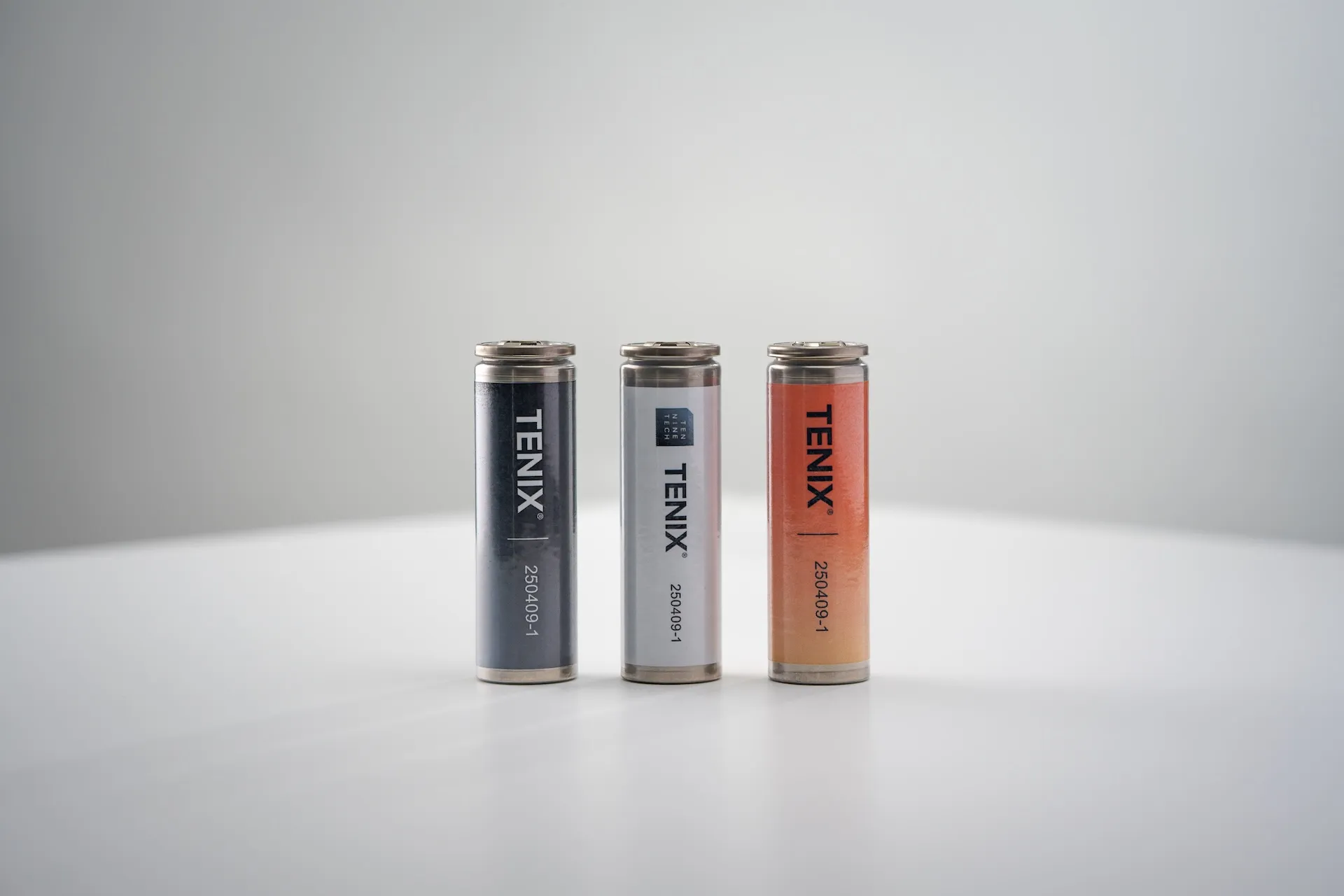
Ten-Nine Technologies is moving its TENIX cathode additive to commercial-scale production, with current capacity of 100 tons the company says is enough to treat 50,000 to 200,000 typical EV battery packs. The Tulsa, Oklahoma-based advanced materials company describes TENIX as “anti-aging for batteries” and reports that third-party testing showed more than 75% additional charge-discharge cycles. Ten-Nine is now accepting orders for 2026–27 delivery from its Tulsa production facility as the battery industry shifts toward manganese-rich cathode chemistries.
Highlights
- Dosing: TENIX makes up 0.5–2% of cathode weight — roughly 1.1–4.4 lbs (0.5–2 kg) per 220 lbs (100 kg) of cathode material, about the amount in a typical EV pack — and requires no new equipment or battery redesign, according to the company.
- Cycle life: In third-party testing, the company reports TENIX delivered over 75% more charge-discharge cycles, extending a typical EV battery’s life from a 150,000-mile warranty baseline to more than 265,000 miles.
- Cost and efficiency: Ten-Nine says the longer life translates to roughly 40% lower cost per kilowatt-hour delivered over a battery’s lifetime, with 10% lower internal resistance and around 40% less heat output.
- Commercial position: Evaluation trials are under way with battery manufacturers representing more than half of global production volume; the company holds 67 granted patents and has raised $45 million to date.
How the Additive Works
According to Ten-Nine, unwanted chemical by-products accumulate inside a battery each time it charges and discharges. That decomposition is the same process behind a phone running hot, an EV losing range, or a laptop needing more frequent charging.
TENIX is blended directly into the cathode material during manufacturing and, the company says, disrupts that aging process at its source. Because it drops into cathode production lines manufacturers already operate, Ten-Nine states that adoption requires neither new equipment nor a battery redesign.
The company reports that TENIX works across battery types used in electric vehicles, defense equipment, power tools, and grid-scale energy storage. It also points to backup batteries at AI-driven data centers, where lower heat output is becoming increasingly critical as those systems are pushed harder.
Why Manganese-Rich Cathodes Matter
Ten-Nine positions TENIX as an enabler for manganese-rich cathodes, which the company characterizes as a cheaper, more abundant, and more geographically secure alternative to the cobalt- and nickel-heavy chemistries that dominate EV batteries today. Manganese is mined widely across Africa, South America, and Southeast Asia rather than concentrated in a few countries, reducing exposure to the geopolitical pressure points that concern manufacturers and policymakers.
The chemistry has long been held back by poor cycle life, which Ten-Nine says is precisely the problem TENIX is built to solve. Recent independent testing of manganese-rich LMFP cathode material passing 1,500 cycles and automaker interest in cobalt-free manganese-oxide cathodes illustrate the broader industry push the company is targeting. Ten-Nine believes the shift could reshape the global cathode supply chain the way LFP did twenty years ago.
Paige Johnson, Founder and CEO of Ten-Nine Technologies, said:
“Just like people, batteries age. Products of chemical decomposition build up during use, limiting a battery’s performance and lifetime, and until now that’s just been treated as an unavoidable cost of doing business. I’m a chemist so I wanted to fix that at the source rather than build a whole new battery to work around it. TENIX has a unique surface chemistry that disrupts that aging process, giving batteries more power and significantly longer life. I started this company in the back of a warehouse in Tulsa with $100,000 and four grams of material in a flask. I never imagined we’d end up here, but I always believed that if the chemistry was right, it would matter to a lot of people’s lives. That’s still what gets me up in the morning.”
Company Background and Competitive Position
Ten-Nine holds 67 granted patents protecting its core cathode chemistry. The company states it has no direct competitor offering a cathode additive of its kind, noting that the nearest points of comparison — silicon anode and solid-state electrolyte technologies — address different problems in different parts of the cell.