
BMW Group has started series production of sixth-generation (Gen6) high-voltage batteries at its new Plant Irlbach-Straßkirchen in Lower Bavaria, a site representing an investment of around €1 billion ($1.13 billion). The plant will serve as the central battery supplier for the company’s German vehicle plants, beginning with packs for the new BMW i3. According to the BMW Group, demand for Neue Klasse models pushed the ramp-up ahead of plan, so series production began immediately on two shifts.
Highlights
- About €1 billion ($1.13 billion) was invested in the 60-hectare (148-acre) site. It went from construction start in April 2024 to its first pre-series battery in March 2026.
- Around 1,600 employees will work at the plant at full operation, building several hundred batteries per day on two production lines.
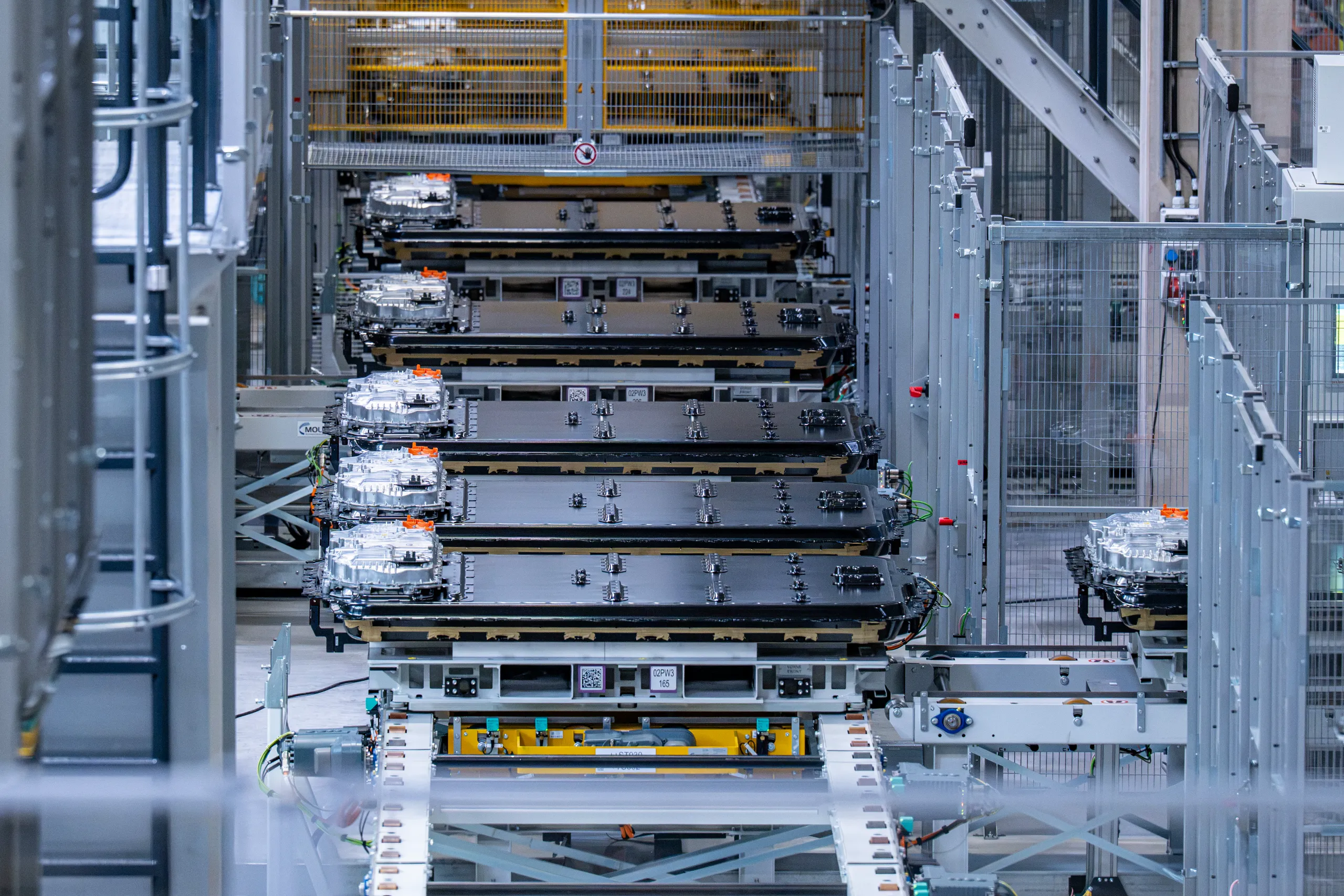
- 500 robots operate across a 50,000-square-meter (538,000-square-foot) production area, and the line collects more than 3,500 data points per battery.
- About 33% lower CO2e per watt-hour for the Gen6 cell compared with the Gen5 cell in the previous model, according to BMW.
Central Supplier for German Vehicle Plants
“The new plant plays a key role in our production network: As the central platform, it will supply our German vehicle plants with sixth-generation high-voltage batteries,” said Raymond Wittmann, Member of the Board of Management of BMW AG, responsible for Production. “In this way, our high-tech plant in Irlbach-Straßkirchen is making a vital contribution to the ramp-up of the Neue Klasse.”
Wittmann framed the investment as a commitment to Germany’s industrial base. “With our Plant Irlbach-Straßkirchen, we are sending a strong signal: for our technological competitiveness, for electromobility – and for Germany as a business location,” he said. “We are convinced that successful industrial production in this country will remain possible in the future. The decisive factor is a reliable and competitive framework.”
The company says about 40% of all BMW cars ever produced were built at its Dingolfing and Regensburg plants. About a fifth of its global workforce is employed at Plants Dingolfing, Regensburg, Landshut and Irlbach-Straßkirchen.
Under Two Years From Construction to Pre-Series
Less than two years passed between the April 2024 construction start and the first pre-series battery in March 2026. BMW credits the pace to cooperation with policymakers, authorities and regional partners, along with digital planning and management tools. In a September 2023 referendum, more than 75% of Straßkirchen residents approved the plant, with turnout of around 77%.
All directly contracted construction companies came from Germany, two-thirds of them from Bavaria. More than three-quarters of the plant engineering firms are German.
Bavarian Minister-President Markus Söder called the opening “a day of celebration for Lower Bavaria, Bavaria and the whole of Germany.” He added: “The BMW plant was built at ‘Bavarian speed’ – this is a prime example of what the future holds.”
How Does BMW Build the Gen6 Battery?
BMW developed the Gen6 battery in-house and plans to use it across all of its vehicle segments. The company says it filed patent applications for more than 500 innovations while developing sixth-generation BMW eDrive technology.
Cylindrical round cells integrate directly into the pack under a cell-to-pack principle. The battery itself forms part of the body structure, an approach BMW calls pack-to-open-body.
Assembly at Irlbach-Straßkirchen follows this sequence:
- Incoming inspection: Cells from outside manufacturers get additional measurements, such as voltage checks, when they arrive.
- Cell clustering: Cells are connected to coolers for insulation and cooling.
- Laser cleaning and welding: Cell clusters and the cell contact system are laser-cleaned and welded.
- Foaming: A foaming process binds the elements into one mechanical unit. The hardened foam supports safety, stability and durability, according to the company.
- Housing and Energy Master: The housing is closed, sealed and riveted. The Energy Master central control unit is then installed with a permanently elastic sealing adhesive.
- End-of-line testing: Every battery undergoes a 100% end-of-line inspection.
Each production step is monitored inline and documented in real time. In-house AI assistants and agents analyze that data to support zero-defect output, and BMW says AI also improves Overall Equipment Effectiveness (OEE). Digital twins and virtual reality supported planning and employee training before commissioning.
“Plant Irlbach-Straßkirchen demonstrates how quickly we can scale a new battery concept to industrial production,” said Rudolf Hummelsberger, Head of High-Voltage Battery Production Dingolfing and Irlbach-Straßkirchen. “The key factor is the interaction between a skilled and committed team and the continuous sharing of experience within the production network.”
Gen6 Battery Specifications in the BMW i3
The plant supplies Plant Munich with Gen6 batteries for the new BMW i3. The company reports these figures:
- Capacity: 108.7 kWh
- Range: Up to 563 miles (906 km) WLTP for the BMW i3 50 xDrive First Edition
- DC charging: Up to 400 kW on 800-volt technology, adding up to 263 miles (423 km) of range in 10 minutes (ISO 12906, WLTP cycle)
- Bidirectional charging: Supported
Range figures follow the European WLTP cycle and are not directly comparable to EPA ratings.
Fossil-Free Operation and Lower-Carbon Cells
The plant requires no fossil fuels for regular operations. A rooftop-independent photovoltaic system supplies part of its electricity on site, and the rest comes from renewable sources. Battery assembly uses no water.
The Gen6 cells for the i3 use secondary materials for a portion of their cobalt, lithium and nickel. BMW says renewable energy powers anode and cathode material production and cell manufacturing.
Part of a Five-Site Global Network
BMW is building five Gen6 battery assembly facilities near its vehicle plants under a “local for local” principle. The sites are Irlbach-Straßkirchen, Debrecen (Hungary), Shenyang (China), Woodruff (USA) and San Luis Potosí (Mexico).
In Bavaria, the plant joins a battery network that runs from research to recycling. Pilot plants in Parsdorf and Hallbergmoos develop Neue Klasse battery production processes. The Cell Recycling Competence Center in Salching, about 10 miles (16 km) from Straßkirchen, began operating in December 2025. It uses a BMW-developed direct recycling method that mechanically dismantles production residue and whole cells without chemical or thermal processing.