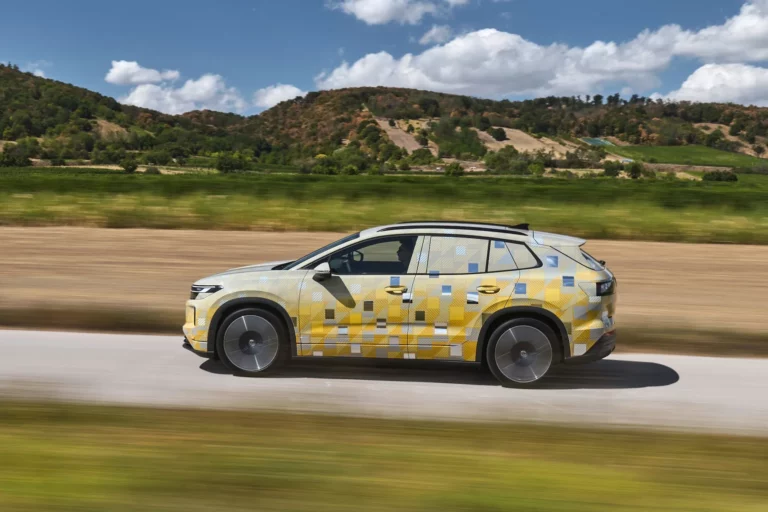

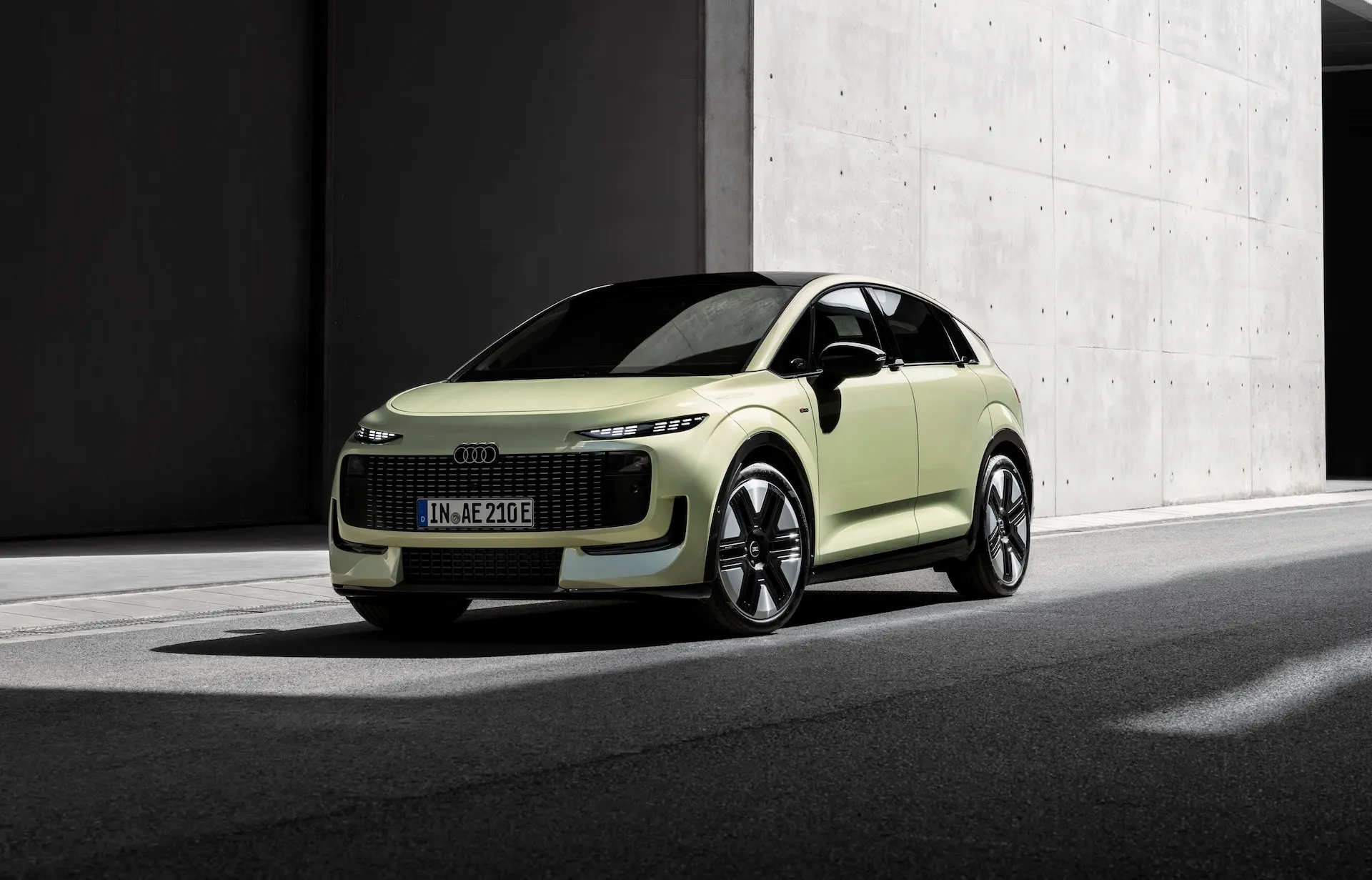
Audi’s A2 e-tron will start at €38,200 (about $44,400) in Germany when orders open September 10, 2026, with first deliveries in December. The company detailed the full lineup of the compact electric model this week, following the Audi A2 e-tron world premiere in Paris. Four power levels, three battery sizes, and a WLTP range of up to 401 miles (646 km) cover the range, with CEO Gernot Döllner framing the car as the brand’s efficiency benchmark and its entry point to electric driving in Europe.
Highlights
- Four variants from 125 kW to 240 kW, with 52, 61, and 84 kWh gross battery options
- German pricing runs from €38,200 (about $44,400) to €51,200 (about $59,500)
- The 140 kW variant with the optional efficiency package is rated at 20.6 kWh per 100 miles (12.8 kWh/100 km) on WLTP, which Audi says is the lowest of any series-production model in its history
- Bidirectional charging is optional, with Vehicle-to-Load standard-market-wide and Vehicle-to-Home in Germany, Austria, and Switzerland
Four Power Levels, Three Battery Sizes
The A2 e-tron uses rear-wheel drive and permanent-magnet synchronous motors, either the APP350 or APP550 depending on output. Power electronics use silicon carbide semiconductors, and the transmission runs polished gear teeth, friction-optimized bearings, and low-viscosity oils to reduce losses. Four regenerative braking levels include one-pedal driving via selector lever position B.
The two smaller batteries use lithium iron phosphate (LFP) cells in a cell-to-pack design, bonded directly into the housing. The 84 kWh nickel manganese cobalt (NMC) pack is modular and available only on the 170 kW and 240 kW variants.
| Technical data | A2 e-tron 125 kW | A2 e-tron 140 kW | A2 e-tron 170 kW | A2 e-tron 240 kW |
|---|---|---|---|---|
| Max power | 125 kW | 140 kW | 170 kW | 240 kW |
| Max torque | 258 lb-ft (350 Nm) | 258 lb-ft (350 Nm) | 258 lb-ft (350 Nm) | 402 lb-ft (545 Nm) |
| Combined consumption (WLTP) | From 22.0 kWh/100 mi (13.7 kWh/100 km) | From 20.6 kWh/100 mi (12.8 kWh/100 km) | From 22.4 kWh/100 mi (13.9 kWh/100 km) | From 22.9 kWh/100 mi (14.2 kWh/100 km) |
| Top speed | 99 mph (160 km/h) | 99 mph (160 km/h) | 99 mph (160 km/h) | 124 mph (200 km/h) |
| 0–62 mph (0–100 km/h) | 8.8 s | 7.9 s | 7.0 s | 5.7 s |
| Max range (WLTP) | Up to 263 mi (423 km) | Up to 320 mi (515 km) | Up to 401 mi (646 km) | Up to 391 mi (630 km) |
| Gross battery capacity | 52 kWh | 61 kWh | 84 kWh | 84 kWh |
| Max DC charging | 100 kW | 105 kW | 183 kW | 183 kW |
| DC charging 10–80% | 24 min | 26 min | 29 min | 29 min |
| German starting price | €38,200 (~$44,400) | €41,900 (~$48,700) | €48,900 (~$56,800) | €51,200 (~$59,500) |
Audi attributes the consumption figure to aerodynamics as much as the powertrain. The company reports a drag coefficient of 0.24, achieved through a largely enclosed underbody, a controllable cooling-air intake that stays closed in normal highway driving, gap reducers and gap breathers in the wheel-arch trim, and aero wheels with a smooth tire-to-rim transition. The 12.8 kWh/100 km consumption figure was previewed as a preliminary value earlier this summer; Audi now presents it as the production rating.
“If we want to bring back the idea of the A2 for a new era, efficiency cannot be one requirement among many. It has to be the leading principle. The result is the most efficient Audi we have ever built. It translates directly into everyday usability: more range, less charging, fewer stops,” Döllner said.
How Does Bidirectional Charging Work on the A2 e-tron?
The high-voltage battery can supply power outward as well as draw it from the grid. Vehicle-to-Load (V2L) runs external devices from a socket in the trunk or through an adapter at the charging port. Vehicle-to-Home (V2H), available in Germany, Austria, and Switzerland with a compatible DC wall box, feeds stored energy into the household grid, so the car can act as storage for home solar output.
Discharge is limited to the 20–80 percent state-of-charge window. An “Instant Charge” function overrides that to charge to 100 percent when full range is needed, and all discharge events are logged in the vehicle as a virtual odometer.
Driver Assistance and Interior
Standard equipment includes adaptive cruise control, front emergency brake assist (active up to about 53 mph, or 85 km/h), swerve assist between 19 and 93 mph (30–150 km/h), front cross-traffic assist, attention assist, parking system plus, and a reversing camera. The optional adaptive cruise assist plus adds lane guidance up to 130 mph (210 km/h) and can brake automatically for red lights; Audi says an automated highway lane change triggered by the turn signal will be added shortly after launch.
The interior pairs an 11.9-inch Audi virtual cockpit plus with a 12.8-inch curved MMI touch display as standard. The gear selector moves to the steering column, freeing the center console for a Qi 2.2 wireless charging tray that charges two phones at up to 25 watts each. Audi says it is the first premium automaker to fit the magnetic Fidlock fastening system as standard, with three adapters in the center console. Trunk volume is 14.0 cu ft (396 liters), expanding to 47.2 cu ft (1,336 liters) with the rear seats folded; the 170 kW and 240 kW variants add a 0.5 cu ft (13-liter) frunk.
Depending on configuration, more than 300 components use recycled materials, over 100 of them post-consumer, and the optional Softwrap surfaces and sport-seat fabrics are 100 percent recycled polyester.
Production at Ingolstadt
The A2 e-tron is built at Audi’s home plant in Ingolstadt in a facility of roughly 1.18 million sq ft (110,000 sq m), with bodies produced alongside the Audi A3. Audi reuses more than 1,200 existing manufacturing assets, including around 250 robots previously assigned to other models, and says the car reached market 21 months faster than comparable predecessor programs.
The plant introduces the “pearl chain” production principle, previously used at Neckarsulm, under which the customer order sequence is fixed six days before assembly and followed across all production areas. Audi says this reduces process complexity and the space required for parts storage and sequencing.