
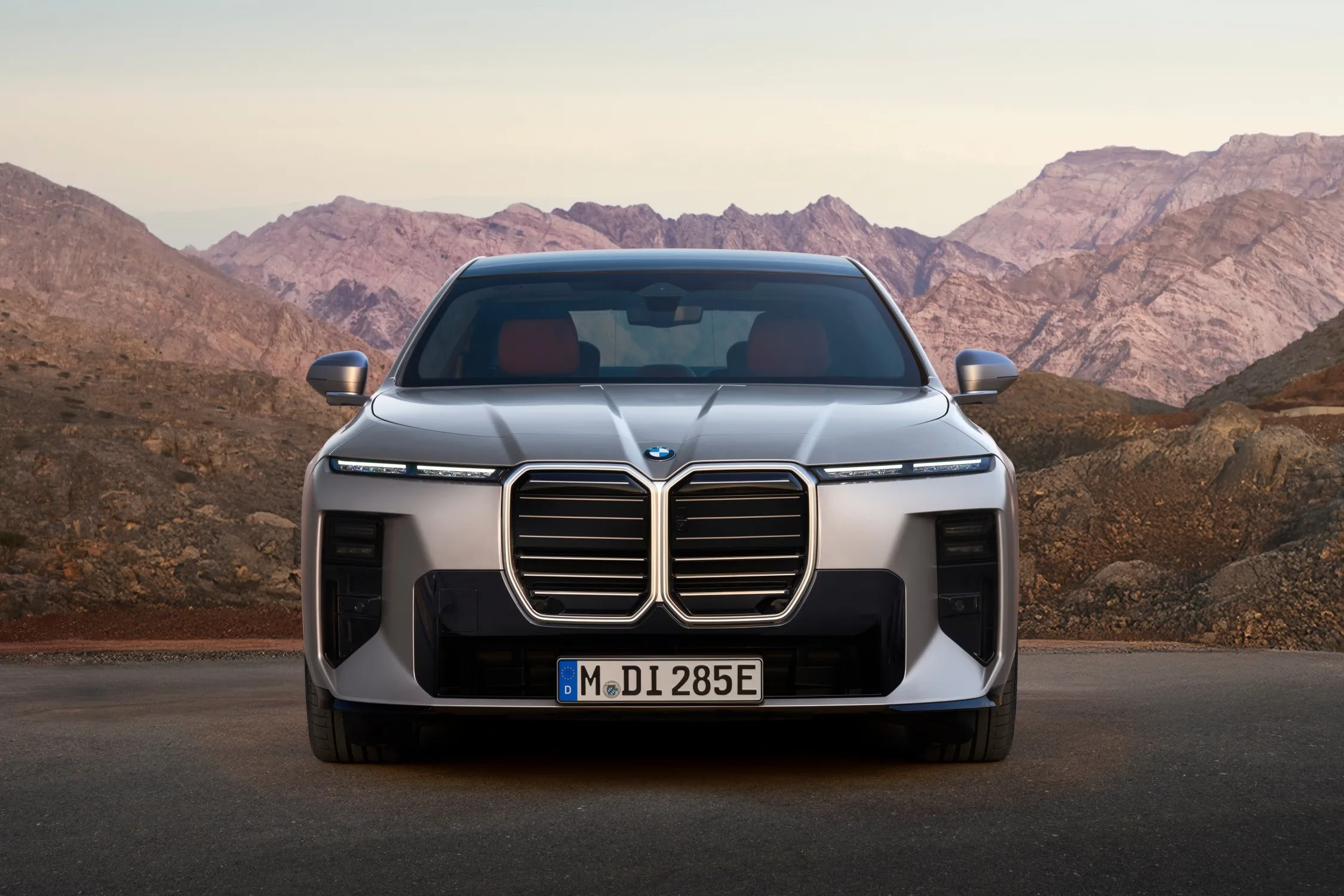
The BMW Group has revealed the seventh-generation 7 Series Sedan, introducing Neue Klasse technologies to the brand’s luxury flagship and extending WLTP range on the fully electric i7 beyond 720 km (447 miles) for the first time. The update spans three i7 variants, two plug-in hybrids, and mild-hybrid petrol and diesel models, all produced on a single line at BMW Group Plant Dingolfing. World premiere is set for 22 April 2026, with worldwide market launch beginning July 2026.
Highlights
- Three fully electric i7 variants adopt Gen6 cylindrical cells, lifting usable battery energy to 112.5 kWh and adding around 120 km (75 miles) of WLTP range versus the outgoing model
- DC fast charging rises from 195 kW to 250 kW, cutting 10–80% charge time to 28 minutes
- BMW Panoramic iDrive, BMW Passenger Screen, and Operating System X debut in the luxury segment after first appearing in the iX3
- Two plug-in hybrid variants and a mild-hybrid petrol 740 xDrive join the range, with a diesel 740d xDrive and both PHEVs following in November 2026
i7 range: three electric variants, 112.5 kWh battery
The i7 adopts Gen6 cylindrical cells from BMW’s sixth-generation eDrive technology, which first entered production in the Neue Klasse iX3. BMW states that volumetric energy density is 20 percent higher than the Gen5 prismatic cells used previously, and usable battery energy content rises by more than ten percent to 112.5 kWh net. The cells are packaged in a new high-voltage battery housing with the same external dimensions as the outgoing unit, in a modular arrangement BMW describes as unique within its all-electric portfolio.
Range figures quoted by BMW are provisional WLTP values for the German market and are not directly comparable to EPA figures that will apply in North America.
BMW i7 50 xDrive
The entry point to the electric line-up produces a combined 335 kW (455 hp) and 660 Nm (487 lb-ft) of system torque from front and rear electric motors. BMW quotes a 0–100 km/h (62 mph) time of 5.5 seconds, a top speed of 210 km/h (130 mph), and WLTP range of 591–728 km (367–452 miles). Combined electric consumption is 21.8–18.1 kWh/100 km.
BMW i7 60 xDrive
The mid-tier variant raises combined output to 400 kW (544 hp) and 745 Nm (549 lb-ft). BMW quotes 0–100 km/h in 4.8 seconds, a 240 km/h (149 mph) top speed, and WLTP range of 581–727 km (361–452 miles).
BMW i7 M70 xDrive
The M Performance flagship delivers 500 kW (680 hp) and up to 1,100 Nm (811 lb-ft) when Launch Control or the M Sport Boost function is activated. BMW quotes 0–100 km/h in 3.8 seconds (3.5 seconds by the one-foot rollout method), a 250 km/h (155 mph) limited top speed, and WLTP range of 566–686 km (352–426 miles).
All three variants use electrically excited synchronous motors, which BMW says allows the rotor to be produced without rare-earth magnets.
Charging and efficiency
Peak DC charging rises from 195 kW to 250 kW, with peak current reaching 630 amps. BMW states that a 10–80 percent DC charge takes 28 minutes, and that ten minutes of DC charging at maximum rate adds up to 235 km (146 miles) of range on the 50 xDrive and 60 xDrive, or 215 km (134 miles) on the M70. AC charging is rated at up to 22 kW as standard, for a full charge in six hours.
The navigation system automatically preconditions the battery when a DC station is set as a destination, and BMW Maps calculates charging-optimised routes using historical data on station reliability, occupancy, and connector types. BMW says overall vehicle efficiency improves by up to seven percent through measures including silicon carbide inverters, friction-optimised wheel bearings, and tyres with A+ labelling.
Panoramic iDrive and cabin technology
The 7 Series is the first luxury sedan to receive BMW Panoramic iDrive, which debuted in the iX3. The system combines a windscreen-wide Panoramic Vision projection, a 17.9-inch free-cut Central Display, a 3D Head-Up Display, and a new multifunction steering wheel. BMW Operating System X, built on the Android Open Source Project, underpins the platform and supports over-the-air updates.
A 14.6-inch BMW Passenger Screen is standard from the Pure Excellence entry variant upwards, marking the feature’s debut in the brand. The 31.3-inch BMW Theatre Screen returns with 8K resolution, full-surface touch operation, and a new built-in camera for rear-seat video calls. Apple CarPlay and Android Auto are included as standard, and the BMW Intelligent Personal Assistant gains Amazon Alexa+ large-language-model integration, which BMW will roll out to Operating System 9 and X vehicles from the second half of 2026 starting in Germany and the US.
Driver assistance: Motorway Assistant and new City Assistant
The 7 Series introduces BMW Symbiotic Drive, the brand’s framing for SAE Level 2 assistance that keeps the driver engaged. The optional Motorway Assistant enables hands-off driving up to 130 km/h (81 mph) in several European countries and supports Entry-2-Exit route guidance with automated lane changes confirmed by the driver’s eye signal. BMW reports that Germany, Canada, and US customers have accumulated more than 190 million kilometres (118 million miles) of hands-off driving with the previous-generation system.
The new City Assistant handles Address-2-Address navigation-guided assistance in urban traffic, including right-of-way handling, turn support, roundabouts, traffic-light stop-and-go, and lane changes. BMW’s rollout begins in Germany in late 2026 via over-the-air updates, with initial US functionality limited to assisted stopping and pulling away at traffic lights.
Combustion and plug-in hybrid variants
The 740 xDrive brings a 3.0-litre inline-six petrol engine with 48V mild-hybrid technology to Europe for the first time, producing 294 kW (400 hp) and 540 Nm (398 lb-ft). The 740d xDrive diesel follows in November 2026 with 230 kW (313 hp) and 670 Nm (494 lb-ft). Both models use an eight-speed Steptronic transmission housing a crankshaft-mounted starter generator.
Two plug-in hybrids arrive in November 2026. The 750e xDrive produces a combined 360 kW (489 hp) and offers 70–82 km (43–51 miles) of WLTP electric range from an 18.7 kWh usable battery. The M760e xDrive raises combined output to 450 kW (612 hp) with 800 Nm (590 lb-ft). Both PHEVs now charge at up to 11 kW AC.
Chassis, brakes, and sustainability
Standard equipment now includes adaptive two-axle air suspension with electronically controlled dampers on all variants. Factory 22-inch wheels are available for the first time, and entry-level tyre width increases at both axles. Optional Adaptive Chassis Control adds Integral Active Steering with up to 3.5 degrees of rear-wheel steering, while Adaptive Chassis Control Professional adds 48V active roll stabilisation.
BMW states that Gen6 battery cell production uses a proportion of renewable electricity and secondary lithium, cobalt, and nickel, which it expects to cut supply-chain CO₂e emissions by approximately 30 percent versus the previous generation. From 2026, i7 wheel rims will use 70 percent secondary aluminium. A TÜV-verified product carbon footprint will be published for all variants at start of production.
Sign up for our popular weekly email to catch all the latest EV news!