

BMW Group has unveiled a new hydrogen storage system for the BMW iX5 Hydrogen. The redesigned flat tank configuration stores at least seven kilograms of hydrogen and enables a manufacturer-estimated range of up to 466 miles (750 km). Production integration across the X5 platform is planned for 2028.
Highlights
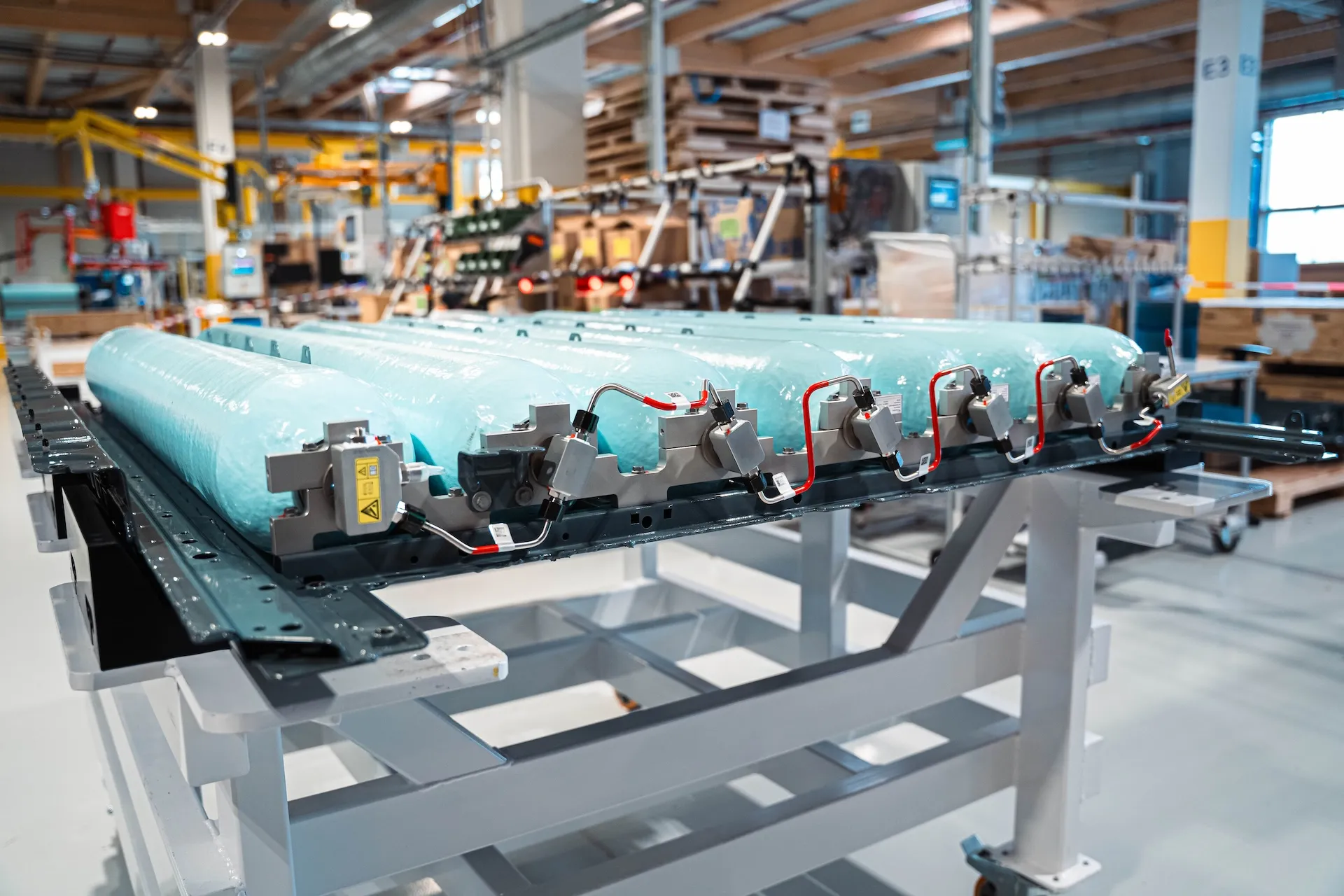
- New flat storage design: Seven carbon-fiber reinforced composite tanks connected in parallel within a single metal frame, controlled by one central valve.
- Range and refueling: Up to 466 miles of estimated range with a sub-five-minute fill from empty.
- Multi-powertrain platform: The X5 architecture supports five drivetrain variants, including BEV, PHEV, conventional, and hydrogen fuel cell, on the same production line.
- Government funding: The “HyPowerDrive” project backing the powertrain and tank development has received approximately $223 million from Germany’s Federal Ministry of Transport and $96 million from the state of Bavaria.
How the Flat Storage System Works
The BMW Hydrogen Flat Storage system replaces conventional individual pressure vessels with a series of interconnected chambers. Seven 700-bar high-pressure tanks made of carbon-fiber reinforced composite sit within a metal frame. Rather than operating independently, the chambers form a single enclosed unit managed by one central main valve.
This arrangement fits within the same geometric envelope as the Gen6 high-voltage battery used in other X5 variants. As a result, interior cabin space remains unchanged regardless of drivetrain. The vehicle’s structural members also provide mechanical protection for the tanks, according to BMW.
The design has generated multiple patent applications, the company said.
“Think of it as installation Tetris: every customer gets the drive system best suited to their needs and a true BMW X5 with no compromises,” said Dr. Joachim Post, Member of the Board of Management of BMW AG responsible for Development.

Powertrain and Performance
The flat tank integrates with BMW’s Gen3 fuel cell technology, which the company describes as its most efficient and powerful generation to date. The powertrain also incorporates a high-voltage battery and the Heart of Joy drivetrain and chassis control software, along with BMW Dynamic Performance Control.
BMW did not disclose specific output figures or acceleration benchmarks in the press release.
Five Drivetrains, One Production Line
The new X5 platform supports five drive system variants: battery-electric, plug-in hybrid, conventional combustion, and hydrogen fuel cell. Uniform geometric specifications for energy storage and drivetrain components reduce complexity and lower production costs across variants.
This flexibility is central to BMW’s broader hydrogen strategy. The company positions fuel cell technology as a complement to battery-electric vehicles, citing benefits in range, refueling speed, and supply chain diversification. Hydrogen reduces dependence on a single infrastructure type or raw material chain, BMW said.
Government Backing
Development of the iX5 Hydrogen powertrain and tank system falls under the “HyPowerDrive” project, funded through Germany’s IPCEI Hy2Move framework. The Federal Ministry of Transport (BMV) is providing EUR 191 million (approximately $223 million), with the state of Bavaria contributing an additional EUR 82 million (approximately $96 million). Project Management Jülich (PtJ) implements the funding, coordinated by NOW GmbH.
Sign up for our popular weekly email to catch all the latest EV news!