
BYD will price its FLASH Charging network per kilowatt-hour and plans 300 chargers across the UK within the next 12 months, with the first site due to go live in the coming weeks. The structure splits two ways: DENZA and BYD owners whose vehicles are factory-fitted with FLASH Charging qualify for preferential electricity rates, while every other driver pays a published standard pay-as-you-go rate. BYD says the preferential rate will sit considerably below prevailing ultra-rapid retail prices in the UK market, with the exact discounted unit tariff to be announced at official launch.
Highlights
- Per-kWh pricing across the board, with preferential rates reserved for BYD and DENZA vehicles factory-fitted with FLASH Charging
- 300 chargers planned nationally within 12 months, prioritizing BYD and DENZA sites in core towns and cities, highway service areas, and existing charging hubs
- 370kWh of on-site battery storage per charger — two 185kWh units — drawing between 100kW and 560kW from the grid
- Open to any CCS2-equipped vehicle, though charge rate is capped by the vehicle rather than the charger
What Will FLASH Charging Cost?
All FLASH Charger services will be priced per kilowatt-hour. Owners qualifying for the preferential tariff get rates BYD describes as considerably lower than prevailing ultra-rapid charging retail prices across the UK market. Drivers of other vehicles pay the published standard per-kWh pay-as-you-go rate, which the company says will be competitive with leading ultra-rapid charging providers.
Payment will be possible through four methods:
- Plug & Charge (Autocharge)
- Scan-to-charge via the BYD FLASH fast charging app
- Credit card payment
- RFID electric card roaming payment
Management rules will govern how long vehicles occupy a bay. Once a battery reaches a reasonable full-charge threshold or a preset stay limit, an overstay parking surcharge can be applied to discourage slower-charging EVs from tying up ultra-fast hardware.
Where the First 300 Chargers Will Go
The rollout gives priority to BYD and DENZA sites covering core towns and cities, alongside high-traffic locations including highway service areas and existing charging hubs. BYD cites a 2024 YouGov survey in which 42% of UK car buyers identified slow charging times as the most significant reason not to buy an electric car.
Solar photovoltaic installation will be deployed selectively as part of a solar-plus-storage integrated design, covering rooftop or carport arrays at large-scale hub sites such as highway service areas, out-of-town retail parks, and major dealership lots where space permits. On-site generation feeds the battery energy storage system for charger consumption. Compact urban sites with limited space will rely on certified off-site renewable power procurement instead.
Which Vehicles Can Use the Full Rate
| Model | Powertrain | FLASH Charging status |
|---|---|---|
| DENZA Z9 GT | Battery electric | First FLASH-capable car arriving in the UK |
| DENZA Z | Battery electric supercar | FLASH Charge-enabled |
| DENZA D9 | DM-i plug-in hybrid | 58.5kWh battery, 130 miles electric range, 10–70% in five minutes |
Plug-in hybrids are not excluded from the technology — DM-i models are compatible. BYD says some of its own models will also become FLASH-compatible in Europe in the future.
Can Non-BYD Drivers Use FLASH Chargers?
Yes. FLASH Charging works with any CCS2-equipped vehicle. Those vehicles will not reach the system’s peak rates, because the limiting factor is the car rather than the charger.
How the 1,500kW Peak Is Delivered
BYD frames the system around what it calls “Ready in Five, Full in Nine, Cold Add Three”: a 10–70% charge in five minutes, 10–97% in nine minutes, and 20–97% in 12 minutes even at -22°F (-30°C). From a suitable charger, the company says that translates to more than 200 miles of range in five minutes — comparable to the time spent filling a gasoline or diesel car.
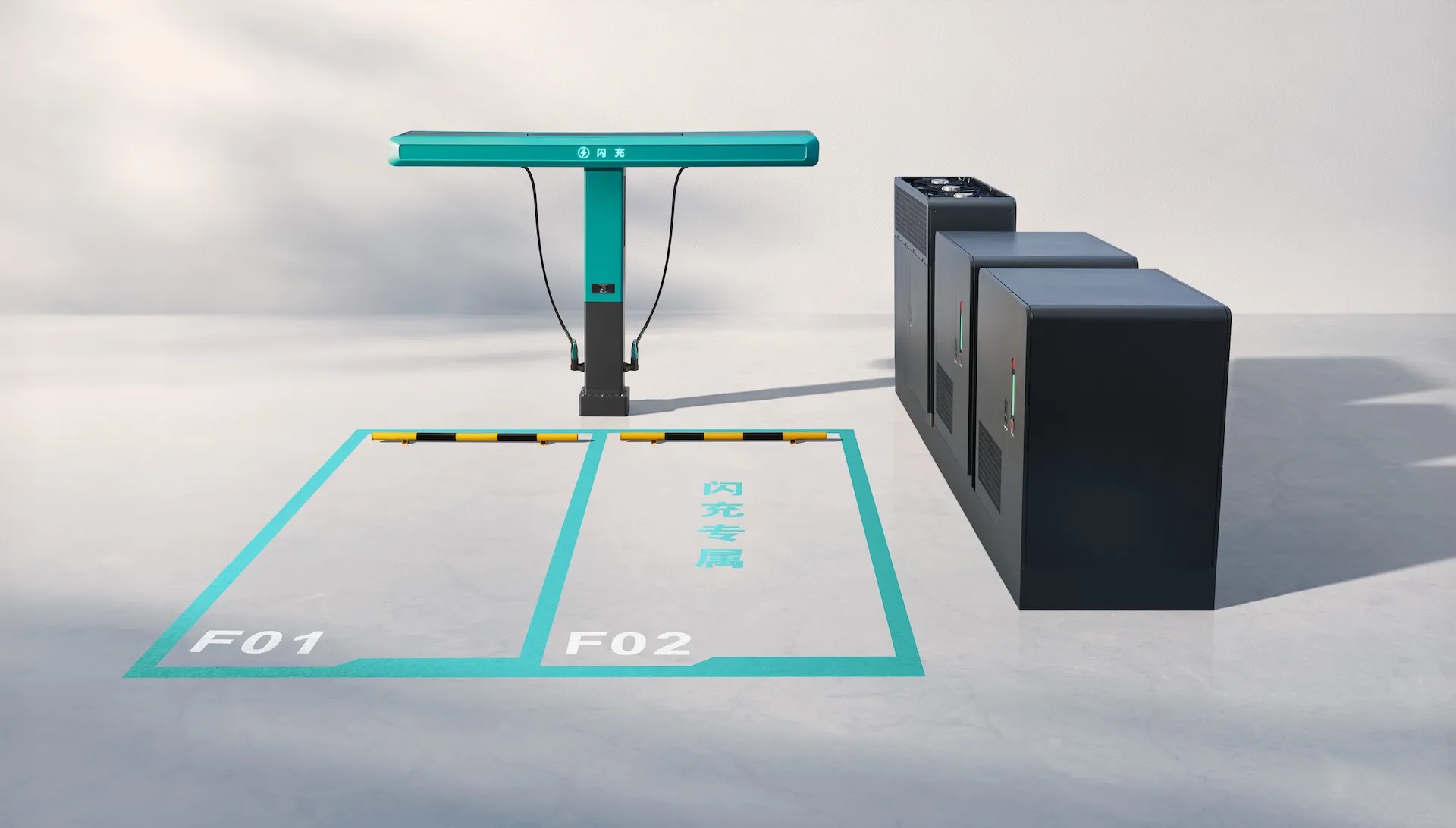
The maximum rate is 1,500kW through a single connector. Each unit carries two connectors and can serve two cars at once, supplying up to 1,000kW each when both are in use. That peak depends on on-site storage rather than grid capacity: two 185kWh battery units per charger hold 370kWh in reserve, topped up from a grid connection drawing roughly 100kW to 560kW depending on local infrastructure and traffic.
On the vehicle side, the speeds require Blade Battery 2.0. BYD attributes the gain to a Flash-Release cathode, Flash-Flow electrolyte, and Flash-intercalate anode, which reduce internal resistance and therefore heat generation. Expressed as a C-rate — where 1C means a full charge in one hour — the technology enables a peak of 10C.
The hardware itself uses a T-shaped structure housing two rail-mounted connectors. Hanging vertically, the cables stay clear of rain and dirt, and gravity carries the weight, which BYD says makes the plug lighter to maneuver and easier to reach regardless of where a car’s charging port sits.
What Provisions Exist for Drivers With Mobility Impairments?
Sites are being rolled out to comply with the UK’s PAS 1899 accessibility standard. Provisions include dedicated accessible parking and charging bays, optimized charger hardware design, and on-site auxiliary support.