

GoSun has launched the Moonrider 27, a 27-horsepower battery-electric compact tractor priced at $19,995 for the North American market. The Cincinnati-based solar products company pairs a 24 kWh lithium iron phosphate battery with an optional 1,100-watt solar canopy, aimed at farms, vineyards, homesteads, and properties in the 5- to 50-acre range. GoSun is taking $50 refundable reservations for the Moonrider 27 ahead of deliveries in 2027.
Highlights
- Rated power: 27 hp (20 kW), with 22.8 hp (17 kW) available at the PTO
- Battery and runtime: 24 kWh LFP pack rated for an estimated five hours of operation per charge
- Charging: 220-volt AC from 0 to 80% in approximately 2.5 hours, or an optional 1,100-watt solar canopy
- Price: $19,995 including the 220-volt charger, held with a $50 refundable deposit
A Compact Tractor Built Around an LFP Pack
The Moonrider 27 uses a four-wheel-drive layout with a constant-mesh gearbox offering nine forward and three reverse speeds. GoSun specifies a mechanically engaged 540/540E rear PTO and a hydraulic three-point hitch with a lift capacity of 1,653 pounds (750 kg), which the company says allows owners to run compact-tractor implements they already own — mowers, tillers, blades, spreaders, and trailers — without adapters.
Published dimensions put the tractor at 105.5 inches (2,680 mm) long and 40.9 inches (1,040 mm) wide on a 62-inch (1,575 mm) wheelbase, with 10.6 inches (270 mm) of ground clearance and a 4.6-foot (1.4 m) turning radius. Curb weight is 2,414 pounds (1,095 kg). Braking is oil-immersed, and draft control uses a two-lever ADDC arrangement. Connected features include mobile app access, GPS tracking, and geofencing.
Battery-electric compact tractors have been offered in North America since the start of the decade, when Solectrac opened reservations for its 30- and 40-horsepower utility models.
How Does the Moonrider Charge From the Sun?
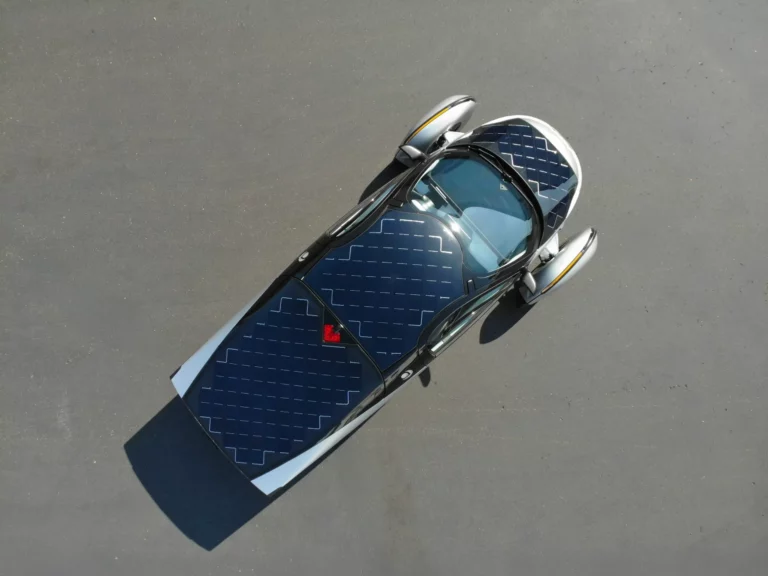
Two charging paths are offered. A 220-volt AC connection takes the pack from 0 to 80% in roughly 2.5 hours, and the standard package includes that charger. The optional 1,100-watt canopy mounts above the operator station and charges the battery while the tractor works or sits parked; GoSun estimates a full day of sun yields about 1.5 hours of runtime.
Solar is GoSun’s core business — the company has built solar cookers, power banks, portable refrigerators, water purification systems, and an EV solar charger since its founding in 2016. Factory solar options have also appeared on other electric work vehicles, including the TELO MT1 pickup.
What Does It Cost to Run Against Diesel?
GoSun publishes a five-year ownership model comparing the Moonrider 27 to a diesel compact tractor. The figures are company estimates, and GoSun notes that actual savings vary with use, fuel prices, and local electricity rates.
| Five-year cost | Traditional diesel | Moonrider 27 |
|---|---|---|
| Fuel and energy | $8,000 | $0 |
| Oil and filter changes | $1,500 | $0 |
| Filters, belts, and service | $2,500 | $500 |
| Downtime and fuel runs | $3,500 | $0 |
| Total | $15,500 | $500 |
Chief Executive Patrick Sherwin framed the pitch around operating cost: “Farmers need to cut their fuel costs. The GoSun Moonrider solar electric tractor provides a cost effective alternative to expensive diesel tractors. Electric tractors are the future of farming.”
Availability and Farm Progress Show Debut
Reservations are open through GoSun’s website with a refundable $50 deposit that holds a place in the first production run, with deliveries scheduled for early 2027. The company says balance payments can be split into monthly financing at checkout when a build is ready.
The Moonrider 27 will be displayed at the Farm Progress Show in Boone, Iowa, September 1–3, 2026, at booth VITW2200.