
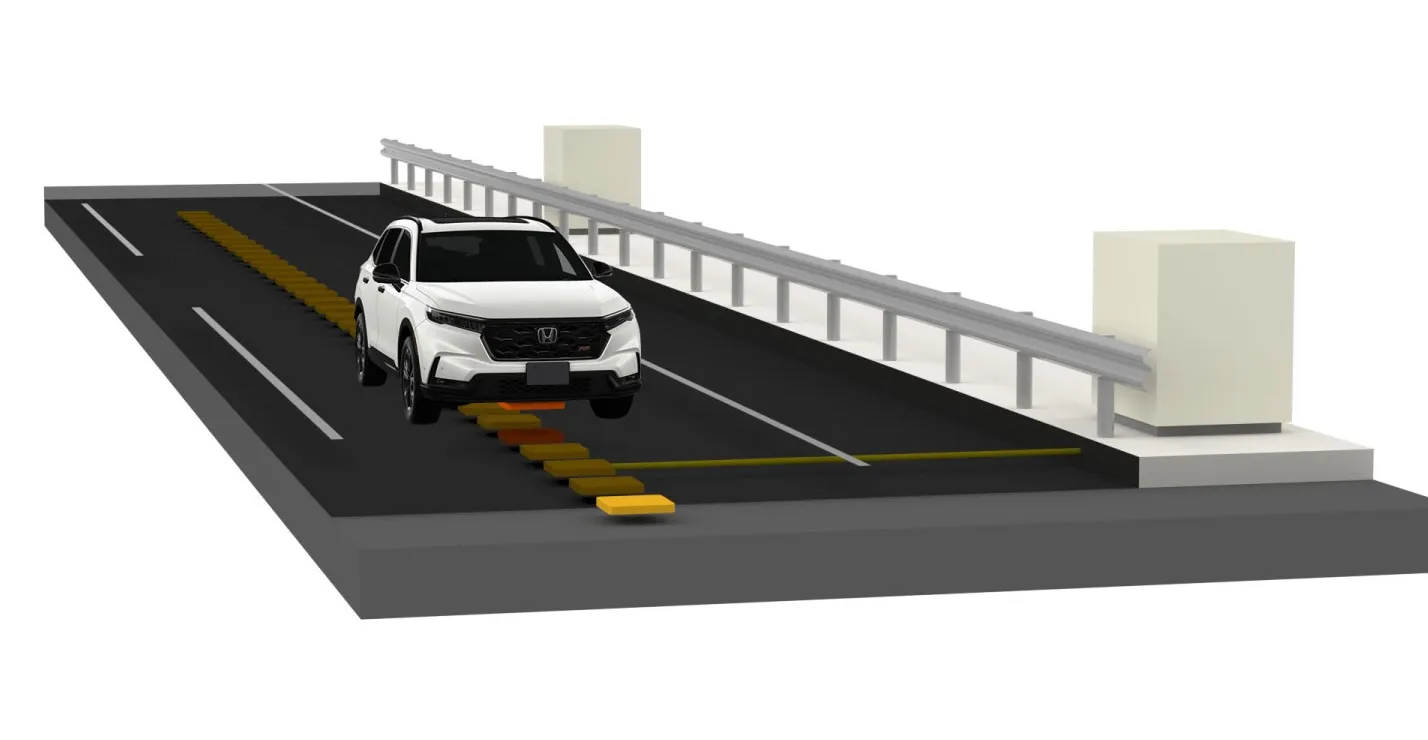
Honda R&D, Taisei Corporation, and Taisei Rotec Corporation have developed the underlying technology for a road system that wirelessly charges EVs in motion, with public-road demonstration testing planned from Japan’s 2027 fiscal year, which begins April 1, 2027. According to Honda, the magnetic coupling wireless power transfer (WPT) road system is designed for vehicles ranging from passenger EVs to large commercial trucks. The three companies have worked on the system jointly since 2025.
Highlights
- Heavy-vehicle rated: Ground units and pavement were tested against vehicles with a gross weight of approximately 44,000 pounds (20 metric tons).
- Target output: Later testing will verify power transfer of up to 150 kW for large commercial vehicles.
- Durability program: A new test roadway will run a loading test equivalent to 1 million wheel loads at about 11,000 pounds-force (49 kN) per wheel.
- Public-road path: The partners will join NEXCO East’s Tateyama Project on the Tateyama Expressway in Chiba, Japan, from fiscal 2027.
How Does the WPT Road System Work?
The dynamic wireless power transfer (DWPT) system has three main components:
- DC power supply system: Ground-based equipment that feeds power to the road.
- Ground assembly (GA) system: Multiple power transmitter units embedded in the road and linked by a DC connection.
- Vehicle assembly (VA) unit: A power receiver mounted on the vehicle.
Honda says the GA system integrates the inverter and coil inside each unit into a single DWPT unit. The company describes this as the world’s first such unit publicly disclosed, based on its own research as of the end of September 2026. Paired with the ground-based DC supply, the design is intended to deliver high-power transfer with fast response and stable output.
Division of Work Among the Three Companies
Each partner contributes its own technology:
- Taisei Corporation: Development of the DC power supply system.
- Honda R&D: Development of the DC distribution-based GA system and a vehicle system equipped with a VA receiver unit.
- Taisei Rotec: Development of construction methods for WPT roads.
- All three companies: Pavement structures and durability testing for roads with embedded GA units, upgrade methods for WPT roads and equipment, and DC distribution and WPT testing.
Key Engineering Challenges Addressed
The companies ran verification tests on a test roadway at the Future Technology Field for Taisei Group/Satte (T-FIELD/SATTE). The work targeted three challenges.
Structural Strength for Commercial Traffic
The internal structure of the GA units was optimized so the pavement and embedded units can withstand long-term use under heavily loaded commercial vehicles.
Stable, High-Response Power Supply
The DC power supply had to deliver high power to the DC-distributed ground system with high responsiveness and stability, a requirement for EVs traveling at high speeds.
Installation in Existing Roads
The GA unit is designed for milling-and-embedding installation in existing pavement. It includes measures to address uneven milled surfaces. Honda says the DC distribution structure simplifies wiring in the embedded sections, reducing component count and installation work. The design is also intended to fit future pavement renewal.
Testing Timeline and Public-Road Plans
Construction of a second test roadway at the Future Technology Field for Taisei Group/Tamura (T-FIELD/TAMRA) begins in late 2026. Testing there will cover:
- Long-term durability under a loading test of 1 million wheel loads using actual vehicles
- DWPT performance
- Measures to address electromagnetic field leakage
Later phases will verify output of up to 150 kW and the reliability of power transfer to vehicles at high speeds. The partners will also take part in the Tateyama Project, a DWPT demonstration that East Nippon Expressway Company (NEXCO East) will conduct from fiscal 2027.
Logistics as the First Application
Honda has developed DWPT technology since 2021 as part of its work on in-motion wireless charging. The company says supplying power while vehicles drive could reduce how often EVs need to charge at home or at stations. Honda plans to target practical use first in logistics and transportation, where it expects the largest benefit.
The work sits alongside Honda Charge, the company’s EV charging network service in Japan. Honda will present its DWPT research at the Japan Mobility Show Bizweek, October 13–16, 2026, at Makuhari Messe in Chiba, Japan, and at the ITS World Congress 2026, October 19–23, 2026, at Gangneung Olympic Park in South Korea. Details on Honda’s Japan Mobility Show Bizweek exhibits cover the broader display.