

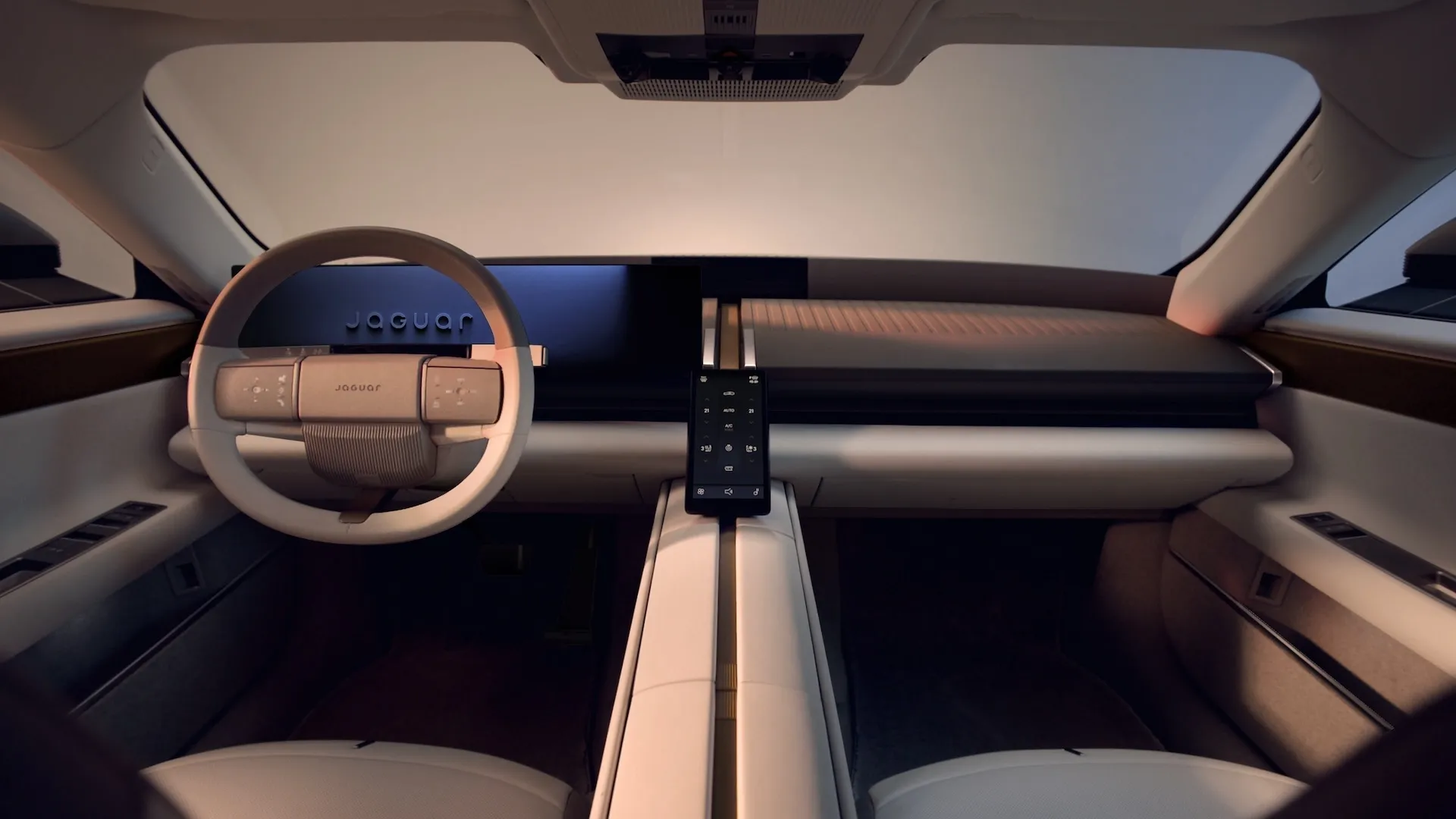
Jaguar has revealed the interior of the Type 01, its first all-electric production car, ahead of the model’s full unveiling in New York on October 6, 2026. The cabin is organized around a central spine running the full length of the interior, a layout the company says carries its Type 01 concept-car vision into production by creating four individual occupant spaces. A prototype wearing a new wrap will appear at Pebble Beach Concours on August 16, 2026, during Monterey Car Week.
Highlights
- Full-length central spine divides the cabin into four individual spaces, with a brass-inspired finish repeated along the tops of the doors
- Digital ClearSight Rear View Display sits centrally at the base of the windshield, at the same height as the side mirrors
- North American prototype debut at Pebble Beach Concours on August 16, 2026, during Monterey Car Week
- Global reveal scheduled for New York on October 6, 2026
Central Spine Defines the Cabin Layout
The spine accentuates what Jaguar describes as the longitudinal character of the design and separates the cabin into four distinct spaces. The company says the cabin shrinks around the driver, with a low seating position intended to inspire confidence behind the wheel.
The brass-inspired finish on the spine continues along the tops of the doors, and these full-length elements carry the Jaguar leaper. According to Jaguar, the material palette draws on travertine stone and artisan textiles, and the cabin includes concealed compartments and technologies that stay hidden until needed.
“Our holistic design philosophy translates the vehicle’s exterior presence into a distinctive interior architecture. In contrast to the horizontal interior design norm, we emphasise its dramatic longitudinal nature through the central spine – an architectural statement that creates four individual spaces. With authentic materials, technology on demand and reductive flowing surfaces, Type 01 presents unmistakable drama and theatre that will define the modern luxury automotive interior of the future,” said Thomas Holden, Chief Interior Designer, Jaguar.
How Does the Type 01 Handle Infotainment?
Jaguar has integrated infotainment into the interior architecture rather than treating it as a separate element, with digital interfaces the company says are applied for control on demand. Strikethrough elements visually merge the hood with a slim dashboard that houses the new system.
A digital ClearSight Rear View Display is positioned centrally at the base of the windshield, at the same height as the side mirrors, to help the driver stay focused on the road.
“Jaguar Type 01 is the first production car to follow our new creative philosophy. Unmistakable from every angle, the interior is no different. With Type 01, we wanted every journey to be an occasion, from how it drives to how it looks and how it makes you feel. With a confidence‑inspiring GT driving position, clean and sophisticated technology and dramatic styling, Type 01 has an interior like no other,” said Rawdon Glover, Managing Director, Jaguar.
From Concept to Production
Type 01 will be the first production Jaguar built on the dedicated Jaguar Electric Architecture (JEA), and the company says the luxury four-door GT is designed, developed, and built in the UK. The name references Jaguar’s Type lineage, with “0” denoting zero tailpipe emissions and “1” marking the first of a new generation.
The cabin’s spine-and-spaces layout traces back to the Type 00 design vision concept that introduced the brand’s current creative philosophy. The production car has since completed Arctic Circle winter testing as part of Jaguar’s most extensive validation program to date.