
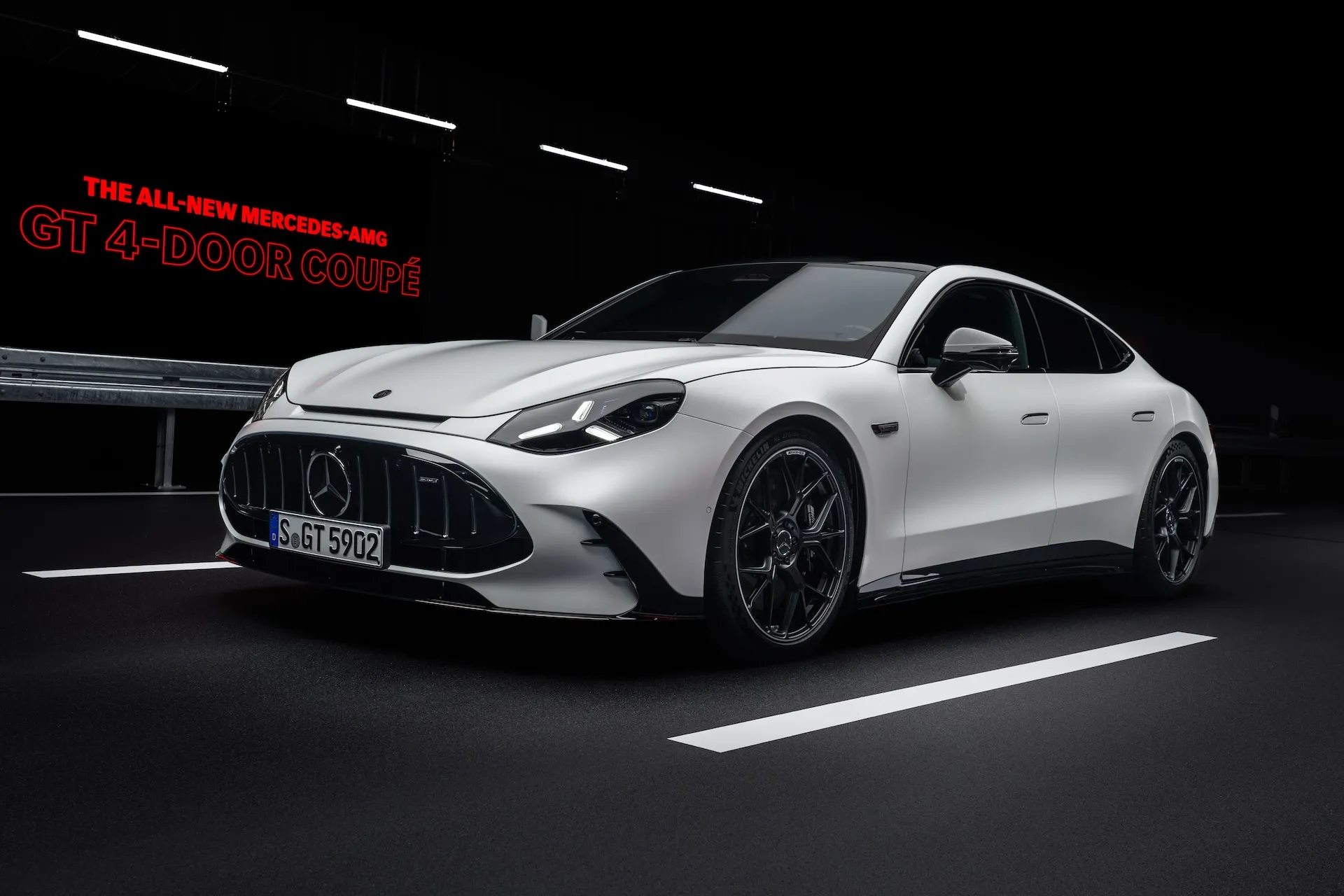
The new Mercedes-AMG GT 4-Door Coupé delivers up to 860 kW (1,169 hp) from three axial flux motors and recharges more than 460 kilometres (286 miles) of WLTP range in ten minutes at 600 kW. The all-electric four-door sports car is the first production application of AMG’s new high-performance EA architecture, and the company says order books open in the coming days for two variants — the GT 63 4-Door Coupé and the GT 55 4-Door Coupé. WLTP range is rated at 596 to 700 kilometres (370 to 435 miles) depending on configuration; EPA figures for the U.S. market have not yet been published.
Highlights
- Tri-motor axial flux drivetrain produces 860 kW (1,169 hp) in the GT 63 and 600 kW (816 hp) in the GT 55, with 2,000 Nm and 1,800 Nm of torque respectively
- 800-volt architecture supports peak DC charging above 600 kW; a 10 to 80 percent charge takes 11 minutes
- GT 63 sprints from 0–100 km/h in 2.1 seconds with one-foot rollout, 2.4 seconds without; top speed 300 km/h with the optional Driver’s Package
- 106 kWh net battery uses 2,660 directly oil-cooled cylindrical NCMA cells with an energy density above 298 Wh/kg
A first for production axial flux motors
The GT 4-Door Coupé is the first series-production electric vehicle to use axial flux motor technology, a design Mercedes-AMG says delivers higher continuous power and torque than conventional radial designs and allows demanding driving performances to be reproduced in close succession. The motors trace back to British specialist YASA, a Mercedes-Benz AG subsidiary since July 2021.
In an axial flux motor, the electromagnetic flux runs parallel to the axis of rotation, with the rotor and stator arranged as thin discs in an H-configuration. The packaging benefit is dramatic: each rear-axle motor measures around eight centimetres wide, and the front motor is just under nine centimetres. Two motors sit on the rear axle in a shared High-Performance Electric Drive Unit (HP.EDU) with a single-stage planetary gearbox and twin silicon-carbide inverters. The front HP.EDU houses one motor acting as a booster, with a Disconnect Unit that decouples it within milliseconds during steady-state cruising to reduce drag losses.
Rear motors spin to more than 13,000 rpm at top speed; the front motor reaches more than 15,000 rpm. AMG notes that the AMG.EA architecture is designed for outputs above 1,000 kW, leaving headroom for future variants.
Formula 1-derived battery
The high-voltage battery is what AMG calls the “AMG High Performance Electric Battery” (HP.EB), developed jointly with Mercedes-AMG High Performance Powertrains in Brixworth, England — the same operation that builds the brand’s Formula 1 powertrains. The 800-volt pack uses 2,660 cylindrical cells measuring 105 mm tall and 26 mm in diameter, grouped into 18 laser-welded plastic modules with a directly cooled architecture.
The cells use a laser-welded aluminium housing rather than steel, a full-tab design connecting cell windings across the full pole surface to cut internal resistance, and an NCMA cathode chemistry paired with a silicon-containing anode. AMG reports cell-level energy density above 298 Wh/kg or 732 Wh/l. A non-conductive oil-based coolant flows around each individual cylindrical cell.
Net capacity is 106 kWh on both variants. AMG says the battery concept is designed to enable WLTP ranges of well above 700 kilometres (435 miles) in future applications.
Charging that targets the next-generation infrastructure
At a 600 kW DC fast charger — Alpitronic’s new unit is named as a reference — the GT 4-Door Coupé draws more than 800 amperes and recovers around 460 kilometres (286 miles) of WLTP range in ten minutes, or 70 kWh of energy. A 10 to 80 percent state-of-charge top-up takes 11 minutes. The system can also switch from 800 to 400 volts to accept slower charging when needed, and the vehicle is configured for CCS2, CCS1, GB/T, CHAdeMO, and NACS depending on market.
The cooling system supporting all of this includes a Central Coolant Hub transferred from the CONCEPT AMG GT XX, which last year covered 40,075 kilometres in just under eight days at Italy’s Nardò test track and broke 25 long-distance records. Total battery cooling capacity is at least 20 kW, which AMG contrasts with the 5 to 8 kW typical of conventional battery systems.
V8 character without a V8
To preserve the sensory character its customer base expects, AMG has built a patent-pending sound and haptic package called AMGFORCE S+. The system simulates traction interruption during gear changes, reconfigures the driver display in a central-tube design, and reproduces AMG V8 acoustics using a real-time mixer drawing on more than 1,600 sound samples derived from the GT R. The cabin sound profile can be adjusted via a Sound Slider with Powerful, Balanced, and Minimal levels combined with a Classic-to-Futuristic tonal scale.
A pull on both steering-wheel paddles in Comfort, Sport, or Sport+ unlocks a boost — up to 110 kW additional power in the GT 63, up to 50 kW in the GT 55 — with tightened seatbelts and a perceptible acceleration jolt.
Dynamics, chassis, and brakes
The vehicle uses what AMG calls the AMG RACE ENGINEER, splitting drive and dynamics control between a central computing chip (RACE ENGINEER Core) and three centre-console rotary dials (RACE ENGINEER Control Unit) governing response, agility, and traction. Traction control is adjustable across nine stages with ESP off in Race, S+, and S modes.
Standard equipment includes AMG ACTIVE RIDE CONTROL air suspension with semi-active hydraulic roll stabilisation in place of conventional anti-roll bars, an 8.2-litre pressure reservoir for rapid height adjustment, and active rear-axle steering with up to 6 degrees of angle change. Below 80 km/h the rear wheels steer opposite the fronts; above that threshold they steer in the same direction.
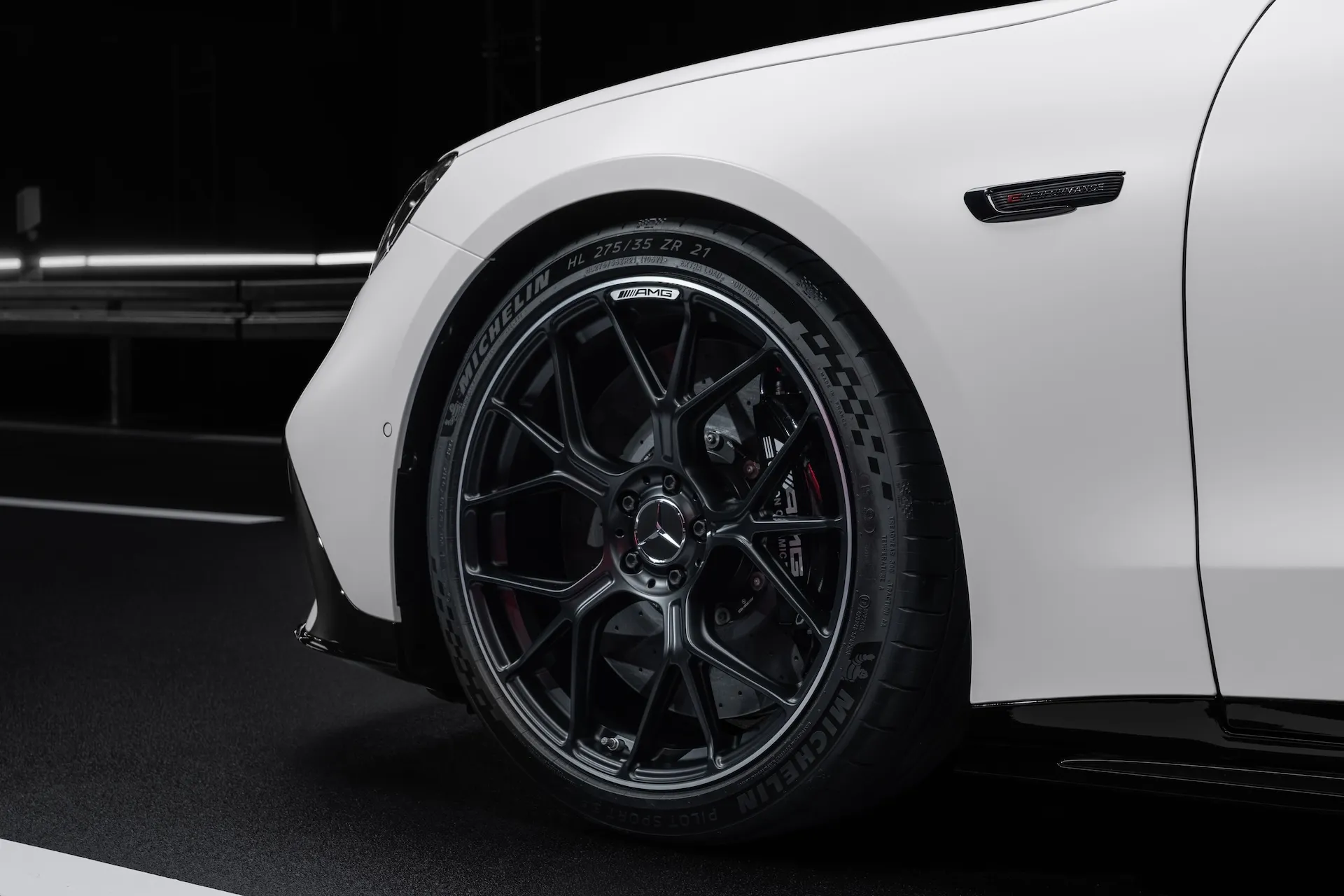
The braking package is a hydraulic composite system pairing carbon-ceramic discs on the front axle with steel discs on the rear, blended with recuperation through what AMG describes as a consistent pedal feel.
Seven AMG DYNAMIC SELECT drive programmes are offered — Comfort, Sport, AMGFORCE Sport+, RACE, Slippery, Individual, and (for the first time at AMG) Eco.
Aerodynamics and design
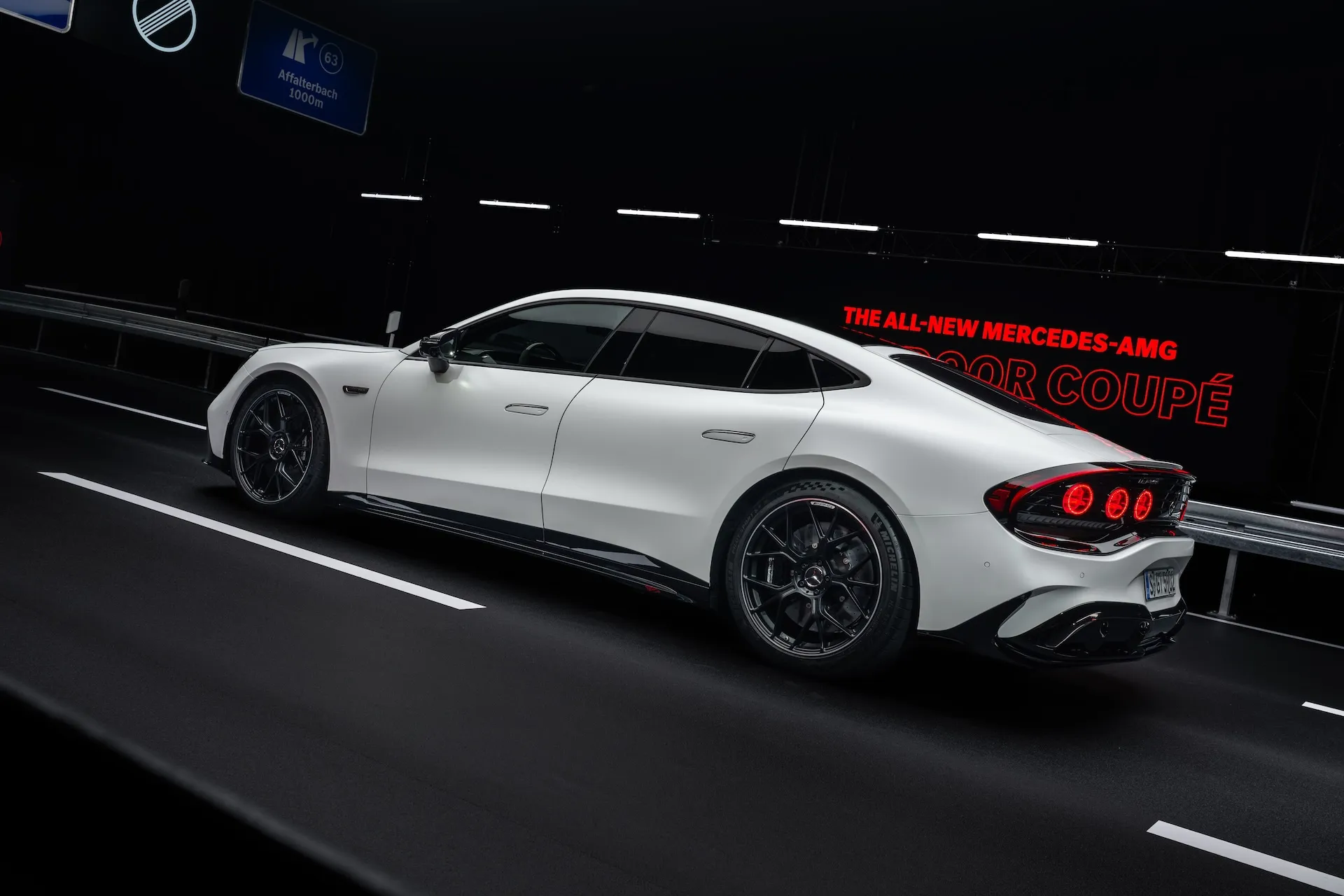
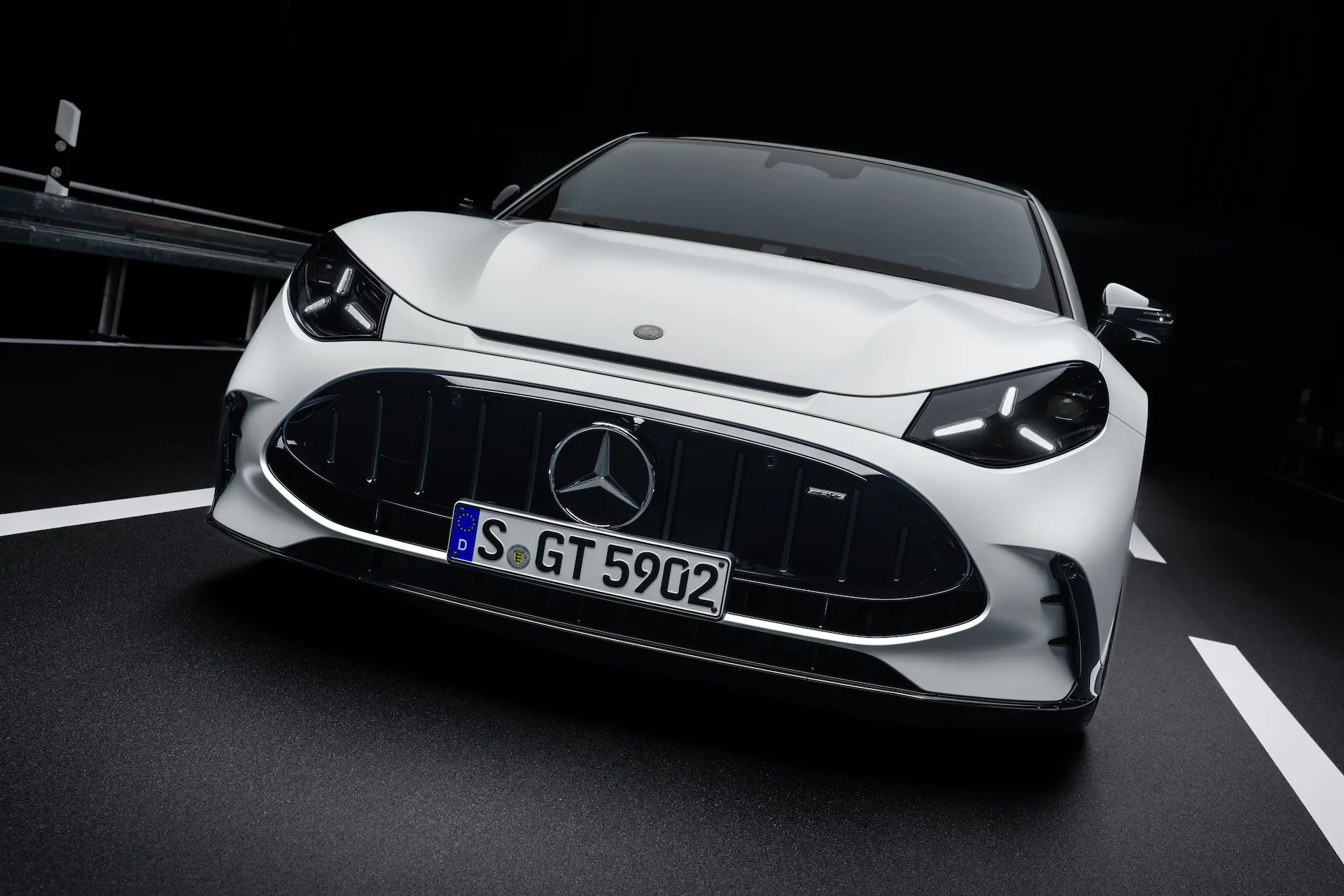
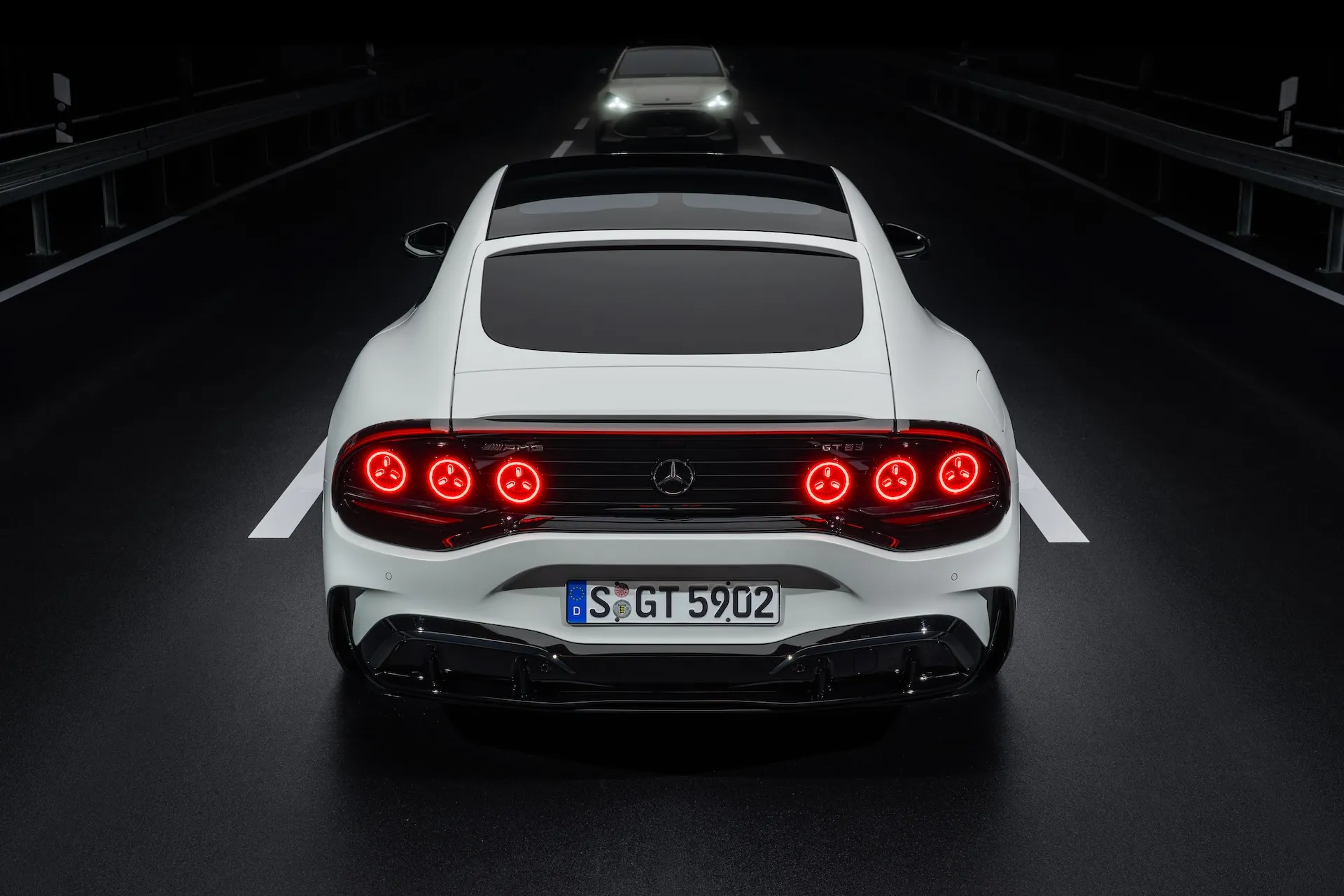
The new AEROKINETICS package includes two active venturi flow plates in the underbody, the active rear diffuser, an extendable rear spoiler, and Airpanel louvres in the front grille operating across nine stages. The front venturi element deploys from 120 km/h, the centre element from 140 km/h, and the rear spoiler operates from 80 km/h. The drag coefficient is 0.22.
Aerodynamic 21-inch wheel designs add up to 14 kilometres of WLTP range, with up to 30 kilometres possible when paired with aero-optimised tyres. The body is 4 cm lower than the outgoing model despite the underfloor battery, and overall dimensions are 5,094 mm long, 1,959 mm wide, and 1,411 mm tall on a 3,040 mm wheelbase. Kerb weight is 2,460 kg.
The interior pairs a 10.2-inch instrument cluster with a 14.0-inch central display and an optional 14.0-inch passenger display, all running the new MB.OS operating system. The MBUX voice assistant integrates ChatGPT, Microsoft Bing, and Google Gemini.
Production timeline
Series production begins at the Mercedes-Benz Sindelfingen plant in summer 2026, with the axial flux motors built at the Berlin-Marienfelde powertrain plant. AMG says motor production at Marienfelde uses around 100 processes, 65 of which are new for the company and 35 of which are world firsts, with the work generating more than 30 patent applications.
Pricing has not been disclosed. The company says it will be based on comparable predecessor vehicles.
Sign up for our popular weekly email to catch all the latest EV news!