
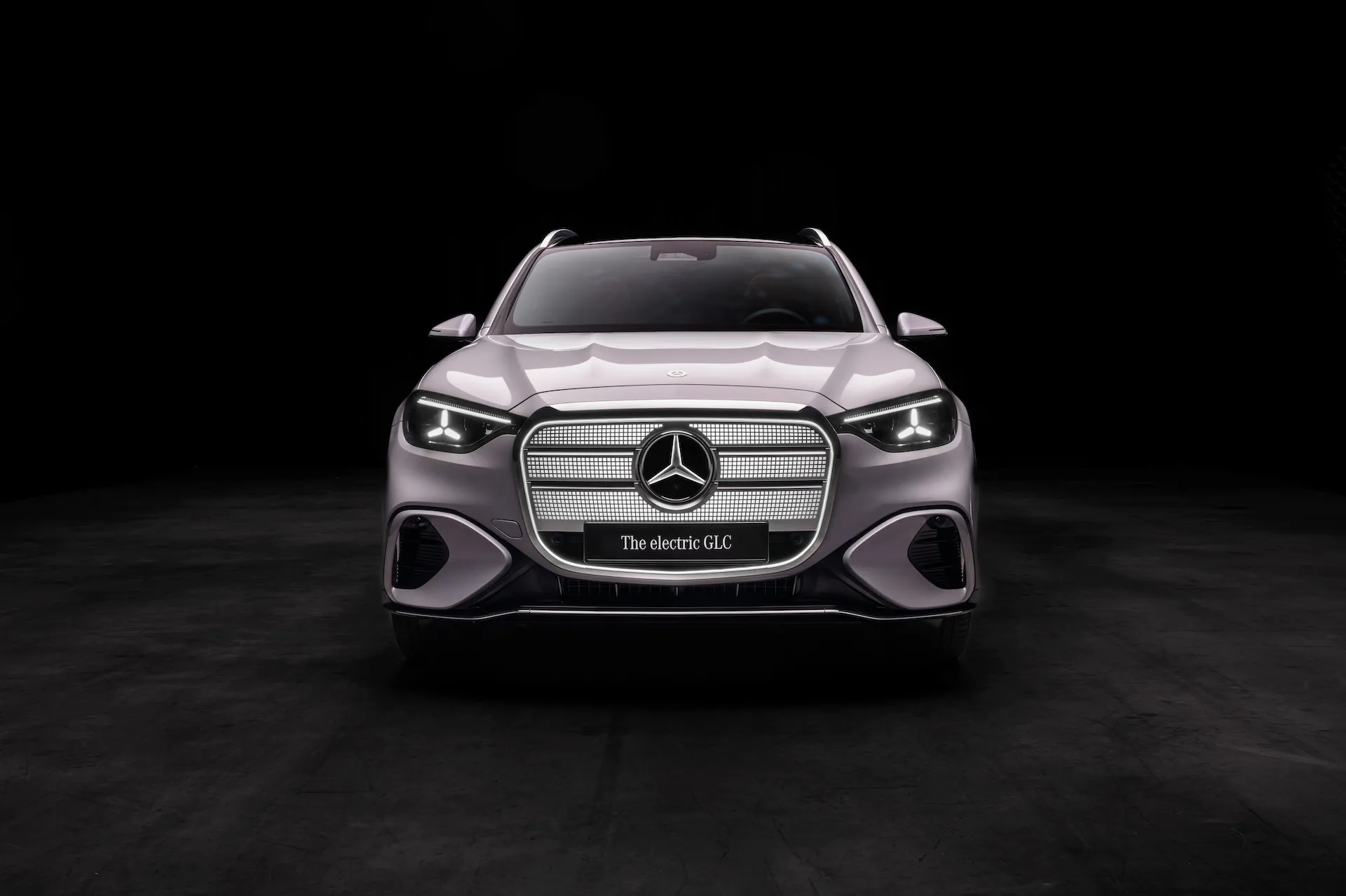
The GLC 400 4MATIC Electric, the launch model of the all-new electric Mercedes-Benz GLC, produces 483 hp and offers up to 350 miles of range on the EPA cycle, according to Mercedes-Benz USA. The figures appear in updated U.S. press information for the all-new electric GLC issued this week, the first to state the SUV’s specifications in EPA and U.S. customary units. Earlier range figures for the model were quoted on the European WLTP cycle, which is not directly comparable with EPA testing. The SUV rides on an 800-volt architecture with a 94-kWh usable battery and DC fast charging the company rates at up to 330 kW.
Highlights
- GLC 400 4MATIC Electric: 483 hp, up to 350 miles of EPA range and a 94-kWh usable lithium-ion battery, per Mercedes-Benz
- Charging: 800-volt system with DC fast charging up to 330 kW; a standard DC converter handles 400-volt stations
- Braking: new One-Box system with recuperation up to 300 kW; the company says hydraulic wheel brakes are unused in over 99 percent of braking events
- Packaging: 117-inch wheelbase, 3.3 inches longer than the combustion GLC, with 20.1 cu-ft of trunk space, 61.4 cu-ft seats-down and a 4.5 cu-ft frunk
Powertrain and Battery
The rear electric drive unit pairs a permanently excited synchronous motor with a two-speed transmission. First gear carries an 11:1 ratio for acceleration, towing and city efficiency; second gear (5:1) handles highway cruising and the electronically limited 130-mph top speed. Mercedes-Benz says it developed the rear unit entirely in-house and reports 93 percent battery-to-wheel efficiency over long distances.
A front drive unit engages through a disconnect unit that couples or decouples almost instantly as conditions change. Both drive units use silicon carbide inverters.
The 94-kWh battery uses anodes that blend silicon oxide with graphite, with cell-level volumetric energy density of 680 Wh/l and reduced cobalt content. The electronics unit is replaceable from below and the cover is bolted rather than glued for serviceability. The pack architecture debuted on the electric CLA, and Mercedes-Benz says CLA and GLC packs share a production line.
How Fast Does the Electric GLC Charge?
DC fast charging peaks at 330 kW on the 800-volt system, according to Mercedes-Benz, and a DC converter is fitted standard for 400-volt stations. Standard MBUX Navigation with Electric Intelligence plans charging stops, accounts for topography and weather, and preconditions the battery ahead of each DC stop.
The standard MB.CHARGE Public service can reserve a charger in advance at select Mercedes-Benz charging hubs; with route guidance active, the vehicle makes the reservation automatically 15 minutes before arrival. The function is currently limited to select Mercedes-Benz stations in Germany and the U.S., and the company says it is free initially but may become chargeable. Authentication runs through the Mercedes-Benz app, an RFID card or Plug & Charge, with expected session cost shown before charging begins.
One-Box Braking and Recuperation
The GLC introduces a One-Box brake system that combines the previously separate brake booster, master cylinder and ESP control components in a single module. For each brake application it calculates maximum recuperation and minimum friction-brake use; Mercedes-Benz says the hydraulic wheel brakes are not required in over 99 percent of braking events.
Recuperation reaches up to 300 kW. Drivers choose from four settings: D- (maximum), D (standard), D+ (none) and D Auto (intelligent). Brake-pedal recuperation is always active, and D- enables one-pedal driving.
Chassis: AIRMATIC and Rear-Axle Steering
The optional Agility & Comfort Package adds AIRMATIC air suspension with adaptive damping and rear-axle steering. Below 37 mph, the rear wheels turn up to 4.5 degrees opposite the fronts, cutting the turning circle by three feet, according to the company; above 37 mph, they turn up to 2.5 degrees in phase for stability in lane changes and evasive maneuvers.
A Car-to-X function, for which Mercedes-Benz has applied for a patent, uses anonymized data from Mercedes-Benz vehicles ahead to adjust damping before the body reaches its bump stops. Ride-height control uses Google Maps data to hold the lowest setting on highways rather than raising the vehicle whenever speed drops. A Terrain drive program permanently engages the front axle on dirt and gravel.
Cabin Space and Cargo
The 117-inch wheelbase is 3.3 inches longer than the combustion-powered GLC SUV. Mercedes-Benz reports 0.5 inches more front legroom and 1.8 inches more front headroom, with 1.9 inches more legroom and 0.6 inches more headroom in the rear. The trunk holds 20.1 cu-ft, expanding to 61.4 cu-ft with the 40:20:40 rear seatbacks folded electrically, and the trunk floor drops 3.1 inches for taller items. The frunk adds 4.5 cu-ft.
With the optional trailer hitch, Trailer Maneuvering Assist steers automatically when reversing at up to 4 mph on grades up to 15 percent, and navigation factors trailer energy demand into charging-stop planning.
MB.OS, MBUX and Driver Assistance
MB.OS runs on chips Mercedes-Benz rates at 254 trillion operations per second and enables over-the-air updates of the entire vehicle software. Display options are:
- MBUX Hyperscreen (optional): 39.1-inch continuous screen with matrix backlighting from more than 1,000 LEDs; Mercedes-Benz has filed a patent on the zone-dimming design
- MBUX Superscreen (Exclusive and Pinnacle Trims): 10.25-inch driver display, 14-inch central display and 14-inch passenger display under one glass surface
- Standard configuration: digital trim element in place of the passenger display
The fourth-generation MBUX integrates AI from ChatGPT, Microsoft and Google, which the company describes as a first for in-car infotainment, and navigation runs on Google Maps with Google Cloud’s Automotive AI Agent. MB.DRIVE draws on up to ten external cameras, five radar sensors and twelve ultrasonic sensors. Optional DIGITAL LIGHT with micro-LED technology is 50 percent more efficient than its predecessor, according to Mercedes-Benz, and Adaptive Highbeam Assist Plus reaches the U.S. GLC for the first time. A center airbag and PRE-SAFE are standard, with up to eleven airbags fitted.
Production at Bremen
The electric GLC is assembled in Hall 9 at the Bremen plant on the same line as combustion models, with drive units from Sebes, Romania, electric axles from Hamburg and batteries from Kamenz. Vehicles in this segment will also be built in Kecskemet, Hungary, and at Beijing Benz Automotive in China. Mercedes-Benz says the plant runs on 100 percent green electricity, that production is net carbon-neutral (unavoidable emissions offset through certified projects), and that the vehicle’s lifecycle carbon footprint is two-thirds lower than the current combustion GLC.
Ola Källenius, Chairman of the Board of Management of Mercedes-Benz Group AG, said: “The biggest product launch program in our company’s history continues with the all-new GLC. We’re not just introducing a new model – we’re electrifying our top seller. It will feature a bold new design language, cutting-edge technology, our MB.OS operating system and performance that sparks excitement. The all-new GLC is comfort, dynamics, efficiency and intelligence in perfect harmony.”