
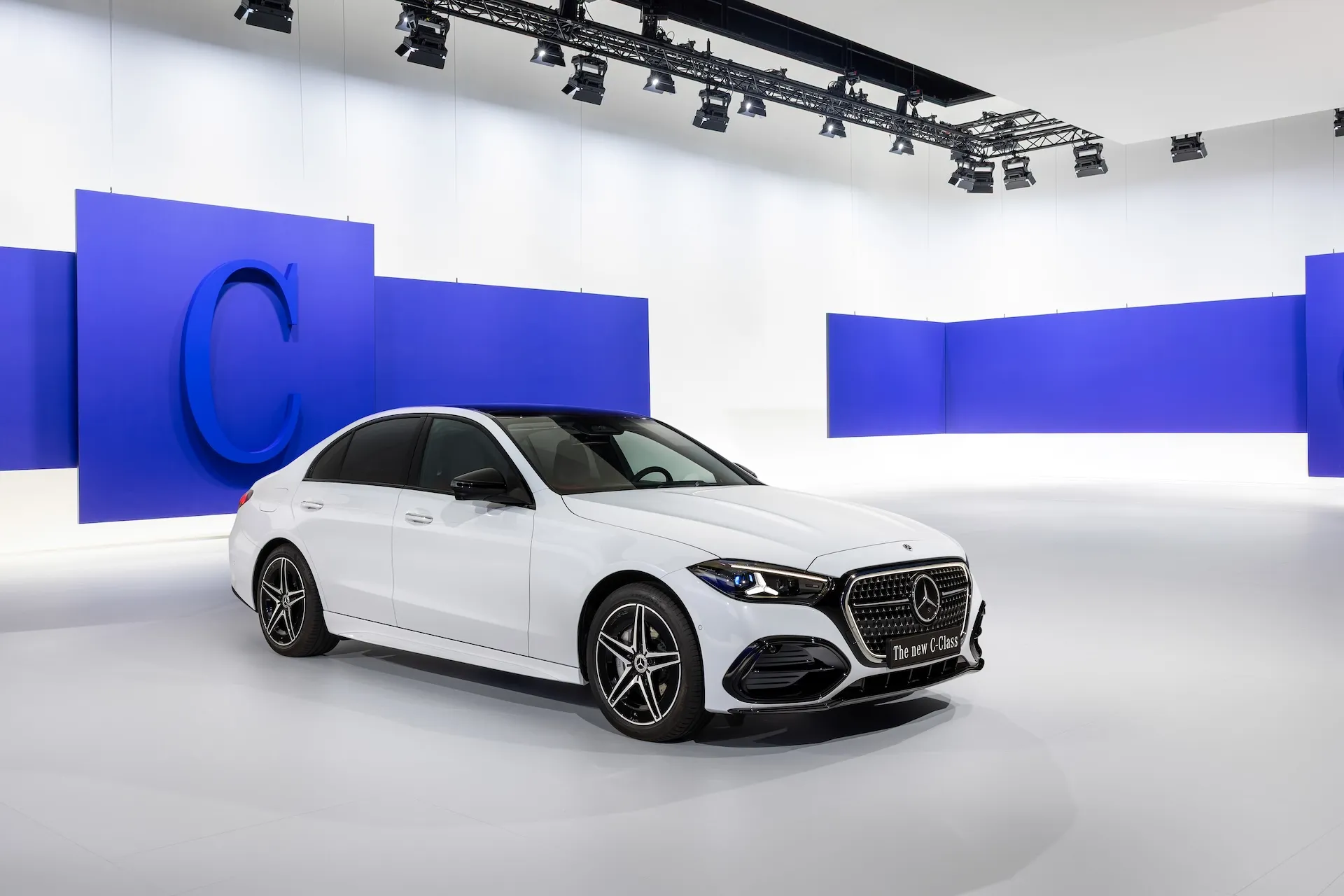
Mercedes-Benz opens orders for the new C-Class sedan and wagon on August 18, 2026, with plug-in hybrid variants the company rates at up to 62 miles (100 km) of electric range under WLTP. The updated range pairs a further-developed 2.0-liter four-cylinder gasoline engine with a 100 kW electric motor and a lithium-ion battery holding 19.53 kWh of usable energy. German pricing starts at €41,045 excluding VAT (about $47,500) for the C 200 sedan. UK ordering opens the same day from £46,995 on the road (about $63,700), with market-specific specifications due on the Mercedes-Benz UK website.
Highlights
- Plug-in hybrid range: up to 62 miles (100 km) WLTP from a 19.53 kWh usable battery, with charging at up to 11 kW AC and 55 kW DC
- Top system output: the C 400 e 4MATIC is rated at up to 290 kW (395 hp) and 479 lb-ft (650 Nm), reaching 62 mph (100 km/h) in 5.3 seconds
- 48-volt mild hybrid across the range: a second-generation integrated starter-generator adds 17 kW and 151 lb-ft (205 Nm) on every gasoline and diesel variant
- Ordering and price: orders open August 18, 2026, from €41,045 excluding VAT / €48,844 including VAT (about $47,500 / $56,500)
What Do the C-Class Plug-In Hybrids Deliver?
The plug-in hybrid models combine the revised four-cylinder gasoline engine with an electric motor and are offered with rear-wheel drive and all-wheel drive. Mercedes-Benz says the electric motor produces 100 kW and 325 lb-ft (440 Nm), with full torque available from low speeds. The fourth-generation NAG3 transmission integrates both the motor and the inverter into the transmission housing.
The company reports the 19.53 kWh usable battery supports up to 62 miles (100 km) of electric running, and that thermal management holds performance in winter conditions. Charging runs at up to 11 kW on AC sources such as a home wallbox and up to 55 kW at public DC fast chargers — a notable figure for a plug-in hybrid, and one that widens the case for opportunity charging on longer trips.
Sedan plug-in hybrid variants, per the manufacturer’s technical data:
| Model | Engine output | Electric motor (peak) | 0–62 mph | Price incl. VAT |
|---|---|---|---|---|
| C 300 e | 160 kW (218 hp) | 100 kW / 325 lb-ft (440 Nm) | 5.9 s | €66,646 (~$77,100) |
| C 300 e 4MATIC | 160 kW (218 hp) | 100 kW / 325 lb-ft (440 Nm) | 6.1 s | €69,026 (~$79,900) |
| C 400 e 4MATIC | 190 kW (258 hp) | 100 kW / 325 lb-ft (440 Nm) | 5.3 s | €73,548 (~$85,100) |
Mild Hybrids Cover the Gasoline and Diesel Engines
Every gasoline and diesel engine carries a second-generation integrated starter-generator (ISG 2.0) rated at 17 kW with up to 151 lb-ft (205 Nm) of additional torque, packaged inside the 9G-TRONIC automatic transmission housing. The 48-volt mild hybrid system enables coasting with the powertrain disengaged and energy recuperation, which Mercedes-Benz says produces meaningful fuel savings.
The M254 EVO gasoline unit uses a Miller-cycle combustion process, a 12:1 compression ratio and 350-bar direct injection, and operates at lambda 1 across the entire engine-speed range to meet Euro 7 limits. An electric auxiliary compressor drawing on the 48-volt system covers turbocharger lag at low engine speeds. Output levels:
- C 200 — 130 kW (177 hp)
- C 250 — 160 kW (218 hp)
- C 300 — 190 kW (258 hp), with a repeatable overboost function adding 20 kW (27 hp) for about 20 seconds; Mercedes-Benz puts total system output at 225 kW including the ISG contribution
- C 200 d / C 250 d — 120 kW (163 hp) and 147 kW (200 hp), with 2,200-bar common-rail injection and compatibility with HVO100, B10 and B20 fuels
How the Update Follows the Electric C-Class
The combustion and plug-in hybrid range arrives shortly after the European market launch of the all-electric C-Class, a separate model on a dedicated EV architecture. Mercedes-Benz has sold more than twelve million C-Class vehicles since the line was introduced in 1982.
“The new C-Class proves that continuity and innovation are not mutually exclusive. With its sporty elegance, electrified high-tech powertrains and intelligent support powered by MB.OS, it delivers what drivers truly need: proven reliability and innovative technology that creates real added value in everyday life. In this way, a familiar classic becomes a modern companion,” said Mathias Geisen, Member of the Board of Management of Mercedes-Benz Group AG, Sales & Customer Experience.
Software, Sensors and Chassis Changes
MB.OS operates as a chip-to-cloud platform handling over-the-air updates across vehicle software, including driver assistance functions. Each car carries up to 10 exterior cameras, five radar sensors and 12 ultrasonic sensors feeding a water-cooled control unit the company rates at up to 254 trillion operations per second. MB.DRIVE ASSIST PLUS can slow the vehicle at stop signs and red lights, while MB.DRIVE ASSIST PRO, which Mercedes-Benz describes as a point-to-point system for dense urban traffic, launches first in China.
Rear-axle steering remains available, with up to 2.5 degrees of steering angle cutting the turning circle by 17 inches (43 cm) to 34.9 feet (10.64 m). The wagon carries 17.3 to 53.3 cubic feet (490 to 1,510 liters) of load space with the 40:20:40 rear seats folded; plug-in hybrid wagons are listed at 12.7 to 48.6 cubic feet (360 to 1,375 liters).