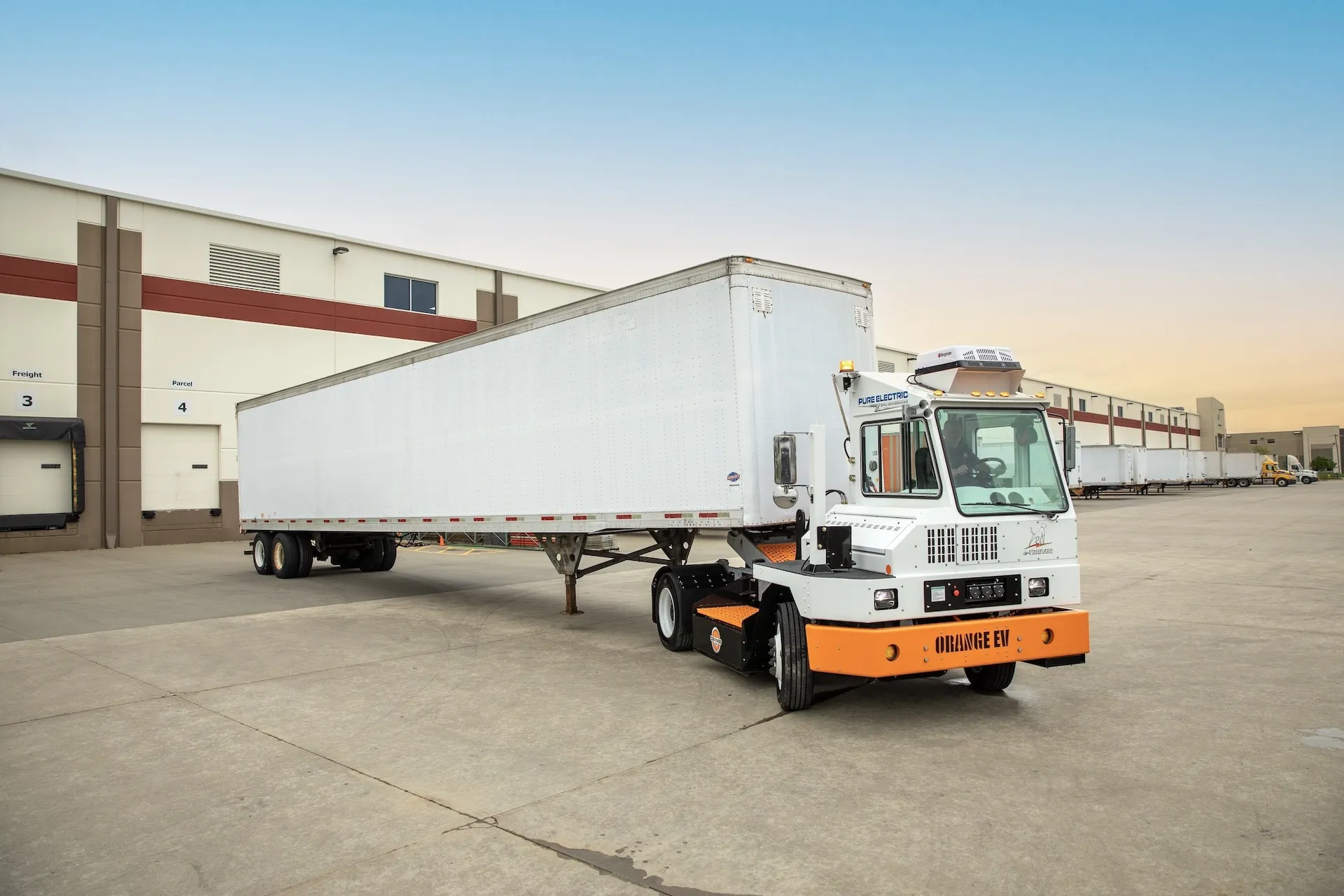

Orange EV has received an order for 600 electric terminal trucks, the largest single order in the company’s history. The Kansas City–based manufacturer also reported record overall order volume, framing the deal as a shift from pilot testing toward fleet-scale standardization across logistics networks. Deployment of the 600 trucks is already underway, with full delivery expected this year, according to Orange EV.
Highlights
- The single 600-truck order is the largest in Orange EV’s history, with deployment underway and full delivery expected within the year.
- The company reports a 272% increase in leasing deals over the past 12 months.
- The deployed fleet has logged 33.8 million operational miles, with many trucks passing 30,000 hours of use on their original battery packs.
- Orange EV expects to capture more than 25% of all new terminal truck orders and deliveries by year end.
A Market Moving Past Early Adoption
Orange EV created the electric terminal truck category more than a decade ago, and more than 1,900 of its trucks are now in service, including a first deployment with DHL in 2015. The company says large organizations with complex supply chains are now scaling fleets after successful trials, with several early adopters expanding from limited tests to more than 100 trucks each.
“We have left the early adopter stage of yard electrification,” said Kurt Neutgens, Co-Founder, President, and CTO of Orange EV. “We’re seeing companies invest in hundreds of trucks because total cost of ownership superiority has been proven, including uptime, reliability, fuel savings, and service guarantees.”
The company also reports a 272% increase in leasing deals over the past 12 months, a financing route it says lets operators standardize on electric trucks without large upfront capital.

Total Cost of Ownership and Service
Orange EV ties the order growth to operating economics. Neutgens said the company’s tractors “can save half a million dollars in Total Cost of Ownership over a diesel” across 10 years, before any incentives. The order is backed by uptime guarantees and extended warranties, supported by a factory-backed service model staffed by Orange EV–trained technicians offering on-site response and same-day support for most maintenance.
“Our largest customers are now standardizing around the Orange EV solution,” Neutgens said.
The company said it expanded its service coverage in 2026 to add multi-shift and weekend support for what Neutgens called “mission-critical environments.”
Charging Without Grid Upgrades
A new enhanced CCS1 option, branded e-CCS1, is now available on all Orange EV trucks, giving them compatibility with CCS1 charging standards and third-party infrastructure. For sites where aging electrical grids cannot support added demand, the company offers the Orange Juicer, a battery-integrated DC fast charger.
“The Orange Juicer trickle charges its internal battery reservoir from the grid, with the capability to dispense high capacity 200kW fast charging on demand,” Neutgens said. “It removes the final barriers to electrification by using existing infrastructure, while also helping yard operators avoid peak usage fees.”
According to the company, the system can shorten deployment timelines from months or years to days by reducing or eliminating permitting and infrastructure upgrades.
Production Capacity and Fleet Record
Orange EV’s Kansas City facility is designed to build 2,400 trucks per year on a single shift, leaving room to produce more than 1,000 trucks beyond current orders, with additional capacity available by adding shifts. Across distribution centers, ports, manufacturing plants, and agricultural sites, the deployed fleet’s operational track record now spans 33.8 million miles, with many trucks surpassing 30,000 hours of use on original battery packs.
“The question for many operators is no longer can Orange EV electric yard trucks do the job,” Neutgens said. “Now, the question is how quickly sites can deploy them.”
Sign up for our popular weekly email to catch all the latest EV news!