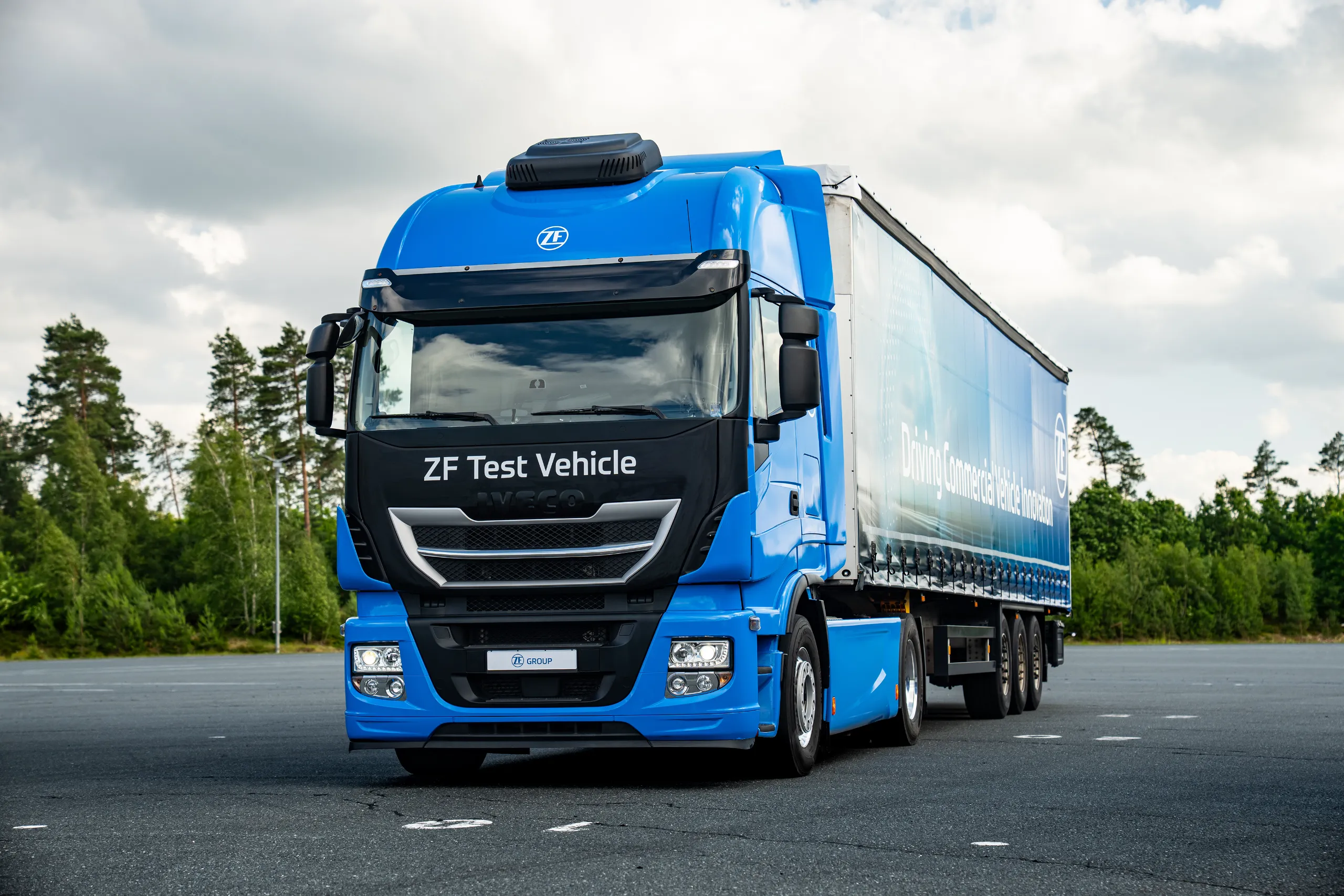

ZF demonstrated its TraXon 2 Hybrid transmission for heavy-duty trucks, a system the company says can cut CO2 by up to 47% in long-haul operation while preserving the range and performance of conventional drivelines. The hybridized automated manual transmission was run through live operating modes this week at ZF’s CV Tech Day 2026, a pre-IAA event at its test track near Hanover. Built on the production TraXon 2 platform, it is designed for both full-hybrid and plug-in hybrid architectures using a P2 layout.
Highlights
- CO2 reduction: ZF states up to 47% CO2 savings in long-haul operation, achieved without forcing a full switch to battery-electric power.
- Power and electronics: The system delivers up to 190 kW of continuous power and is operated by a 600–800V silicon-carbide (SiC) inverter.
- Platform reuse: It builds on the production TraXon 2 automated manual transmission, enabling hybridization of existing platforms with minimal vehicle changes.
- Operating modes: A P2 layout supports full-hybrid and plug-in hybrid driving, with electric pull-away, partial electric assistance (e-boost), energy recuperation, and conventional mechanical operation.
A Bridge Technology for Heavy-Duty Decarbonization
Heavy-duty transport must reduce CO2 while maintaining range, performance, and operational flexibility, and ZF argues that full electrification is not always feasible over the next decade because of cost, infrastructure, and duty-cycle constraints. The company positions TraXon 2 Hybrid as a scalable, economical bridge that connects conventional and electric drivetrains and fits existing platforms across diverse applications. It supports Euro 7 compliance through optimized engine operation and recuperation, and ZF says it can provide access to zero-emission zones depending on the hybrid concept and application.
What the Demonstration Showed
The live demonstration ran the transmission through four operating modes. An electric start aid launches the vehicle electrically to cut local emissions and improve start-stop efficiency. Partial electric assistance, or e-boost, adds electric torque during driving to reduce engine load. Energy recuperation recovers energy while driving, and a conventional mechanical mode covers scenarios that require long-range capability.
How TraXon 2 Hybrid Fits ZF’s Electrification Range
ZF frames the transmission as one element of a flexible electrification path that also includes modular electric drivelines — central drives such as the CeTrax 2 central drive and CeTrax 2 dual, plus electric axles including AxTrax 2, AxTrax 2 dual, and AxTrax 2 LF. The concept builds on the proven TraXon 2 design and ZF’s transmission and e-mobility expertise. ZF has previously reported results from real-world fleet testing of the system on European routes.
“We believe the hybrid powertrain will become an important technology for commercial transport. In applications with high daily mileage, the classic long-haul truck needs a pragmatic and charging infrastructure-independent solution. The hybrid powertrain will enable OEMs and fleets to achieve their CO2 reduction targets, while also delivering a strong economic business case in terms of cost-effectiveness,” said Christian Feldhaus, Vice President, Product Segment Transmissions & Hybrids at ZF.
Matthias Holzer, Global Head of Strategy for the same product segment, added: “Experiencing the hybrid system in real driving conditions is key. It allows stakeholders to understand the technology beyond specifications – and to see its real impact in operation.”
ZF presented the transmission on a technology demonstrator and said it will preview the technology at IAA Transportation 2026 in Hannover, September 15–20, 2026.
Sign up for our popular weekly email to catch all the latest EV news!