
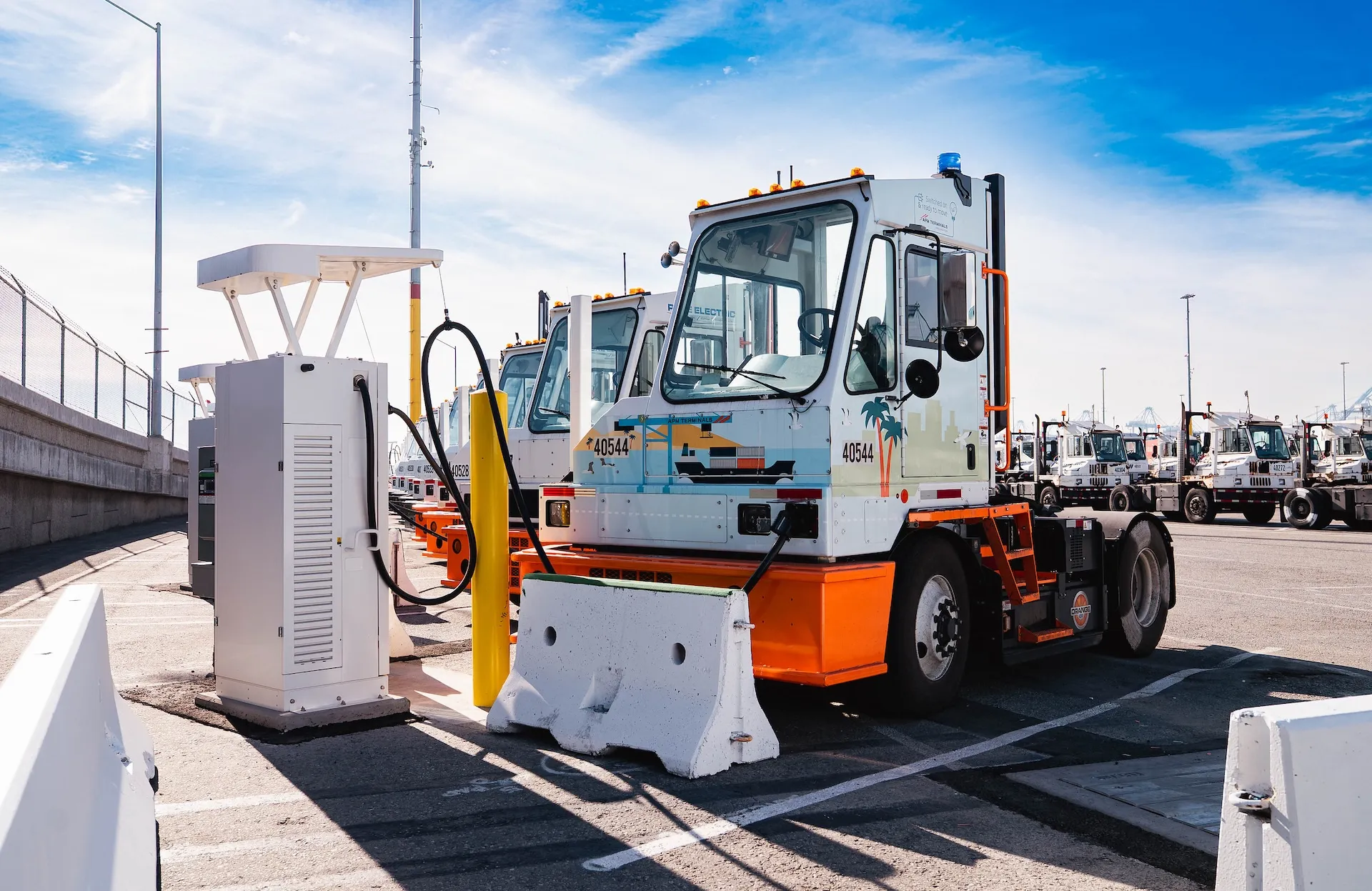
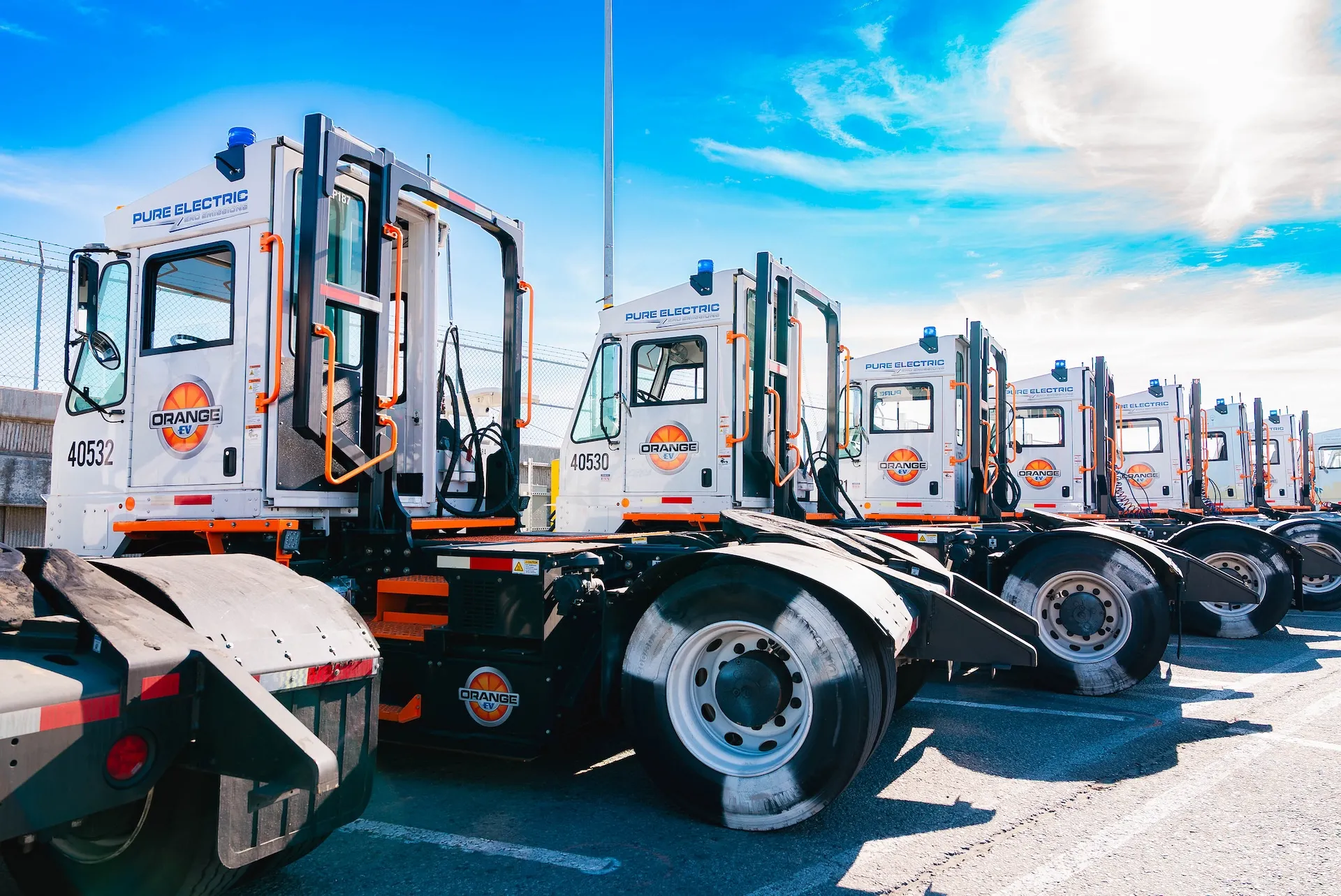
APM Terminals Los Angeles will add 40 battery-electric terminal tractors to its Pier 400 operation under a new contract with Orange EV, raising the terminal’s electric tractor count to 60 units. The order builds on an existing fleet relationship and, according to the companies, completes the electrification of the terminal’s on-dock rail drayage fleet — the first container terminal in the Port of Los Angeles to reach that milestone. The new units are Orange EV HUSK-e XP models, purpose-built for heavy port and terminal work and powered by the largest battery pack in the company’s lineup.
Highlights
- Forty new Orange EV HUSK-e XP battery-electric terminal tractors are on order, raising Pier 400’s electric tractor count to 60 units.
- The terminal’s first 20 Orange EV tractors have logged 42,000 operating hours at a 98.8% average uptime rate since April 2025, according to the company.
- Each HUSK-e XP runs on a 310 kWh lithium iron phosphate battery and can move up to 180,000 lbs of combined weight.
- The purchase falls under APM Terminals’ $80 million sub-recipient contract through the EPA Clean Ports Program.
Performance Data Behind the Expansion
APM Terminals first deployed 20 Orange EV terminal tractors at Pier 400 beginning in April 2025. The company says the manually operated fleet has since accumulated 42,000 zero-tailpipe-emission operating hours at an average uptime rate of 98.8%, displaced more than 40,700 diesel-equivalent gallons, and avoided an estimated 427 metric tons of CO₂.
“This procurement is grounded in 12 months of real-world performance data,” said Jon Poelma, Managing Director of APM Terminals Los Angeles. “Our operators ran these trucks hard, and the results earned this expansion. Their performance feedback drove the standard we required, and our lead mechanics are trained and ready to keep this fleet running at the highest level.”
According to the Port of Los Angeles Air Emissions Inventory, Pier 400 has cut emissions from its owned container handling equipment fleet since 2017 by 82 percent for nitrogen oxides, 61 percent for diesel particulate matter, 56 percent for sulfur oxides, and 59 percent for greenhouse gases.
Fleet Conversion and Charging
With 60 electric terminal tractors expected in operation by January 2027, Pier 400 will have converted roughly 60 percent of its 101-unit terminal tractor fleet to battery-electric — what the company describes as the highest conversion rate among container terminals at the Port of Los Angeles. An additional grant application for 30 more electric units is in progress.
The terminal currently operates 51 chargers, and the company says existing infrastructure can support the initial deployment of the 40 new units. To serve the expanded fleet, it plans to procure 20 additional dual-plug Level 3 fast-charging stations through a separate competitive request-for-proposal process anticipated in Q2 2026.
Workforce Training
Ahead of the new units entering service, a group of lead ILWU mechanics will complete a Level 2 electrical safety training course, building on foundational training completed by 21 Power Shop mechanics in 2025. Orange EV has also placed a HUSK-e XP unit at the ILWU mechanic training center to serve as a hands-on training asset.
About the HUSK-e XP
The HUSK-e XP is built at Orange EV’s production facility in Kansas City, Kansas, and the company says the units meet Build America, Buy America Act (BABA) requirements applicable to the EPA Clean Ports Program with no waivers required. Each truck is purpose-built for heavy port and terminal operations and can move up to 180,000 lbs of combined weight. The vehicles use a 310 kWh lithium iron phosphate (LFP) battery, the largest pack available in the Orange EV lineup. Orange EV reports more than 30 million miles and 12 million hours of operation across more than 40 states, Canada, and the Caribbean.
“In environments like APM Terminals, performance is measured in uptime, throughput, and reliability,” said Kurt Neutgens, Co-Founder, President, and CTO of Orange EV. “We’ve worked closely with the Pier 400 team even before the first units were deployed, and their operational feedback directly informed improvements to the HUSK-e XP. This expansion reflects both the strength of our partnership and a broader inflection point, where fleets are standardizing around Orange EV trucks to improve uptime and total cost of ownership.”
EPA Clean Ports Program Funding
The procurement is part of APM Terminals’ $80 million sub-recipient contract under the EPA Clean Ports Program, awarded through the Port of Los Angeles. The project scope covers replacement of 64 pieces of container handling equipment, including top handlers, forklifts, and cone carts. Funding is structured as 60 percent federal EPA Clean Ports Program grant dollars, 20 percent Port of Los Angeles contribution, and 20 percent APM Terminals capital investment. The terminal has also committed $40 million of its own capital to its broader Pier 400 electrification program.
“The EPA Clean Ports Program was designed to deliver cleaner air to port communities, and APM Terminals is demonstrating how that investment is meant to work,” said Port of Los Angeles Executive Director Gene Seroka. “Sixty human-operated, electric terminal tractors operating at Pier 400 means fewer diesel exhaust emissions for the workers and the communities neighboring the port. This is the Clean Ports Program achieving its purpose — real equipment, in operation, making a measurable difference.”
Sign up for our popular weekly email to catch all the latest EV news!