

Rivian is scaling its Adventure Network ahead of the first R2 customer deliveries this spring, with new NACS connectors, tap-to-pay terminals for non-Rivian drivers, and pre-built underground infrastructure designed to absorb rapid charger additions. The company outlined the buildout in a May 5 post on its Rivian Stories site, framing the expansion around the arrival of R2 owners and continued opening of the network to drivers of other EV brands. Rivian first opened the Adventure Network to non-Rivian vehicles in late 2024, beginning at the Joshua Tree Charging Outpost in California.
Highlights
- Network scale-up tied to first R2 customer deliveries arriving this spring, following start of production
- Newest chargers feature taller designs with longer cables and add NACS connectors alongside existing CCS1
- Tap-to-pay terminals added at sites for non-Rivian drivers, removing the app requirement
- Rivian reports 98% network uptime across 2025, an unverified manufacturer figure
NACS Rollout Reaches Most Sites
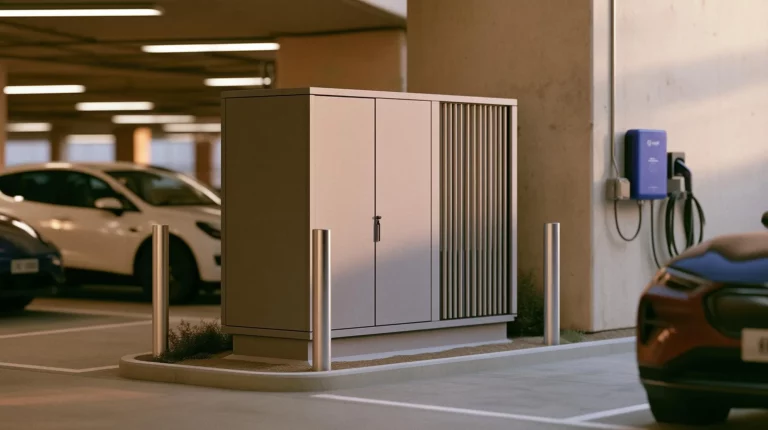
Nearly every Adventure Network location now accepts compatible non-Rivian EVs, and Rivian is in the process of adding NACS connectors at sites already equipped with CCS1. The newest hardware uses taller cabinets and longer cables, intended to reach charge ports across a wider range of vehicle layouts. Rivian began installing NACS hardware at flagship Charging Outposts including Joshua Tree, Yosemite, and the Hamptons in July 2025, with the rollout expected to continue across the broader site footprint.
The company has also added tap-to-pay terminals so non-Rivian drivers can initiate sessions without downloading the Rivian app. Rivian owners retain their existing authentication flow through the in-vehicle navigation system.
Underground Infrastructure Built for Faster Buildout
Rivian said the underground portion of most existing Adventure Network sites — conduits, transformers, and power capacity — has been provisioned ahead of demand. The company says this allows it to add chargers at established sites without the heavy civil construction that normally drives station expansion timelines and budgets.
That capital-efficiency framing matters as the R2 enters customer hands. Rivian confirmed start of production for the R2 in earlier 2026 communications, and customer reservations are being converted into deliveries over the coming weeks.
Reliability Claim and Industry Context
Rivian reports 98% uptime across the Adventure Network in 2025, a figure attributed to in-house ownership of hardware, software, and localized maintenance. The company has cited similar uptime numbers in prior years, though no independent third-party audit of network reliability has been published.
The Adventure Network operates inside a substantially larger U.S. DC fast-charging market. Citing the U.S. Department of Energy’s Alternative Fuels Data Center, Rivian noted nearly 15,000 Level 3 DC fast-charging locations with more than 70,000 individual charge ports were available across the country as of early 2026. For context, the most recent public Adventure Network footprint disclosed by the company stood at roughly 780 chargers across 123 sites in 37 states as of August 2025 — meaning RAN accounts for approximately 1% of U.S. DC fast-charging port capacity, with the bulk of national volume sitting at Tesla Supercharger, Electrify America, EVgo, and ChargePoint installations.
The 2026 R2 will arrive with a native NACS port, which gives it direct access to both Rivian’s growing NACS-equipped Adventure Network sites and the broader Tesla Supercharger footprint without an adapter.
Sign up for our popular weekly email to catch all the latest EV news!