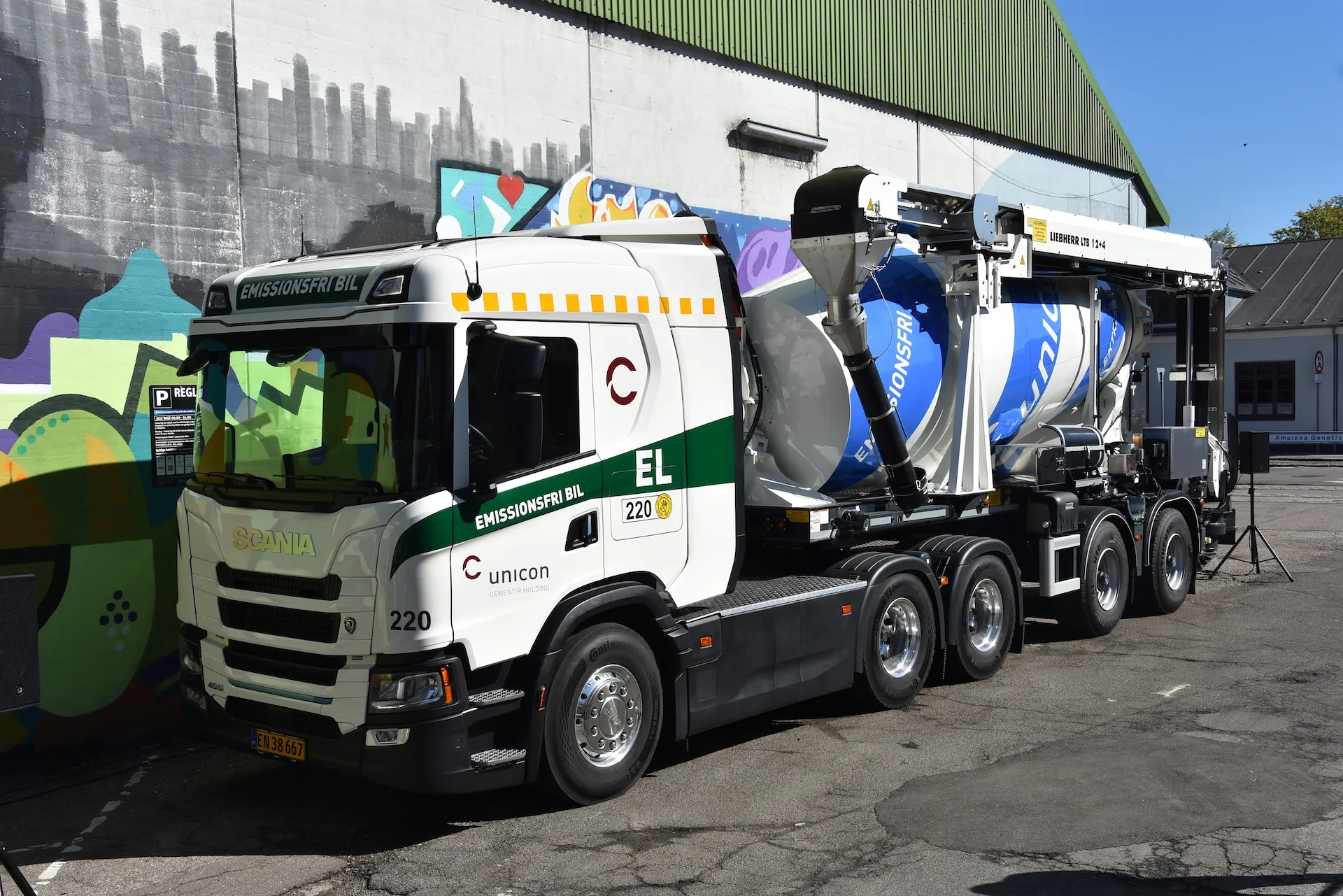

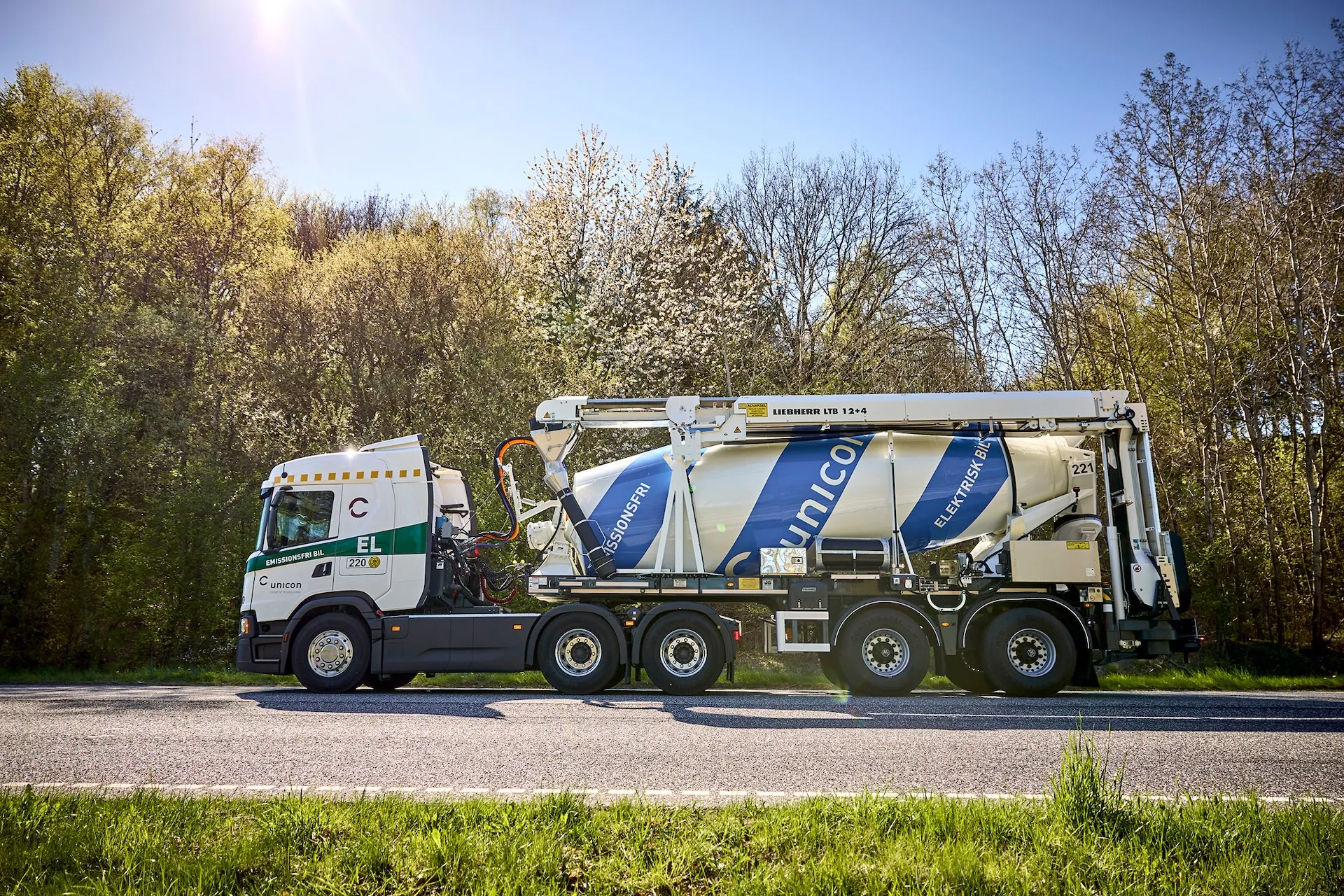
Scania and Danish ready-mix concrete supplier Unicon, working with mixer specialist Liebherr-Mischtechnik, have deployed a battery-electric concrete transport solution into daily commercial operations, with 10 additional electric trucks already on order. The vehicle pairs a Scania battery-electric chassis with a fully integrated electric mixer driven by an electric power take-off (ePTO), eliminating tailpipe emissions in one of road freight’s most energy-intensive vocational segments. Unicon has set a target of operating only emission-free concrete transport by 2035, and the deployment was announced from Södertälje, Sweden by Scania on May 6.
Highlights
- Battery capacity of up to 400 kWh delivers an operational range of around 200 kilometres (approximately 124 miles) on typical concrete distribution routes
- Fully integrated ePTO powers the mixer drum directly from the truck’s traction battery, eliminating a separate diesel auxiliary
- Scania and Unicon have placed an order for 10 additional electric concrete trucks for deployment in the coming years
- Unicon targets a fully emission-free concrete transport fleet by 2035
A Vocational Segment Long Considered Hard to Electrify
Concrete transport sits among the more demanding commercial duty cycles. Mixer trucks operate on variable routes, run heavy loads onto unpaved building sites, and must continuously power an auxiliary mixer drum that has historically drawn from the diesel engine via a mechanical PTO. Each of those factors increases energy demand and complicates the energy budget for a battery-electric drivetrain.
The Scania-Unicon-Liebherr solution addresses this by treating the chassis, the mixer, and the energy strategy as a single integrated system rather than bolting an electric mixer onto a battery truck. The three-year development program produced a vehicle Scania says is engineered for off-road site conditions and continuous mixing duty, not pilot demonstrations.
According to Tobias Ejderhamn, Global Manager, Transformation & New Business at Scania, “This project shows that electrification is not limited to standard applications. It can be applied where it matters most. By combining our modular electric platform with deep application expertise and close customer collaboration, we are demonstrating a viable path towards zero-emission transport, even in the most demanding use cases.”
How the Powertrain and ePTO Work Together
The central engineering choice in the deployment is the fully integrated electric power take-off. Rather than carrying a separate diesel or auxiliary system to drive the mixer, the ePTO draws directly from the same battery that powers the wheels. That creates a single energy budget for both traction and mixing — and keeps the vehicle genuinely zero-emission while unloading on site.
Battery capacity is configurable up to 400 kWh, giving an operational range of around 200 kilometres (approximately 124 miles) on typical concrete distribution duty cycles. Scania says the configuration was tuned through route simulation and energy modelling to match real Unicon delivery patterns rather than a generic spec sheet.
For context, that battery sizing is broadly consistent with Scania’s other heavy vocational deployments. The company’s first electric 8×4 heavy tipper for LKAB mining, launched in late 2025, uses 416 kWh of installed battery capacity for waste rock haulage on a five-kilometre route with 250 metres of elevation gain. Both vehicles ride on Scania’s modular electric platform.
A Step Past the First-Mover Stage in Concrete
The world’s first fully electric heavy concrete mixer was deployed in 2023, when CEMEX and Volvo Trucks put a Volvo FMX electric mixer into service in Berlin. The Scania-Unicon program signals where that segment is now: from a single launch unit three years ago to a multi-vehicle, fleet-scale rollout with an explicit retirement date for diesel.
Christian Elleby, Supply Chain & Procurement Director at Unicon, framed the deployment in those terms: “This is not a pilot, it is a solution designed for daily operations and future scale. We are taking solid steps to reduce emissions in construction logistics, and this collaboration shows what is possible when the right partners and technologies come together.”
What It Means for Construction Logistics
Construction logistics has been one of the slower commercial segments to electrify, behind urban distribution and last-mile parcel. The combination of energy-hungry auxiliaries, off-road duty, and tight delivery windows on perishable cargo (ready-mix concrete has a working window measured in hours) has kept the segment dependent on diesel longer than passenger vehicles or city trucks.
A 200-kilometre operational range may not suit every concrete operator, but Unicon’s deployment profile — concentrated metropolitan delivery from fixed batching plants — is the kind of duty cycle where the math now works. As fleet sizes grow, the depot-charging model that supports return-to-base trucking translates directly to ready-mix operations.
Ejderhamn added: “As the transition accelerates, the industry must move beyond pilots and into scalable solutions. This project shows how electrification can deliver real impact – reducing emissions, improving working conditions, and enabling more sustainable cities.”
Sign up for our popular weekly email to catch all the latest EV news!