

Scania has handed over the first of three plug-in hybrid trucks to Sweden’s Defence Materiel Administration (FMV), each built around a 208 kWh battery that the company says delivers roughly 43 to 50 miles (70 to 80 kilometers) of electric-only range. The handover took place this week at the Eurosatory defense exhibition in Paris, where the Swedish Armed Forces will begin evaluating the vehicles across its three service branches. FMV purchased the trucks under a joint development project meant to test electrified powertrains under real military conditions, work the company ties to its development of future defense solutions for the sector.
Highlights
- FMV has bought three hybrid trucks from Scania, with the first now delivered for operational testing across the Swedish Armed Forces’ three service branches.
- The trucks carry a 208 kWh battery; at roughly 75 percent state of charge, Scania reports about 156 kWh of usable energy.
- The company reports an electric range of approximately 43 to 50 miles (70 to 80 kilometers), with the combustion engine able to recharge the battery from 0 to 100 percent in about 45 to 60 minutes at idle.
- As a stationary power source, the truck can supply around four hours of continuous AC power, drawing on an electric powertrain rated up to 290 kW in short bursts and 2,065 lb-ft (2,800 Nm) of torque.
A Plug-In Parallel Hybrid Built for the Field
Scania’s design is a plug-in parallel hybrid, meaning the combustion engine and electric motor can drive the wheels separately or together. The company says that arrangement gives crews flexibility across mission types and terrain, with the electric motor adding instant torque, stronger maneuverability at low speeds, and the option of silent movement for limited periods.
The approach echoes the modular hybrid powertrain logic Scania has applied to its commercial lineup, where electric machines pair with combustion engines to suit specific duty cycles. That heritage is visible in earlier Scania work on versatile hybrid truck powertrains and in its hybrid range-extender program with DHL, both of which leaned on the same in-house, building-block philosophy now being adapted for defense use.
The Truck as a Mobile Energy Platform
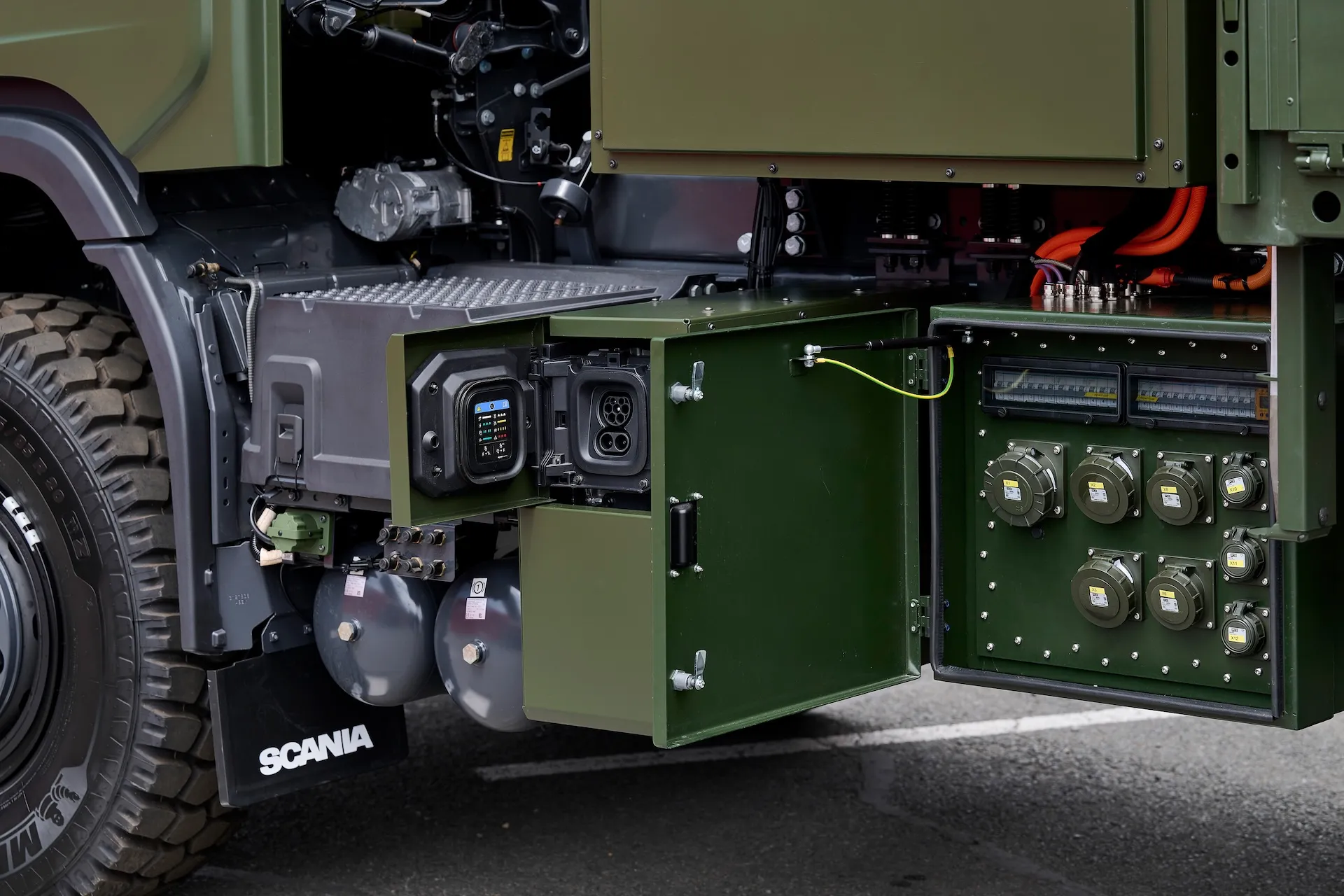
Beyond propulsion, the vehicle is designed to function as a mobile energy platform, supplying electricity to external equipment even while parked. According to Scania, that can power command posts, sensor equipment, communication systems, and temporary camps — applications where reliable power close to the operational area is becoming more important.
The contrast Scania draws is with diesel generators, which militaries commonly use for field power today. A battery solution can deliver that power silently, the company reports, reducing acoustic signature and the associated risk of detection. The truck supplies both 400 V and 230 V AC through onboard outlets, though it offers no DC outlets for external equipment.
“The defence sector is facing changing requirements, where power supply, mobility and flexibility are becoming increasingly important. Through this cooperation with FMV, we can develop and evaluate hybrid technology under real conditions, while also demonstrating how Scania’s industrial capability can contribute to future defence solutions,” says Stefano Fedel, Head of Scania Commercial.
Key Specifications
- Powertrain: Plug-in parallel hybrid; combustion engine and electric motor drive the wheels separately or together.
- Electric range: Approximately 43 to 50 miles (70 to 80 kilometers), depending on use, load, and conditions.
- Battery capacity: 208 kWh total; about 156 kWh usable at roughly 75 percent state of charge.
- Engine charging: 0 to 100 percent in about 45 to 60 minutes at idle.
- Continuous AC power: About four hours, depending on output and usage profile.
- Electric output: Up to 290 kW for short periods, about 200 kW nominal, and 2,065 lb-ft (2,800 Nm) of torque.
- Power take-off: Usable while charging, stationary, maneuvering, and driving — up to 60 kW electric and 220 kW mechanical.
Scaling the Technology Into Scania’s Modular System
Scania says it is now exploring how to industrialize hybrid truck production for defense and fold it into the company’s modular system, which would let the technology be adapted to different vehicle configurations and mission requirements. The project deepens an existing relationship among FMV, the Swedish Armed Forces, and Scania around future heavy wheeled vehicles, giving the military an operational test bed and the manufacturer data for scaling hybrid solutions.
“We see clear potential for hybrid solutions in heavy military vehicles. It is about combining robustness and mobility with new opportunities for power supply and quieter operation. For Scania, this is an important step in the development of future defence solutions,” says Fedel.
Sign up for our popular weekly email to catch all the latest EV news!