

Skoda Auto has begun large-scale battery production at its Mlada Boleslav facility in the Czech Republic. The new manufacturing line produces batteries compatible with Volkswagen Group’s MEB platform. At full capacity, the plant will turn out 1,122 battery packs per day, making Skoda the group’s largest European producer of BEV batteries.
Highlights
- Skoda’s new battery plant processes 234,000 cells and produces 9,000 battery stacks daily across four production lines.
- The facility uses LFP (lithium-iron-phosphate) chemistry instead of NMC, offering lower cost and improved thermal stability.
- Robots handle approximately 85% of all production operations, performing more than 936,000 welds per day.
- Batteries will supply Skoda’s Elroq and Enyaq models as well as other Volkswagen Group EVs.

Production Scale and Automation
The factory integrates a battery-cell warehouse with roughly one week of production inventory. It can hold up to 5,000 returnable containers, equivalent to 1.2 million cells. Cells arrive from an overseas supplier and transfer to the warehouse automatically after inspection.
From there, fully automated conveyor systems deliver cells to four production lines. Each line produces four battery stacks every 30 seconds. Approximately 600 employees support the operation across three shifts, five days a week.
However, human involvement is limited compared to earlier efforts. According to Jan Houser, Battery Production Coordinator, robots now handle about 85% of operations. When Skoda began battery production roughly six years ago for plug-in hybrids, the ratio was nearly reversed. As a result, most workers serve as production technicians or quality-control specialists.
Key Production Figures
- Daily output: 1,122 batteries and 9,000 stacks
- Daily cell processing: 234,000 cells
- Daily robotic welds: more than 936,000
- Dimensional tolerances: measured in hundredths of a millimeter
- Quality monitoring: 270 cameras for quality control and fire safety
- Total conveyor length: 2,500 meters from warehouse to final stack installation
New Cell-to-Pack Architecture
The batteries produced in Mlada Boleslav represent a significant departure from earlier MEB designs. While the external battery frame remains unchanged for vehicle compatibility, the internal architecture is entirely new.
Instead of enclosed modules, Skoda now manufactures interconnected cell assemblies called stacks using a cell-to-pack method. Robots stack and bond individual cells with double-sided adhesive tape. They then weld side rails to reinforce each assembly. In addition, all measured parameters are recorded and traceable to each individual battery produced.
Shift From NMC to LFP Chemistry
The most notable change involves cell chemistry. Skoda has transitioned from NMC (nickel-manganese-cobalt) to LFP (lithium-iron-phosphate). This shift brings several advantages:
- Lower manufacturing cost compared to NMC
- Improved thermal stability and reduced fire risk
- More environmentally friendly production process
Additionally, battery cooling has been redesigned. The cooling system now sits in the upper cover rather than the lower section. This change increases cooling efficiency. LFP batteries will gradually roll out across Skoda and other Volkswagen Group vehicles, including the Elroq and Enyaq electric models.
Assembly and Final Testing
Once stacks are complete, they transfer to the battery assembly line. The process starts with joining the frame and lower cover. A special sealant ensures a watertight seal, while dozens of screws create a solid mechanical connection.
Notably, the frame uses no pre-drilled holes. Instead, each screw spins at high speed, melts the aluminum frame wall on contact, and cuts directly into the material. Skoda has used this flow-drill technique previously and rates it highly for simplicity and reliability.
Robots then bond cell assemblies into the sealed frame using a two-component adhesive. After application, workers have roughly 25 minutes to complete the remaining steps. High-voltage contacts are connected by robots, followed by installation of wiring and control units.
Quality Control and Safety Protocols
Each battery undergoes demanding in-line testing before final closure. The upper cover includes integrated cooling channels and a thermally conductive compound between cells and cover. Before final tightening, each battery passes under a 500-kilogram weight to ensure even compound distribution.
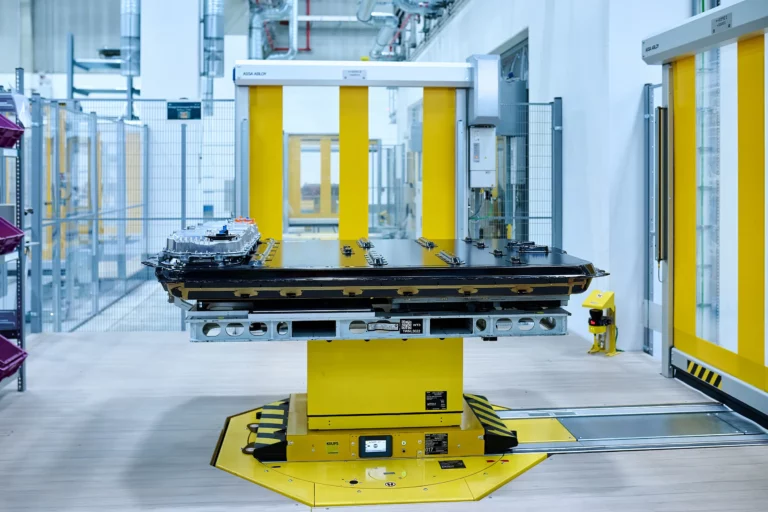
Final inspection includes both electrical tests and pressure testing. Completed batteries weigh approximately 450 kilograms each. Autonomous transport vehicles carry them to the warehouse on custom steel pallets, with each vehicle handling four pallets at once.
Throughout production and storage, continuous monitoring systems track battery temperature. If any risk is detected, specialists respond immediately. For additional safety, the factory is equipped with fire-protection containers that can be flooded with water. According to Houser, LFP technology minimizes fire risk and provides sufficient response time to isolate any affected battery.
Sign up for our popular weekly email to catch all the latest EV news!