
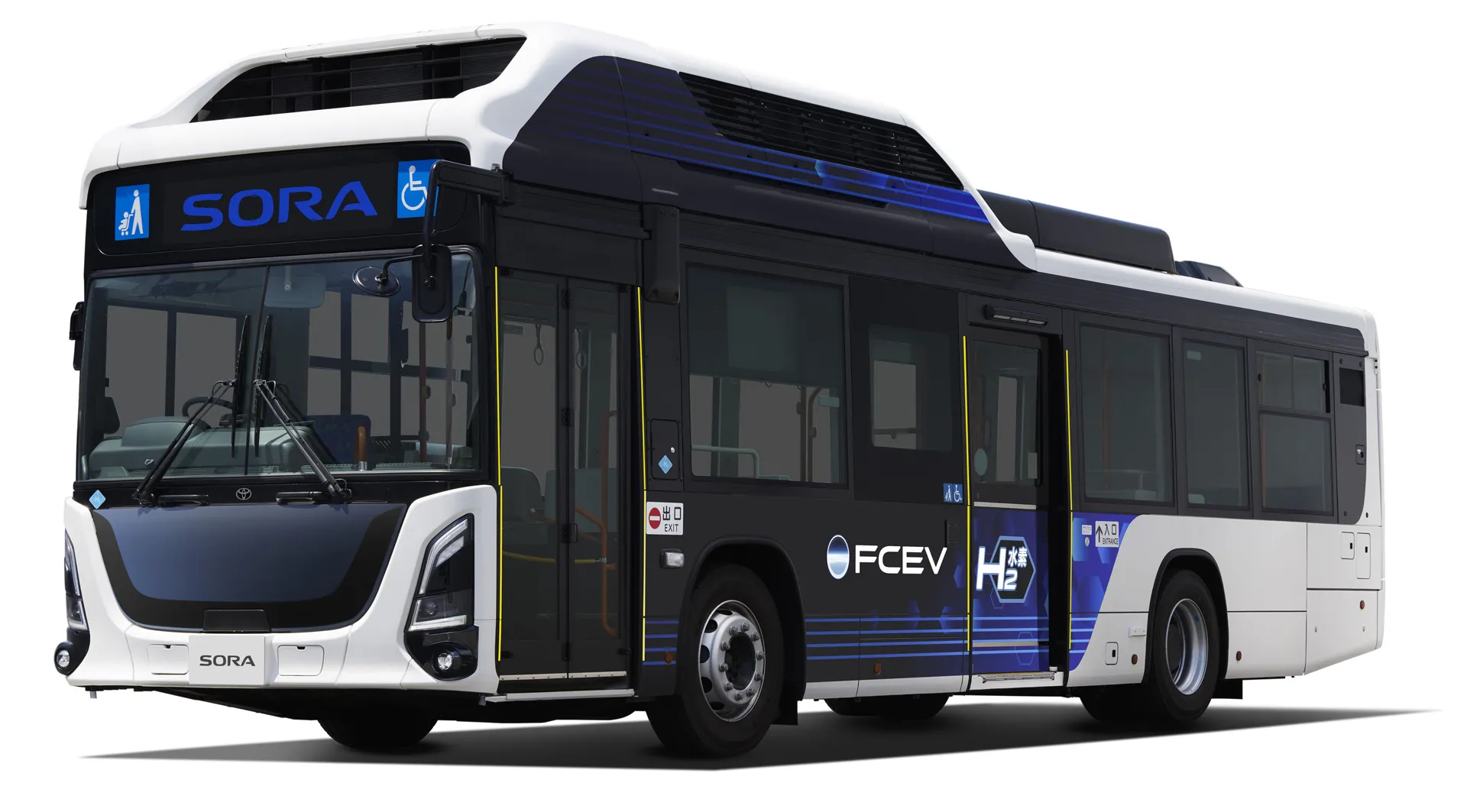
Toyota has launched a new hydrogen-powered Sora fuel cell route bus with a cruising range the company puts at more than 186 miles (300 km), about 62 miles (100 km) farther than the first-generation model. Jointly developed with Isuzu Motors, the new Sora pairs Isuzu’s full-flat battery-electric route bus platform with Toyota’s fuel cell system. According to Toyota, the bus achieves its longer range while carrying roughly 20% less total hydrogen tank capacity than its predecessor.
Highlights
- Range: More than 186 miles (300 km), up about 62 miles (100 km) from the first-generation Sora, based on Toyota’s own reference measurements.
- Refueling: A full hydrogen fill takes about 10 minutes, and the bus complies with a new high-speed filling standard that Toyota says could cut refueling time by about half at compatible stations.
- Powertrain: A 113 kW (152 hp) fuel cell stack feeds two AC induction motors producing a combined 220 kW (295 hp) and 715 lb-ft (970 Nm).
- Capacity: The urban model carries 70 people: 19 seated, 50 standing, and one crew member.
How Does the New Sora Improve on the First Generation?
Toyota introduced the first-generation Sora in 2018, positioning it as a clean, quiet fuel cell option for route bus operators. The new model grew out of a joint development effort with Isuzu aimed at zero-emission route buses.
The company attributes the efficiency gains to more effective use of the fuel cell and a large-capacity battery. Toyota fitted a compact fuel cell stack designed for commercial vehicles, with increased output and durability that the company says contributes to smoother, more stable operation.
A newly developed large-capacity hydrogen tank for commercial vehicles is also part of the package. Toyota mounted the fuel cell system compactly on the roof, which the company says makes vehicle maintenance easier for bus operators.
Safety Systems
The Sora carries an Emergency Driver Stop System (EDSS) linked to a Driver Status Monitor (DSM). If the system detects that the driver is experiencing a problem, the bus decelerates and stops, then automatically applies the parking brake, a step Toyota says helps maintain safety on slopes.
A front blind spot monitor detects pedestrians and bicycles ahead of the bus and alerts the driver.
Accessibility, Refueling, and Emergency Power
- Full-flat floor: The passenger compartment has no steps, allowing passengers using wheelchairs or strollers to move through the cabin more easily.
- One-touch wheelchair securement: An optional system helps wheelchair users board and exit and helps the driver secure them. Orders for the option open around April 2027.
- Four variants: Two urban and two suburban versions offer different seat layouts for varying operating needs.
- High-utilization refueling: The roughly 10-minute fill time supports operations that keep buses in heavy rotation.
- Emergency power: Connected to an external power supply unit, the bus can serve as an emergency power source during disasters.
Main Specifications (Urban Model)
| Component | Specification | Value |
|---|---|---|
| Vehicle | Length / width / height | 34.6 ft / 8.2 ft / 11.3 ft (10,545 / 2,485 / 3,440 mm) |
| Vehicle | Capacity (seated + standing + crew) | 70 (19 + 50 + 1) |
| Fuel cell stack | Type | Toyota FC stack (polymer electrolyte membrane) |
| Fuel cell stack | Maximum output | 113 kW (152 hp) |
| Motor | Type | AC induction motor |
| Motor | Maximum output | 220 kW (295 hp); 110 kW x 2 |
| Motor | Maximum torque | 715 lb-ft (970 Nm); 358 lb-ft (485 Nm) x 2 |
| Hydrogen tanks | Number (nominal pressure) | 3 (10,150 psi / 70 MPa) |
| Hydrogen tanks | Tank volume | 124.4 gal (471 L) |
| Propulsion battery | Type | Lithium-ion |
Toyota’s Broader Hydrogen Business
Toyota launched its first fuel cell electric vehicle, the Mirai, in 2014 and has sold it in more than 30 countries and regions. Since 2019, the company has also supplied fuel cell systems to outside customers, reaching more than 3,500 units across over 100 customers worldwide as of the end of September 2026, for uses including buses, rail, and stationary generators.
With partners, Toyota has also developed a hydrogen cartridge and a hydrogen sauna. The company says it will continue working with government agencies and businesses to expand hydrogen mobility, including through a joint public-private initiative to implement a hydrogen backbone network.