
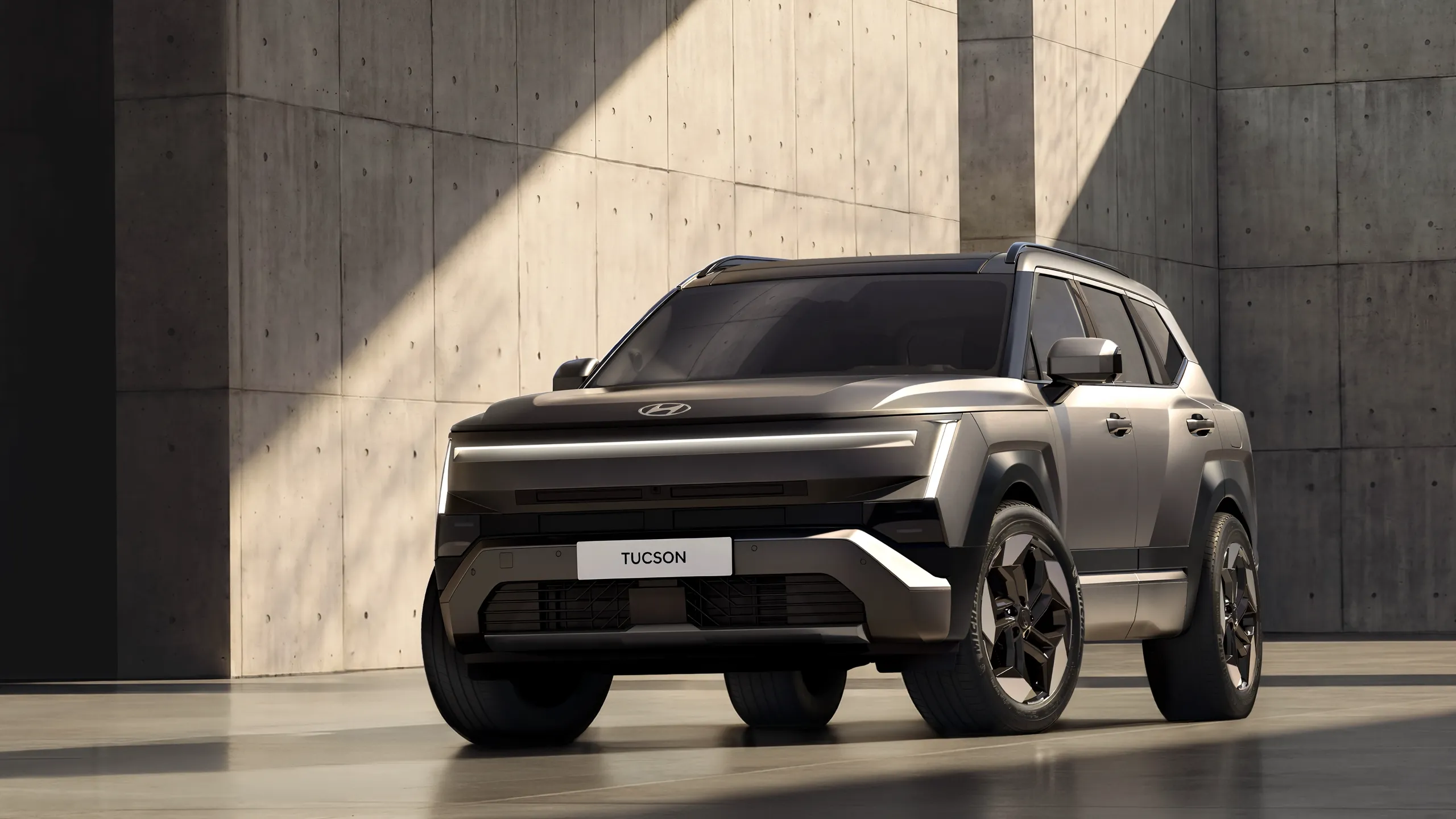
Hyundai Motor Company has revealed the all-new Tucson SUV, led by a next-generation hybrid powertrain that the company says targets up to 42 mpg, with North American sales to follow in 2027. The all-new Tucson pairs Hyundai’s “Art of Steel” design language with the Android Automotive-based Pleos Connect infotainment system, the Gleo AI assistant and a new off-road-focused XRT PRO variant. Hyundai staged the world premiere in New York City this week, and the SUV goes on sale in Korea later this year.
Highlights
- 42 mpg target: Hyundai says the hybrid targets up to 42 mpg in North American 2WD form on 17-inch wheels, with 0–60 mph in 8.5 seconds.
- Larger body: The long-wheelbase model grows to 185.0 inches (4,700 mm) long, 75.0 inches (1,905 mm) wide and 66.3 inches (1,685 mm) tall.
- More towing: North American hybrid towing capacity rises to 3,000 pounds (1,361 kg), up 1,000 pounds.
- Launch timing: Korea first, then North America, Europe and other global markets in 2027.
How Efficient Is the Next-Generation Tucson Hybrid?
Hyundai says its Next-generation Hybrid System is built around an “Intelligent Efficiency” principle. The North American hybrid produces 233 hp and 279.9 lb-ft (38.7 kgf·m) from a P1 (13 kW) and P2 (47.7 kW) motor layout, a 1.49 kWh, 270-volt battery and a six-speed automatic transmission.
The hybrid-only E-Traction system adjusts driving torque to reduce wheel slip during cornering. HEV Stay Mode runs air conditioning, heating, audio and device charging with the engine off. Every powertrain uses an integrated electric water pump that consolidates separate cooling circuits to cut weight.
| Specification | Gasoline (ICE) | Hybrid (HEV) | Plug-in Hybrid (PHEV) |
|---|---|---|---|
| Engine/motors | 1.6T-GDI / 2.0 MPI | P1 (13 kW) + P2 (47.7 kW) | P1 (13 kW) + P2 (79 kW) |
| Output (US) | 184 hp | 233 hp | — |
| Output (Korea) | 148–190 hp (150–193 ps) | 233–242 hp (236–245 ps) | 288 hp (292 ps) |
| Torque | 141.8–195.3 lb-ft | 279.9 lb-ft | 279.9 lb-ft |
| Battery | — | 1.49 kWh / 270V | 17.1 kWh / 351V |
| Transmission | 6MT / 7DCT / 8AT / 6AT | 6AT | 6AT |
| 0–60 mph | 9.5–12.4 sec | 8.5 sec | 7.9 sec (4WD) |
| Targeted fuel economy (N.A.) | 28 mpg (2WD), 26 mpg (4WD) | 38–42 mpg | — |
| Towing | — | 3,000 lb (US/4WD) | 4,211 lb (1,910 kg) |
Tucson Plug-in Hybrid Specifications
The Tucson Plug-in Hybrid, offered in select markets, pairs a 1.6-liter turbocharged engine with a plug-in hybrid system for 288 hp (292 ps). Hyundai estimates its all-electric range at 50 miles (81 km), enough for most daily commutes, according to the company. A 7.2 kW onboard charger handles home and public charging.
Design, Dimensions and Lighting
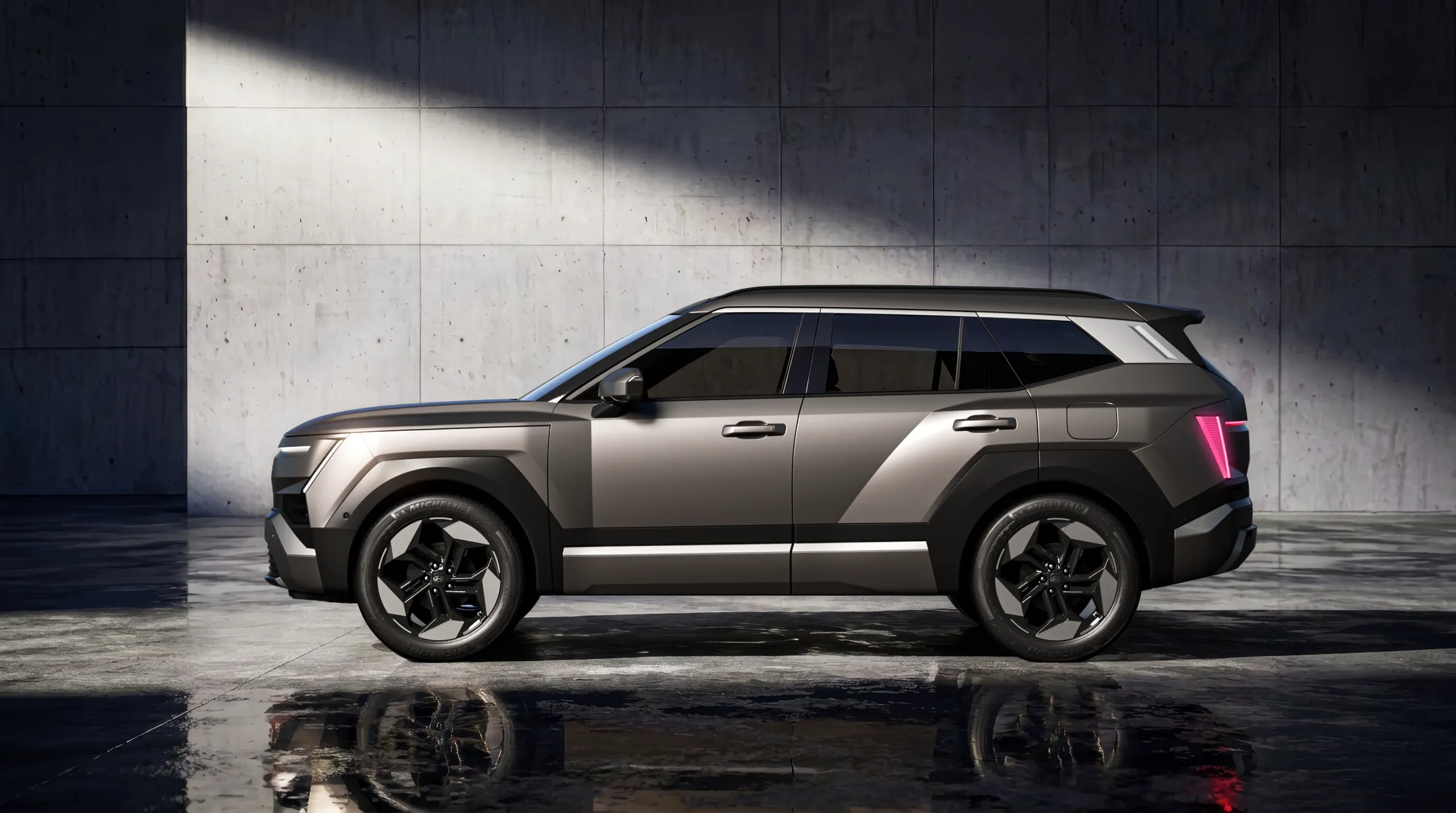
Pronounced fenders anchor the “Art of Steel” exterior. Compared with the previous model, the long-wheelbase Tucson measures:
- Length: 185.0 inches (4,700 mm), up 2.4 inches (60 mm)
- Width: 75.0 inches (1,905 mm), up 1.6 inches (40 mm)
- Height: 66.3 inches (1,685 mm), up 0.8 inches (20 mm)
- Wheelbase: 109.6 inches (2,785 mm), up 1.2 inches (30 mm)
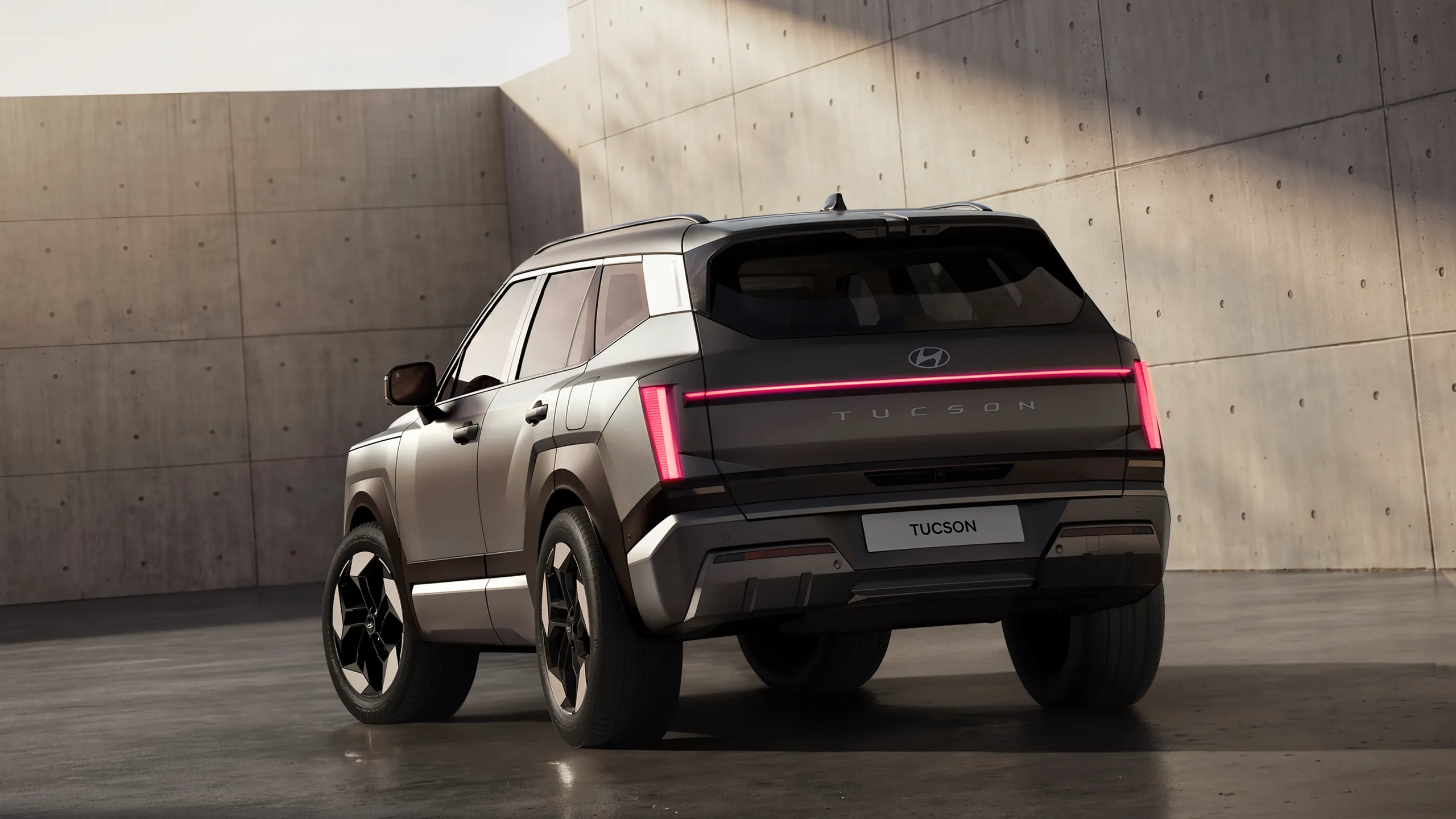
Door opening angles widen from 73 to 83 degrees. Up front, H-Edge lighting combines indirect center lighting with edge lighting, while Prism Rear Lamps define the tail. LED headlamps with a two-in-one module and LED taillamps are standard.
Cabin and Pleos Connect
Pleos Connect pairs a 17-inch or 12.9-inch touchscreen with a 9.9-inch slim display above the Double D-Cut steering wheel. The system supports three-finger gesture controls, native third-party apps without smartphone mirroring, and over-the-air updates. Gleo AI, an agentic in-vehicle assistant, handles conversational requests such as finding a trailhead with parking within 30 minutes.
Tactile buttons below the center display control HVAC and audio. A steering column-mounted shift-by-wire lever replaces the console shifter. Dual 15W Qi 2.0 wireless charging pads and 100W USB-C seatback ports cover device charging. Front headroom measures 40.8 inches (1,036 mm) and rear legroom 41.9 inches (1,064 mm).
Several cabin features are limited to the short-wheelbase model, which Hyundai will not sell in North America: the Ergo Motion massage seat, the Relaxation Comfort Seat, three-zone climate control, 13.5V metal-coated heated glass and Micro Pixel Lighting with 25,600 LED pixels.
Safety and Driver Assistance
Hot-stamped steel reinforces key body structures, and the center pillars use 2.0 mm reinforcement. An In-Cabin Monitoring Unit tracks driver eye activity and drowsiness, while Child Presence Detection and Rear Occupant Alert flag occupants left behind.
Intelligent Speed Limit Assist adjusts set speed to posted limits. Navigation-Linked Smart Cruise Control slows for curves, roundabouts, intersections and speed bumps. Hyundai is targeting a five-star NHTSA rating, IIHS Top Safety Pick+, a five-star Euro NCAP rating, KNCAP Level 1 and a five-star rating in Australia.
What Does the Tucson XRT PRO Add?
The XRT PRO adds all-wheel drive, all-terrain tires, front recovery hooks and 8.3 inches (210 mm) of ground clearance, 1.2 inches (30 mm) more than the standard model. It debuts Hyundai’s first Smart Terrain Assist, a North America-only feature that analyzes traction and slip and displays a green, orange or red “stuck score.”
Target Speed Control holds a driver-selected speed between 1 and 16 mph (2–25 km/h) off-road. Memory Reversing Assist records up to 19 mph (30 km/h) of driving and steers the vehicle back along that path. In North America, the hybrid tows up to 3,000 pounds (1,361 kg), a 1,000-pound increase over the previous model.
Market Position and Launch Timing
Hyundai reports cumulative Tucson sales above 11.1 million units since 2004, including China-only models. The U.S. accounts for roughly 20 percent of that total, and hybrids made up 31 percent of U.S. Tucson sales in 2025.
“Millions of families around the world count on the Hyundai TUCSON, and this is the best one we have ever built,” said José Muñoz, President and CEO, Hyundai Motor Company. “Its combination of bold design, generous cabin space, seamless infotainment, and available hybrid efficiency sets a new standard for what customers should expect in this segment. TUCSON opens the most ambitious product offensive in our history, including more than 100 new and refreshed vehicles globally by 2030 — 58 in North America alone.”
A sport-inspired Tucson variant will debut at the Paris Motor Show on October 12, 2026.