
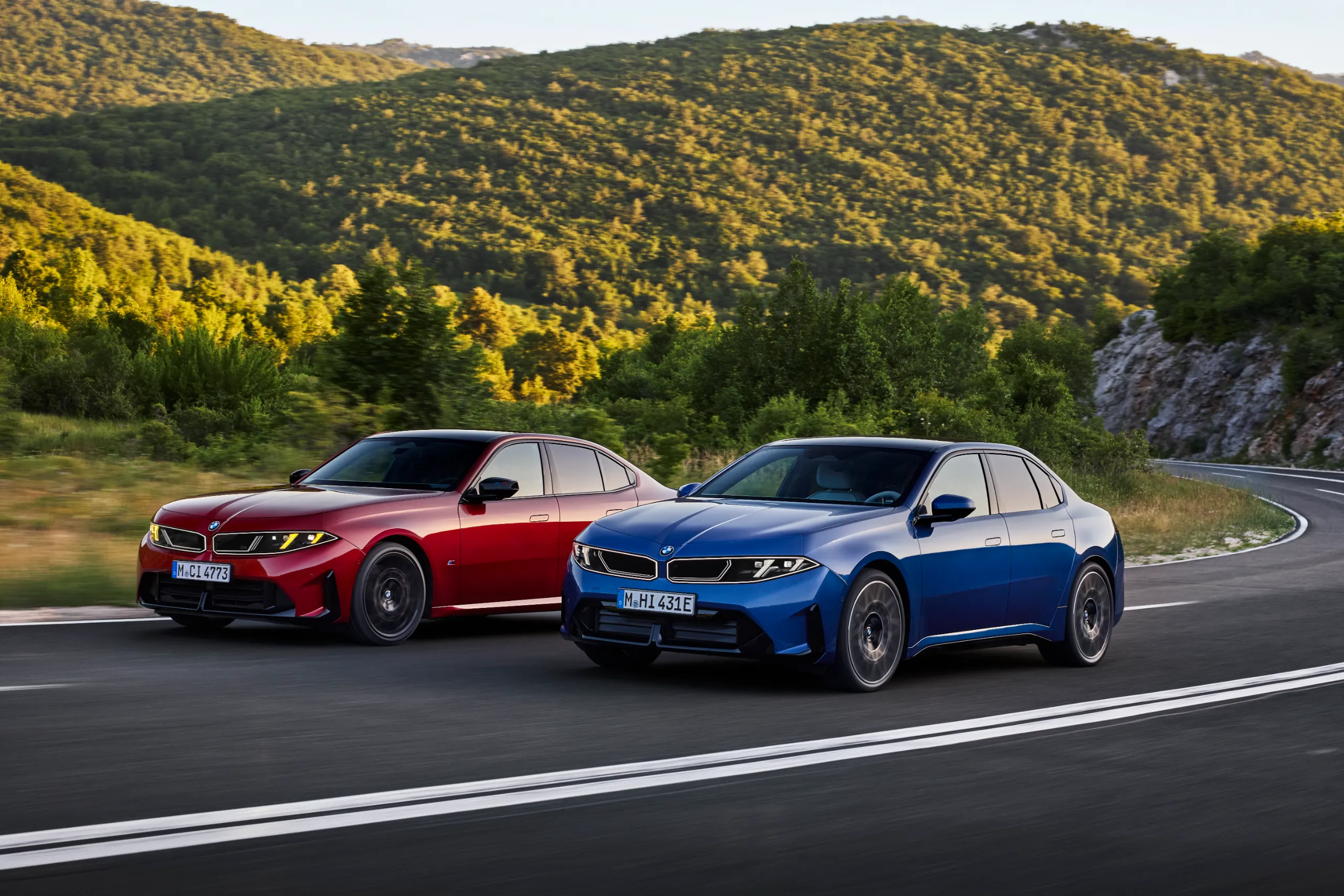
The 2027 BMW i3 50 xDrive will start at $61,500 plus $1,350 destination and handling when US sales begin in the first quarter of 2027, with an estimated range of 446–468 miles. BMW says the range figures are preliminary estimates based on its own testing using EPA procedures. The i3 is the first fully electric 3 Series built on the company’s Neue Klasse architecture, and it arrives alongside new gasoline models with 48V mild-hybrid technology. BMW Group also reports it is investing around €2 billion ($2.27 billion) in German vehicle and battery production for the eighth-generation 3 Series.
Highlights
- $61,500 base MSRP for the i3 50 xDrive, plus $1,350 destination, with US launch in the first quarter of 2027
- 463 hp and 476 lb-ft from a dual-motor system, with 0–60 mph in 4.5 seconds, according to BMW
- 400 kW DC fast charging on an 800V architecture, adding an estimated 191–208 miles of range in 10 minutes
- About €1 billion ($1.13 billion) invested in the new Irlbach-Straßkirchen battery plant, which begins supplying i3 batteries in October 2026
2027 BMW 3 Series Pricing and Specifications
| Model | Powertrain | Output | 0–60 mph | Base MSRP |
|---|---|---|---|---|
| BMW 330 | 2.0L four-cylinder, 48V mild hybrid | 255 hp | 5.9 sec | $49,900 |
| BMW 330 xDrive | 2.0L four-cylinder, 48V mild hybrid | 255 hp | 5.9 sec | $51,900 |
| BMW M350 xDrive | 3.0L inline-six, 48V mild hybrid | 437 hp | 3.9 sec | $65,900 |
| BMW i3 50 xDrive | Dual-motor electric | 463 hp | 4.5 sec | $61,500 |
All models require the $1,350 destination and handling charge. The BMW i3 M60 xDrive joins the lineup in 2027.
How Does the BMW i3 Drivetrain Work?
The i3 50 xDrive uses BMW’s sixth-generation eDrive system. An electrically excited synchronous motor (EESM) drives the rear axle with 322 hp and 321 lb-ft. A front asynchronous motor (ASM) adds 165 hp and 188 lb-ft.
Compared with Gen5, BMW reports the motor pairing cuts energy losses by 40%, costs by 20%, and weight by 10%. The company also says Gen6 delivers 30% more range and 30% faster charging than Gen5 technology in other BMW models.
In everyday driving, the i3 decelerates almost entirely through recuperation, according to BMW. The friction brakes engage only for sporty driving or emergency braking.
Battery and Charging
The battery uses cylindrical cells measuring 1.8 inches (46 mm) in diameter and 3.7 inches (95 mm) in height. BMW says they offer 20% greater volumetric energy density than the prismatic cells in Gen5 batteries. The cells mount directly into the pack without modules, and the battery housing doubles as the vehicle underbody.
The i3 builds on charging advances introduced with the BMW iX3, the first Neue Klasse model. Key charging capabilities include:
- DC fast charging at up to 400 kW at 800V stations, with 400V DC compatibility through the Energy Master’s integrated switching matrix
- AC charging at up to 15.4 kW
- Bidirectional charging for Vehicle-to-Load, with up to 3.7 kW for external devices, and Vehicle-to-Home backup power during outages
- Plug & Charge Multi Contract authentication under ISO 15118-2, storing up to 10 charging contracts from different providers
Charging-optimized route planning can prioritize IONNA, which BMW describes as its preferred network, with access to more than 180 sites and 1,500 high-power charging plugs.
Where Is the New BMW 3 Series Built?
BMW Group says it has spent about €1 billion ($1.13 billion) developing its Munich and Dingolfing vehicle plants for the new generation, and around €1 billion more on the Irlbach-Straßkirchen battery plant in Lower Bavaria.
Series production of the i3 began at BMW Group Plant Munich in August 2026. The plant will build only fully electric vehicles from 2027. Combustion-engine and plug-in hybrid 3 Series versions will be produced at Plant Dingolfing starting in November 2026.
Battery packs currently come from BMW Group Plant Debrecen in Hungary. Irlbach-Straßkirchen, about 19 miles from Dingolfing, begins supplying Gen6 batteries to Munich in October 2026 and will create up to 1,600 jobs. Plant Steyr in Austria builds the EESM, and Plant Landshut supplies the Energy Master.
Around 760 supplier locations serve the Munich and Dingolfing plants during the ramp-up. More than 70% are in Europe and more than 30% in Germany. BMW will also apply the same production standards to the i3 and 3 Series at Plant San Luis Potosí in Mexico, and to a modified 3 Series for China at Shenyang.
“We are investing in value creation, competitive production and job security in Germany. The new BMW 3 Series is the proof. We are in control of the transformation – from development to industrialisation and high-efficiency production in Munich and Dingolfing. The new high-voltage battery plant in Irlbach-Straßkirchen illustrates how we are bringing key electromobility technology back to our home base,” said Raymond Wittmann, Member of the Board of Management of BMW Group, Production.
Jochen Goller, Member of the Board of Management of BMW AG, Customer, Brands, Sales, described the model’s role: “As a fully electric model in a high-volume segment, the BMW i3 is a hugely significant car for the BMW Group. Feedback from our customers has already confirmed the car’s enormous potential.”