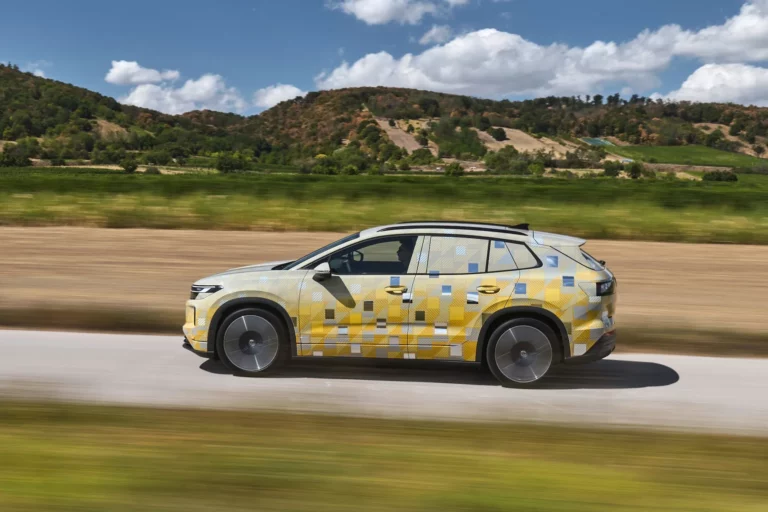

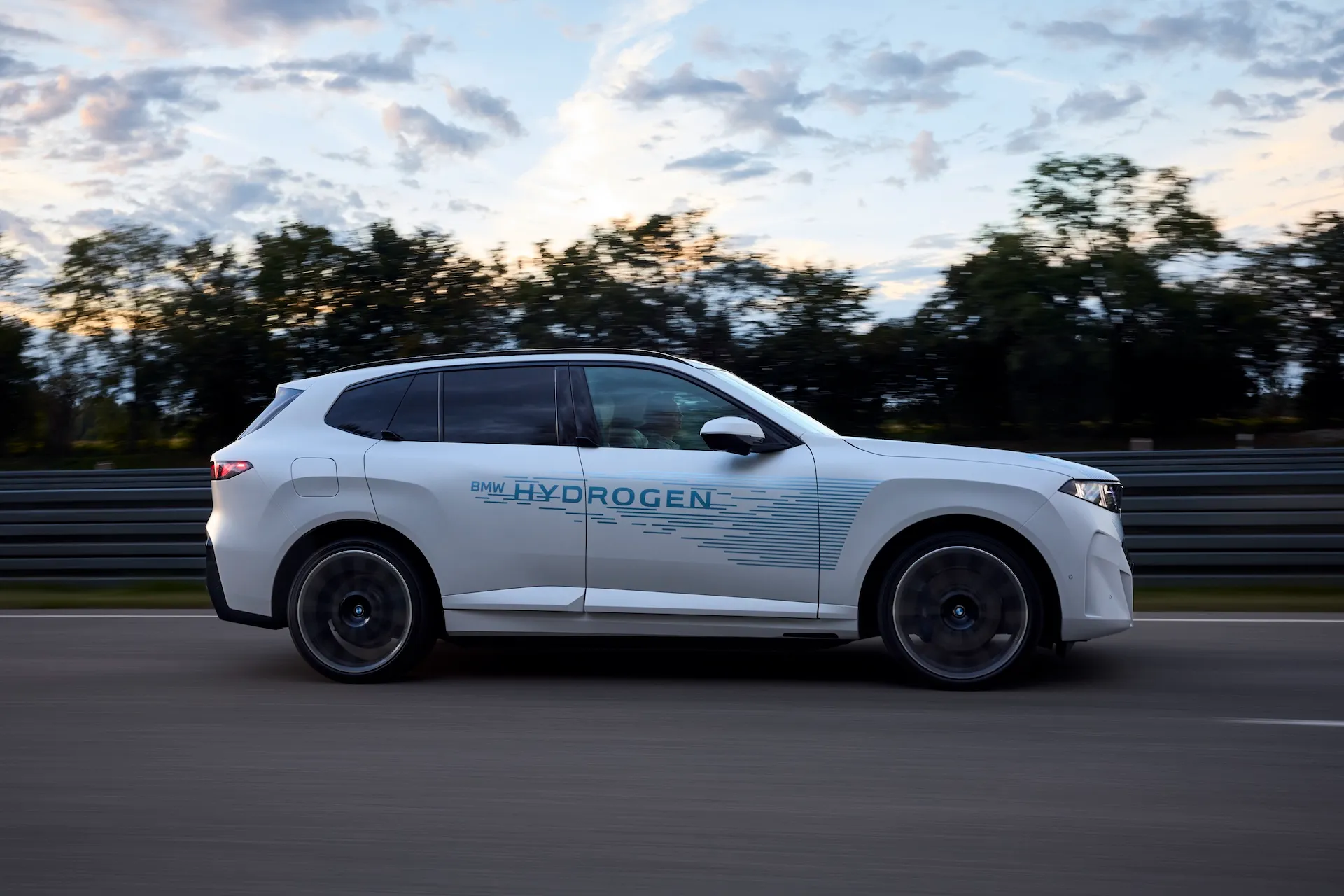
The BMW iX5 Hydrogen has moved into a new development phase, with current prototypes undergoing a full testing program while the third-generation fuel cell system enters prototype assembly in Munich and BMW Group Plant Steyr in Austria prepares for series production. The company says the vehicle targets a range of up to 466 miles (750 km) on the WLTP cycle and 0–62 mph (0–100 km/h) acceleration in under five seconds. According to the BMW Group, the three workstreams are running in parallel as it develops what will be its first hydrogen production vehicle.
Highlights
- Three parallel tracks: Vehicle prototype testing, third-generation fuel cell prototype assembly at the Hydrogen Competence Centre in Munich, and industrialization preparation at Plant Steyr.
- Performance targets: Up to 466 miles (750 km) WLTP range, refueling in under five minutes, and 0–62 mph (0–100 km/h) in less than five seconds.
- Steyr readiness: First test benches and manufacturing equipment already installed, with employees being trained in stages.
- Public funding: $222.3 million (€191 million) from Germany’s federal government plus $95.4 million (€82 million) from the state of Bavaria under the HyPowerDrive project.
What Is BMW Testing in the iX5 Hydrogen?
Current testing centers on validating the complete drive system under demanding environmental and operating conditions. Development teams are checking the functionality of every component within the integrated vehicle and refining system control, including under high loads. The goal, the company says, is to keep the powertrain’s full performance available at all times while tuning the driving dynamics BMW associates with the brand.
Testing so far confirms coordinated operation among the fuel cell system, electric motor, high-voltage battery, the Hydrogen Flat Storage tank system, and the Energy Master control unit. The company says the high-voltage battery and the Energy Master, which serves as the central control unit for the high-voltage system, enable higher recuperation performance and raise overall system efficiency. Development aims for driving performance on par with the battery-electric BMW iX5.
“Our ambition for the BMW iX5 Hydrogen is clear: a true BMW – with Sheer Driving Pleasure. A perfectly coordinated overall system is crucial for this. Current testing demonstrates how the fuel cell system, high-voltage battery and electric drive train are already successfully integrated and how systematically we are developing the technology towards series production,” said Josef Hochreiter, head of Hydrogen Vehicles at the BMW Group.
Fuel Cell Prototype Assembly Moves to Next Phase
Alongside vehicle testing, the next prototype assembly phase for the third-generation fuel cell system is starting at the Hydrogen Competence Centre in Munich. This phase focuses on finalizing and validating the testing methodology and continuing industrialization preparations. The previous prototype phase concentrated on component buildability and basic supplier qualification.
The upcoming process steps are intended to establish conditions for robust and efficient manufacturing, which the company describes as a significant contribution to future series production. Series production of the fuel cell systems will take place at BMW Group Plant Steyr.
“Prototype assembly is about much more than manufacturing individual components. Each phase helps us optimise processes, gain experience and systematically share this knowledge with the teams in Steyr. In this way, we are laying the foundation for the next steps on the road to industrialisation,” said Claudia Stephan, head of Technology Development and Fuel Cell Prototype Assembly at the BMW Group.
Munich Development Feeds Steyr Series Production
The start of the new assembly phase marks another step toward industrialization. The first test benches and manufacturing equipment are already in place at Plant Steyr, and employees are being trained in stages. The company says the insights gained there form the basis for subsequent industrialization steps and the eventual production ramp-up.
The competence centers in Munich and Steyr are developing and assembling prototypes while building experience for industrialization. Additional system components are being manufactured at the BMW Group facility in Landshut.
Hydrogen as a Third Electric Drive Option
The iX5 Hydrogen continues the BMW Group’s technology-open approach. The company positions hydrogen as a supplement to battery-electric vehicles where high range, short refueling times, and high versatility are required. Following global testing of the pilot fleet, the iX5 Hydrogen will be the first hydrogen-powered BMW Group production model released to market. The new BMW X5 will offer customers a choice among battery-electric, plug-in hybrid, gasoline, diesel, and hydrogen fuel cell drivetrains.
Inside the fuel cell, hydrogen from the tanks reacts with oxygen from ambient air in an electrochemical reaction that generates the electric current driving the motor. The third-generation fuel cell system was co-developed by the BMW Group and Toyota Motor Corporation.
Development of the iX5 Hydrogen’s powertrain and tank system is funded under the HyPowerDrive project as part of IPCEI Hy2Move. Germany’s Federal Ministry of Transport (BMV) is providing $222.3 million (€191 million), with the state of Bavaria co-financing a further $95.4 million (€82 million). Funding is administered by Projektträger Jülich (PtJ) and coordinated by NOW GmbH.