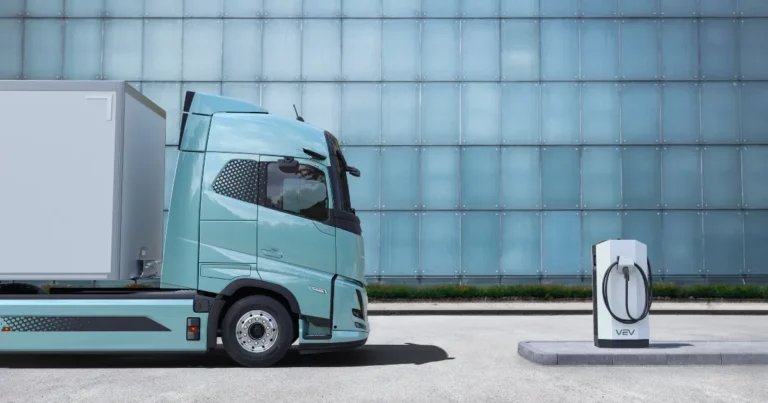


Daimler Truck’s battery-electric eActros 600 and hydrogen-powered NextGenH2 Truck share the same in-house electric drive axle but store energy in fundamentally different ways — a 621 kWh battery in one, 85 kilograms of liquid hydrogen in the other. The two long-haul trucks anchor Daimler Truck’s dual-track strategy to decarbonize road freight with both batteries and hydrogen, an approach the company says lets it tailor the powertrain to each transport task. The eActros 600 has been in series production since 2024, while the NextGenH2 Truck remains under development, with small-series deployment planned from the end of 2026.
Highlights
- Both trucks run on the same in-house electric drive axle (eAxle) from Mercedes-Benz Trucks, integrating electric motors, power electronics, and a four-speed transmission between the rear wheels.
- The eActros 600 carries 621 kWh across three lithium-iron-phosphate (LFP) packs of 207 kWh each, with more than 95% of installed capacity usable and a stated 500 km range per charge at roughly 40 tonnes.
- The NextGenH2 Truck stores up to 85 kg of liquid hydrogen at −253°C for a stated range well beyond 1,000 km, supported by a 101 kWh buffer battery and refueling in about 10 to 15 minutes.
- The eActros 600 has been in series production since 2024; the NextGenH2 Truck is slated for small-series deployment from the end of 2026.
What the two trucks share
From the driver’s seat, the eActros 600 and NextGenH2 Truck behave almost identically. Both are electric trucks: the accelerator delivers immediate power, acceleration is smooth, and noise stays low even under heavy load — characteristics Daimler Truck says make for a calmer, less fatiguing drive on long motorway stretches. Depending on configuration, the two can pair with the same trailers and share a familiar cab.
The overlap is deliberate. The NextGenH2 Truck adopts several series components from the second-generation eActros family, including the integrated electric drive axle, the aerodynamically optimized ProCabin, the Multimedia Cockpit Interactive 2, the latest high-voltage and E/E architecture, and safety systems such as Active Brake Assist 6, Active Sideguard Assist 2, and Front Guard Assist.
Most important, both trucks are driven by the same electric drive axle, developed in-house by Mercedes-Benz Trucks. The compact unit sits between the rear wheels and combines electric motors, power electronics, and a four-speed transmission, turning electrical energy into motion in either vehicle. Both also carry high-voltage batteries on board. What differs is not whether a battery is present, but the role it plays.
Inside the eActros 600’s battery system
In the eActros 600, Mercedes-Benz Trucks built the truck around a battery system exceeding 600 kWh — the figure behind the model name. Total installed capacity reaches 621 kWh, split across three LFP packs rated at 207 kWh each. Because of the LFP chemistry, the company reports that more than 95% of the installed capacity is usable.
The system is engineered for a long service life. Daimler Truck cites durability targets of up to 1.2 million kilometers over ten years, with battery state of health expected to stay above 80% at the end of that period. The truck is designed for a gross combination mass of up to 44 tonnes and, with a standard semitrailer, offers a payload of around 22 tonnes in the EU, depending on national rules. As in any electric drive, braking and downhill running feed kinetic energy back into the battery.
According to Daimler Truck, the eActros 600 covers 500 kilometers without intermediate charging at a gross combination weight near 40 tonnes — a figure determined in internal testing. Across a full working day, range can extend well beyond 1,000 kilometers when charging is folded into legally required driver breaks and suitable infrastructure is available. The design favors predictable, plannable routes where charging can be scheduled around operations. In series production since 2024, the eActros 600 now runs in customer long-haul operations supported by a growing charging network.
How the NextGenH2 Truck carries hydrogen
The NextGenH2 Truck reaches the same eAxle by a different route. Rather than storing electricity, it carries liquid hydrogen cooled to −253°C in two insulated tanks mounted along the frame behind the cab, much like diesel tanks today. The tanks hold up to 85 kilograms of hydrogen — enough, the company says, for well over 1,000 kilometers at full load. Onboard fuel cell systems convert hydrogen and oxygen from the air into electricity, leaving only water vapor, and that electricity drives the same axle as the eActros 600.
A smaller buffer battery, rated at 101 kWh, supports the system, smoothing power delivery during acceleration, adding energy on steep gradients, and capturing energy under braking — all managed automatically. This is the central distinction in battery role: the NextGenH2 Truck uses a compact power battery for situational support and energy recovery, while the eActros 600 relies on a much larger energy battery as its primary source of propulsion.
Because liquid hydrogen refuels in about 10 to 15 minutes, the NextGenH2 Truck suits short, predictable stops and a fast return to the road — an edge on flexible or demanding routes where downtime matters and the next charging point may not be close at hand. To handle liquid-hydrogen operation, the truck adds a compact Tech Tower behind the cab, housing dedicated components including boil-off management and additional cooling. The eActros 600, by contrast, packages its high-voltage components in a frontbox.
Same foundation, different strengths
Side by side, the two trucks share more than their silhouette. Both:
- Drive electrically through the same eAxle
- Recover energy under braking and on descents
- Run with low noise and zero local emissions
- Offer a familiar driver environment with advanced safety assistance and a digital cockpit, depending on configuration
Where they part ways is in how energy is stored and replenished, and how close each is to market:
- Energy carrier: the eActros 600 stores electricity directly in a large energy battery; the NextGenH2 Truck carries energy as liquid hydrogen and leans on a small power battery for support
- Replenishment: the battery truck recharges at high power during planned stops; the hydrogen truck refuels in about 10 to 15 minutes
- Range: Daimler Truck states 500 kilometers per charge for the eActros 600 and well beyond 1,000 kilometers per fill for the NextGenH2 Truck
- Market status: the eActros 600 is in series production and customer operation with an established service offering; the NextGenH2 Truck is under development, with deployment planned from the end of 2026 and hydrogen infrastructure still early
Why Daimler is building both
Daimler Truck frames the two trucks as complementary rather than competing. Long-haul transport, the company notes, ranges from clearly defined routes with reliable charging to cross-border runs that demand careful planning and real-time flexibility, and no single energy carrier covers all of it equally well. Batteries fit predictable, plannable lanes; liquid hydrogen fits routes where fast refueling and long single-fill range matter most.
Both technologies share one goal: eliminating emissions while keeping freight moving. For Daimler Truck, covering the full span of transport applications means developing the two approaches in parallel rather than choosing between them.
Sign up for our popular weekly email to catch all the latest EV news!