
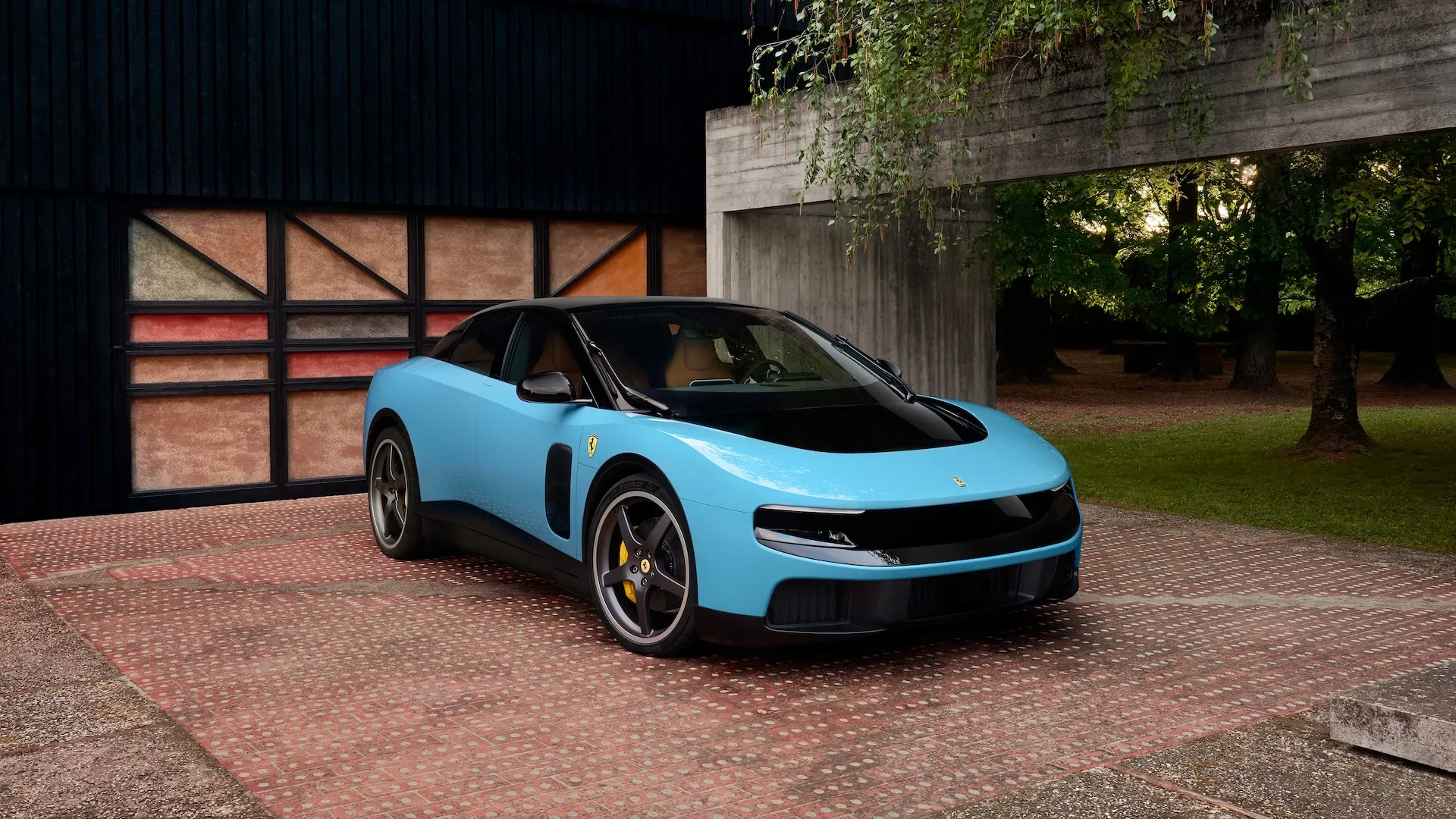
The Ferrari Luce is Maranello’s first fully electric production car, unveiled in Rome with a 122 kWh battery, four electric motors generating up to 1,050 cv, and a stated range of more than 530 km. Ferrari presented the four-door, five-seat sports car at the Vela di Calatrava – Città dello Sport, returning to the city where the marque scored its first competition victory in 1947. The Luce sits alongside Ferrari’s combustion and hybrid models rather than replacing them, the company says, completing the multi-energy strategy announced at the 2022 Capital Markets Day.
The model marks the second four-door in Ferrari’s history and the first to seat five, made possible by an all-electric architecture that eliminates the central tunnel and integrates the battery beneath the floor and rear seats.
Highlights
- Powertrain: Four F80-derived permanent magnet synchronous motors, one per wheel, with 800 V architecture and combined output of 1,050 cv (772 kW)
- Battery: 122 kWh pack with 210 cells in series, supporting fast charging up to 350 kW
- Performance: 0–100 km/h in 2.5 seconds, 0–200 km/h in 6.8 seconds, top speed over 310 km/h
- Range: In excess of 530 km (under homologation), with WLTP cycle consumption pending
A Dedicated Electric Platform
Ferrari built the Luce on a bespoke chassis designed in synergy with the battery pack, eliminating steel from the body in favor of high-strength aluminum extrusions and sheets. Chassis, body, and battery form an integrated structural system. The battery housing contributes 20% of bending rigidity and 40% of torsional rigidity, and the combined body-in-white plus battery assembly is 10% lighter than the category average among leading players, according to Ferrari.
Kerb weight lands at 2,260 kg with a 47% front / 53% rear distribution. The 800 V battery sits low in the floorpan, delivering a centre of gravity 95 mm lower than the Purosangue and a yaw moment of inertia 15% lower — characteristics Ferrari says produce direction-change behavior equivalent to a vehicle weighing roughly 400 kg less.
This is Ferrari’s first electric grand tourer with four-door packaging, following the broader category established by models such as the Polestar 5, which uses a comparable 800V architecture in a four-door performance GT layout.
Four Motors, Independent Wheel Control
The quad-motor layout — two front, two rear — was developed primarily to raise the level of torque control rather than peak output, Ferrari says. Each wheel has a dedicated torque actuator, enabling full torque vectoring on both axles during acceleration and braking. The rear axle delivers 620 kW and 7,750 Nm at the wheels in Launch Control mode; the front axle delivers 210 kW and 3,400 Nm at the wheels. Maximum angular acceleration reaches 45,000 rpm/s, with front motors spinning to 30,000 rpm and rear motors to 25,500 rpm.
A new Vehicle Control Unit makes its debut on the Luce, integrating powertrain and vehicle dynamics under a single controller that updates actuation targets 200 times per second across a three-line 800 V / 48 V / 12 V network. Side Slip Control X coordinates with Active Suspension Control 3.0, independently steering rear wheels via Virtual Short Wheelbase 3.0, and an extended-regenerative ABS Evo system.
| Spec | Front E-Axle | Rear E-Axle |
|---|---|---|
| Power at axle | 210 kW | 620 kW |
| Torque at wheels (Launch Control) | 3,400 Nm | 7,750 Nm |
| Torque at engines (Launch Control) | 280 Nm | 710 Nm |
| Power density | 3.23 kW/kg | 4.80 kW/kg |
| Engine revs | 30,000 rpm | 25,500 rpm |
| Weight | 65 kg | 129 kg |
How Does Ferrari Approach Electric Vehicle Sound?
Ferrari has taken what it describes as an authentic, functional approach rather than synthesizing engine sound. A precision accelerometer mounted in the rear axle housing captures the vibration generated by rotating components, gears, and electric machines in real time. The signal is filtered, equalized, and amplified through a proprietary, patented system that Ferrari likens to an electric guitar’s amplifier. Output is two-layered, with an external amplification system generating a natural sound wavefront proportional to torque delivery and an internal system adding high-fidelity detail.
Sound is gated to the e-Manettino position. In “Range” mode the cabin is silent; “Tour” offers a scaled performance experience with the powertrain sound muted; full sonic expression activates in “Perfo.” Development required five years of work and 40,000 km of dedicated track testing, the company reports.
Battery, Charging, and Thermal Management
The battery pack consists of 15 modules — 13 in the floor and two beneath the rear seats — built from 210 pouch cells co-designed with SK On. Cells use a graphite anode, high-nickel NMC cathode, and liquid electrolyte, with a cell-level specific energy of 305 Wh/kg and pack-level density near 280 Wh/l. Peak discharge power reaches 830 kW. Ferrari states that 70 kWh can be added in 20 minutes on a 350 kW DC fast charger, and a high-voltage DC/DC booster enables 150 kW charging on 400 V columns.
The cooling system uses three architectures built around coolant, water (managed at three temperature levels), and air, the last regulated by three active grilles that close to eliminate radiator drag when cooling demand is low. The configuration is supported by remote battery and cabin preconditioning.
Design by LoveFrom
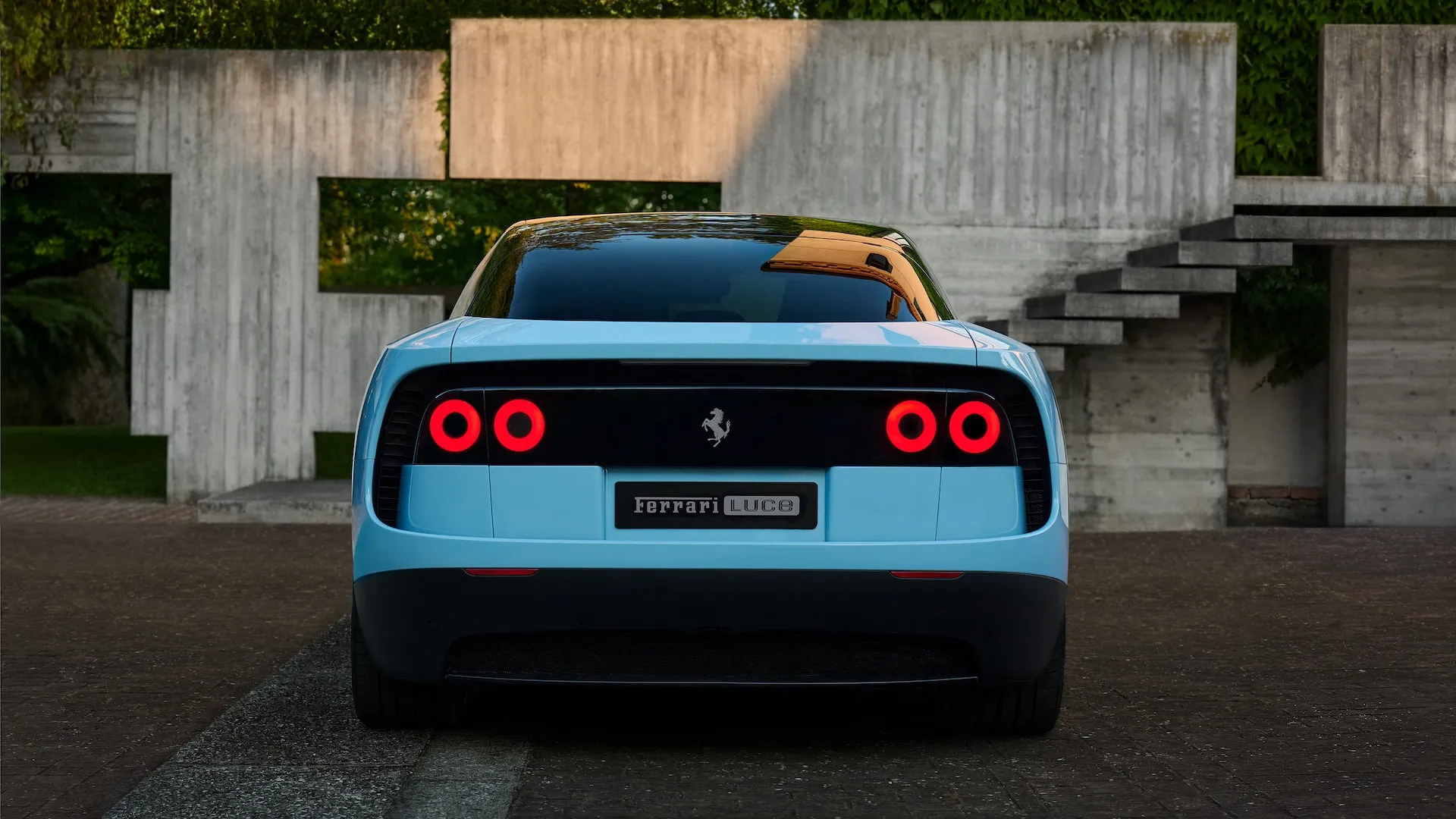
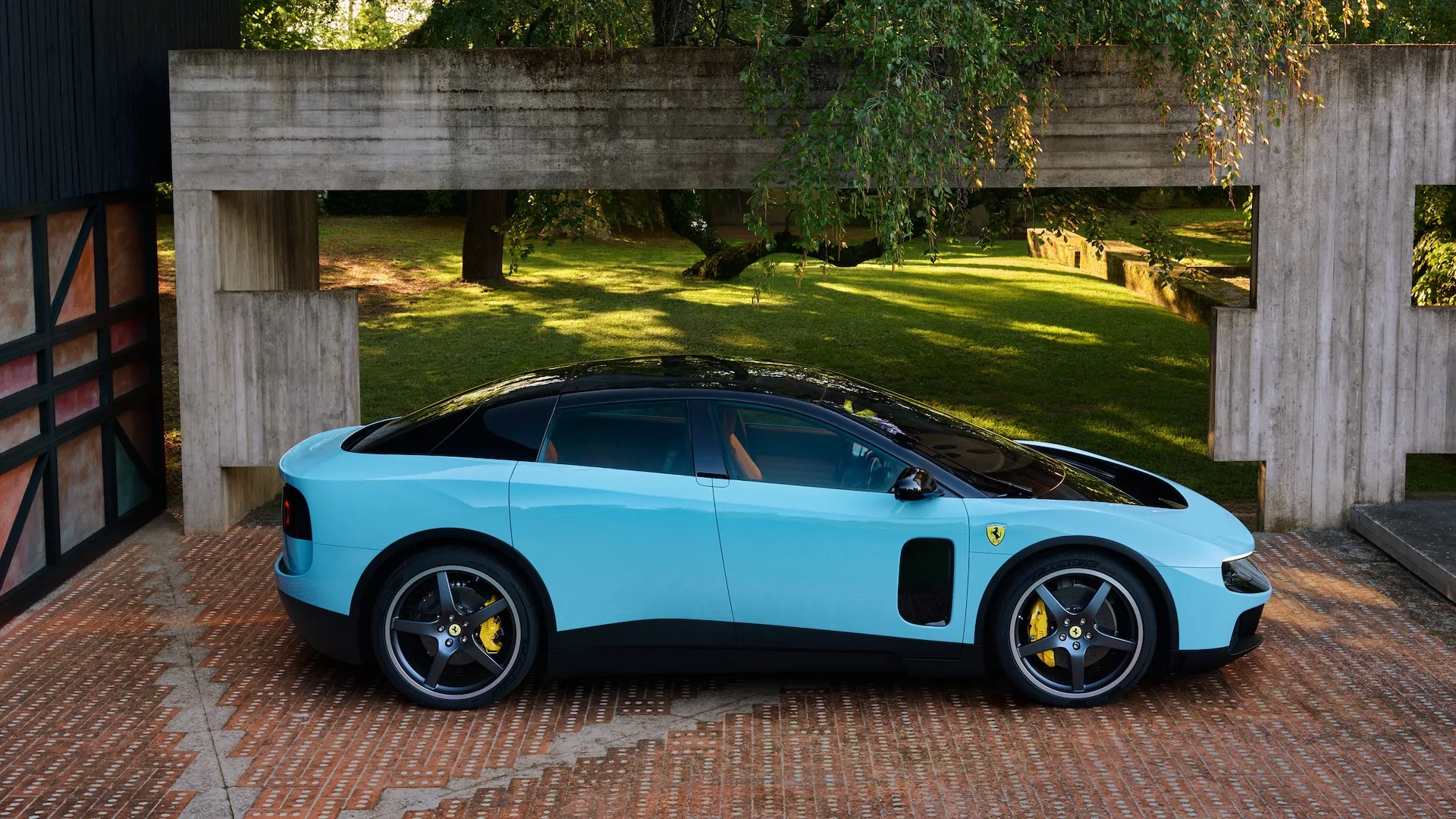
Ferrari handed the design lead to LoveFrom, the creative collective founded by Sir Jony Ive and Marc Newson, which worked with Flavio Manzoni’s Ferrari Design Studio during refinement. The Luce introduces what Ferrari calls a “glass house” form, with floating front and rear aerodynamic wings, transparent light panels integrated into the primary surfaces, and the largest staggered wheel diameters on a series-production Ferrari road car at 23 inches front and 24 inches rear. Aerodynamic development consumed more than five years, around 6,000 CFD simulations, 250 hours of scale-model wind-tunnel testing, and roughly 80 hours of full-scale testing.
The cabin combines mechanical buttons, dials, and toggles with multifunctional OLED displays developed exclusively for the Luce by Samsung Display across four panels (12.9″, 12″, 10.1″, and 6.3″). A Corning Gorilla Glass key with bistable “E Ink” display — described by Ferrari as a world first in automotive — initiates the start sequence. The 21-speaker, 24-channel, 3,000 W audio system introduces the Ferrari Audio Signature acoustic identity, with five presets and per-vehicle calibration. Bringing this together with the Lucid Air Sapphire and Mercedes-Benz EQS, the Luce enters a luxury electric performance sedan segment defined by sub-three-second acceleration and bespoke high-voltage architectures.
Drive Modes and Regeneration
The three-position e-Manettino governs power, traction, and top speed:
- Range: Power limited to 320 kW, predominantly rear-wheel drive, top speed 260 km/h, with high-frequency alternating-traction logic and front-axle disconnect for roughly 15% lower consumption
- Tour: Power rises to 460 kW with permanent all-wheel drive, top speed 260 km/h
- Performance: Up to 725 kW with all-wheel drive permanent, top speed 310 km/h
Launch Control adds an additional 40 kW from the battery and accesses an extra torque boost on all four motors, peaking at 765 kW. The advanced regenerative braking system (eCRB) can absorb up to 0.5 MW and regenerate up to 0.5 g, which Ferrari says increases electric contribution by 50% over previous hybrid models and yields 20% greater range on mountain roads and 5% in motorway traffic.
A new Torque Shift Engagement system offers five power levels via the right paddle and five engine-braking levels via the left, replacing simulated gear changes with what Ferrari calls a torque language for electric drive.
Service and Warranty
The Ferrari Luce is covered by the marque’s seven-year Genuine Maintenance programme with 20,000 km / one-year service intervals, alongside a dedicated eight-year warranty on key electric powertrain components — front and rear axles, battery, and charging system. The MyFerrari Luce app adds remote preconditioning, charge monitoring, and EV-aware navigation through Google Maps and Apple Maps integration.
Sign up for our popular weekly email to catch all the latest EV news!