
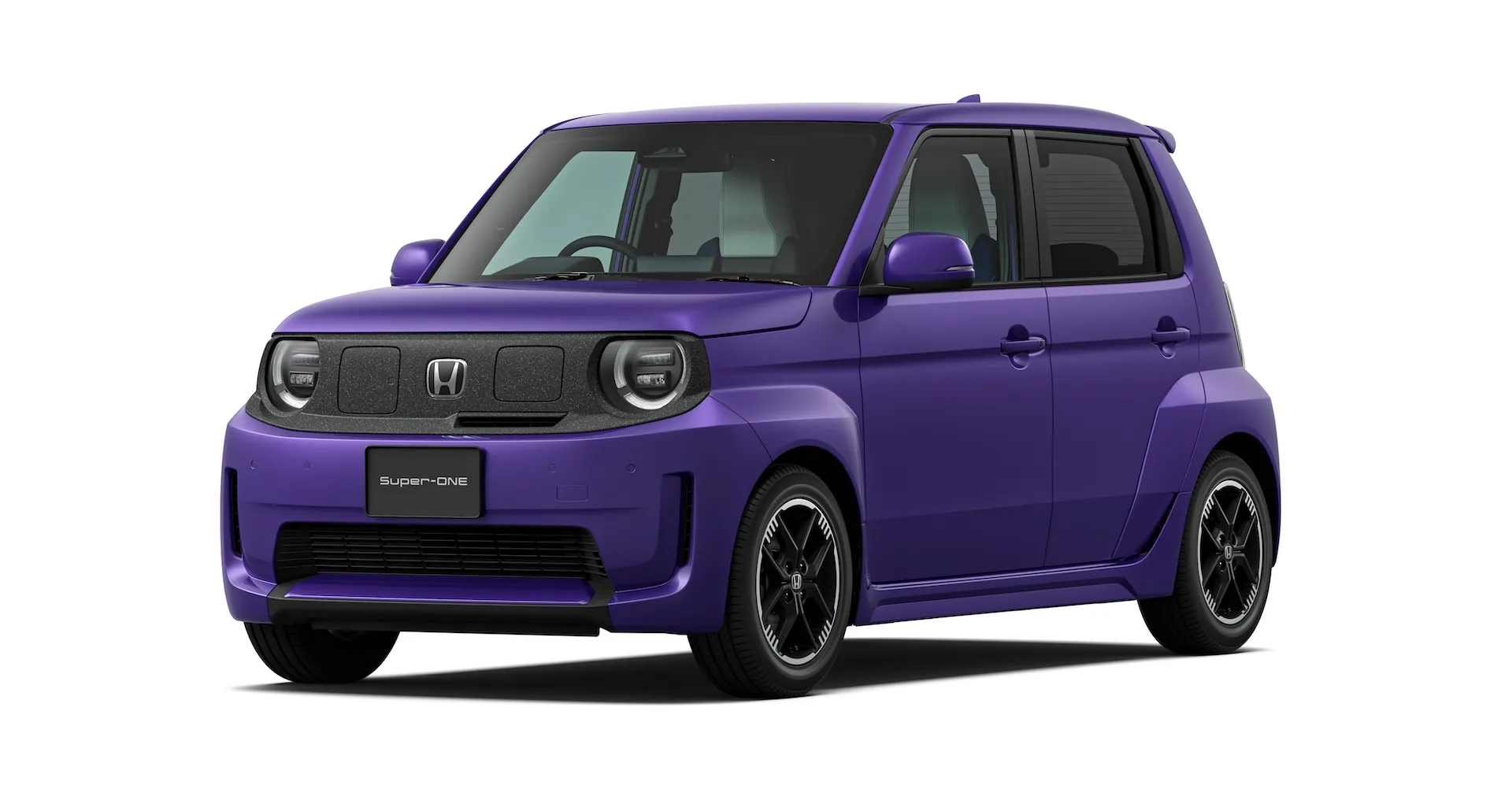
Honda has begun Japan sales of the Super-ONE, a compact electric vehicle priced from 3,390,200 yen (approximately $21,280) including consumption tax. The model launches as a sportier derivative of the N-ONE e: mini-EV, built on a dedicated chassis with a wider track and a BOOST drive mode that lifts motor output from 47 kW to 70 kW. It joins an EV lineup that already includes the N-VAN e: commercial-use mini-EV and the Insight crossover passenger EV, with an electric N-BOX scheduled for 2028.
The Super-ONE arrives nearly two months after Honda confirmed its July UK launch under the rebadged Super-N nameplate, and roughly seven months after the model’s prototype debut at the Japan Mobility Show.
Highlights
- Starting price of 3,390,200 yen (~$21,280) including 10% consumption tax, with single FF drivetrain and four-occupant capacity
- WLTC range of 274 km (170 miles) — Japan’s WLTC test cycle is not directly comparable to EPA combined ratings used in North America
- BOOST Mode raises motor output from 47 kW to 70 kW, paired with a simulated 7-speed transmission and Active Sound Control synthetic engine note
- Curb weight of 1,090 kg with a 1,345 mm tread — 10 mm wider than the N-ONE e: platform donor
- Up to 1,500W external AC output via the dealer-option Honda Power Supply Connector
Powertrain and Drive Modes
The Super-ONE pairs a compact e-Axle with a slim, high-capacity battery and offers five selectable drive modes: ECON, CITY, NORMAL, SPORT, and BOOST. In NORMAL the motor produces 47 kW; BOOST Mode lifts that to 70 kW for what Honda describes as sharper acceleration. CITY mode enables Single Pedal Control, allowing acceleration, deceleration, and a complete stop using only the accelerator pedal — Honda classifies it as a driver-assistive function rather than full one-pedal autonomy.
Honda has paired BOOST with a simulated 7-speed transmission and an Active Sound Control system that reproduces engine noise through the cabin in response to accelerator input. LED line illumination on the front passenger side and a triple-meter display that shifts from blue to purple provide visual reinforcement when BOOST is active — the same emotional-feedback approach Hyundai uses in the Ioniq 5 N.
Range and Charging
Honda quotes a WLTC range of 274 km (170 miles) on a full charge. The WLTC figure is generated under Japan’s standardized test protocol and, like WLTP in Europe, runs higher than EPA combined ratings used in the United States.
A standard charger with output above 6 kW completes a full charge in approximately 4.5 hours from the low-charge warning point. A fast charger above 50 kW reaches 80% in approximately 30 minutes, with longer durations expected in summer and winter conditions. The Honda Power Supply Connector — a dealer-option external AC output device — delivers up to 1,500W for use with appliances or as backup power.
Chassis and Packaging
The Super-ONE retains the N-ONE e: platform but widens the tread by 10 mm to 1,345 mm and adds blister fenders that house wide, large-diameter tires. Honda claims a lightest-in-class curb weight of 1,090 kg based on internal research as of May 2026 — a manufacturer claim that the company has not benchmarked against named competitors.
The interior carries sports seats with an asymmetric blue surface material and a horizontally oriented instrument panel. The dive-down and tip-up rear seat mechanism inherited from the broader N Series preserves cargo flexibility.
Audio, Infotainment, and Safety
The Super-ONE becomes the first Honda compact model in Japan to fit a Bose Premium Sound System as standard equipment. The setup includes eight speakers and a 13.1-liter subwoofer in the cargo area, and uses Bose’s Dynamic Speed Compensation technology to adjust output based on vehicle speed.
A 9-inch Honda CONNECT display with Google built-in supports Google Maps and Honda Total Care Premium services. Honda SENSING is standard, bundling Collision Mitigation Braking, Adaptive Cruise Control with Low Speed Follow, Lane Keeping Assist, Traffic Jam Assist, Pedestrian Collision Mitigation Steering, Road Departure Mitigation, and Unintended Acceleration Mitigation, among 14 total functions.
Body Colors and Options
Five solid colors are offered: Boost Violet Pearl (a Honda original new color), Platinum White Pearl, Charge Yellow, Luminous Gray, and Crystal Black Pearl. Pearl and metallic finishes carry a 33,000-yen surcharge. Four two-tone variants pair Boost Violet Pearl, Platinum White Pearl, Charge Yellow, or Luminous Gray with a black roof at a 104,500-yen surcharge.
Sign up for our popular weekly email to catch all the latest EV news!