
The Polestar 4 SUV goes on sale this week at £54,750 (about $73,900) in the UK, offering up to 391 miles of WLTP range and 58.8 cubic feet (1,665 liters) of luggage capacity with the rear seats folded. The new variant pairs the design and performance of the updated Polestar 4 coupé with a redesigned rear end, more cargo space, and added utility features, according to Polestar’s launch announcement. Production began in Busan, South Korea, in the second quarter of 2026, and the company says first customer deliveries are planned for the fourth quarter of 2026.
Highlights
- Two powertrains: Rear motor with 272 hp (200 kW) and up to 391 miles WLTP; Dual motor with 544 hp (400 kW), 0–62 mph in 3.9 seconds, and up to 373 miles WLTP
- Standard 100 kWh battery supporting DC charging up to 200 kW
- Vehicle-to-Load delivers up to 3.3 kW of AC power to external devices, arriving via a future software update
- UK pricing from £54,750 (Rear motor), £60,750 (Dual motor), and £68,250 (Performance pack)
Redesigned Rear End Adds Cargo and Headroom
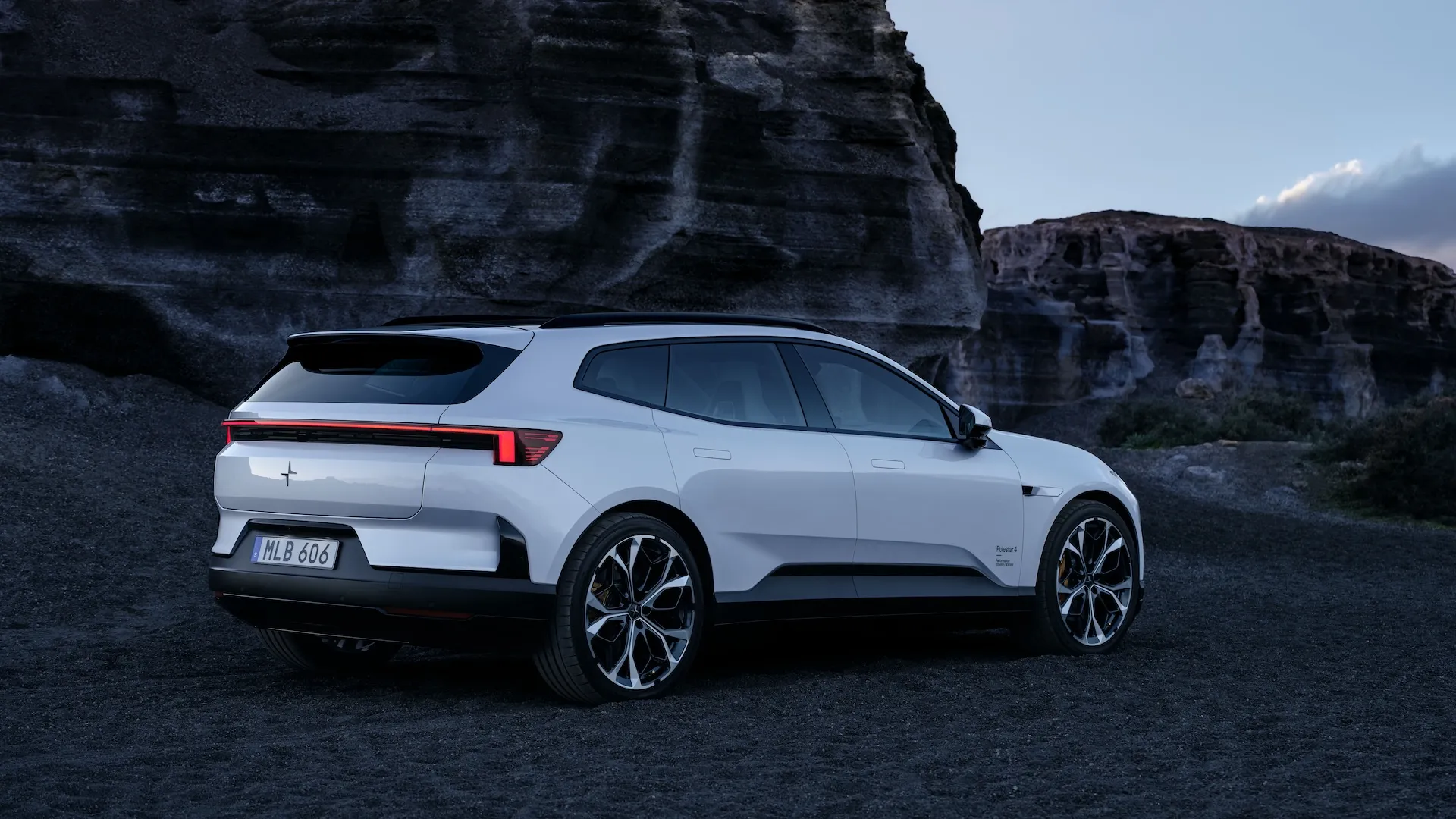
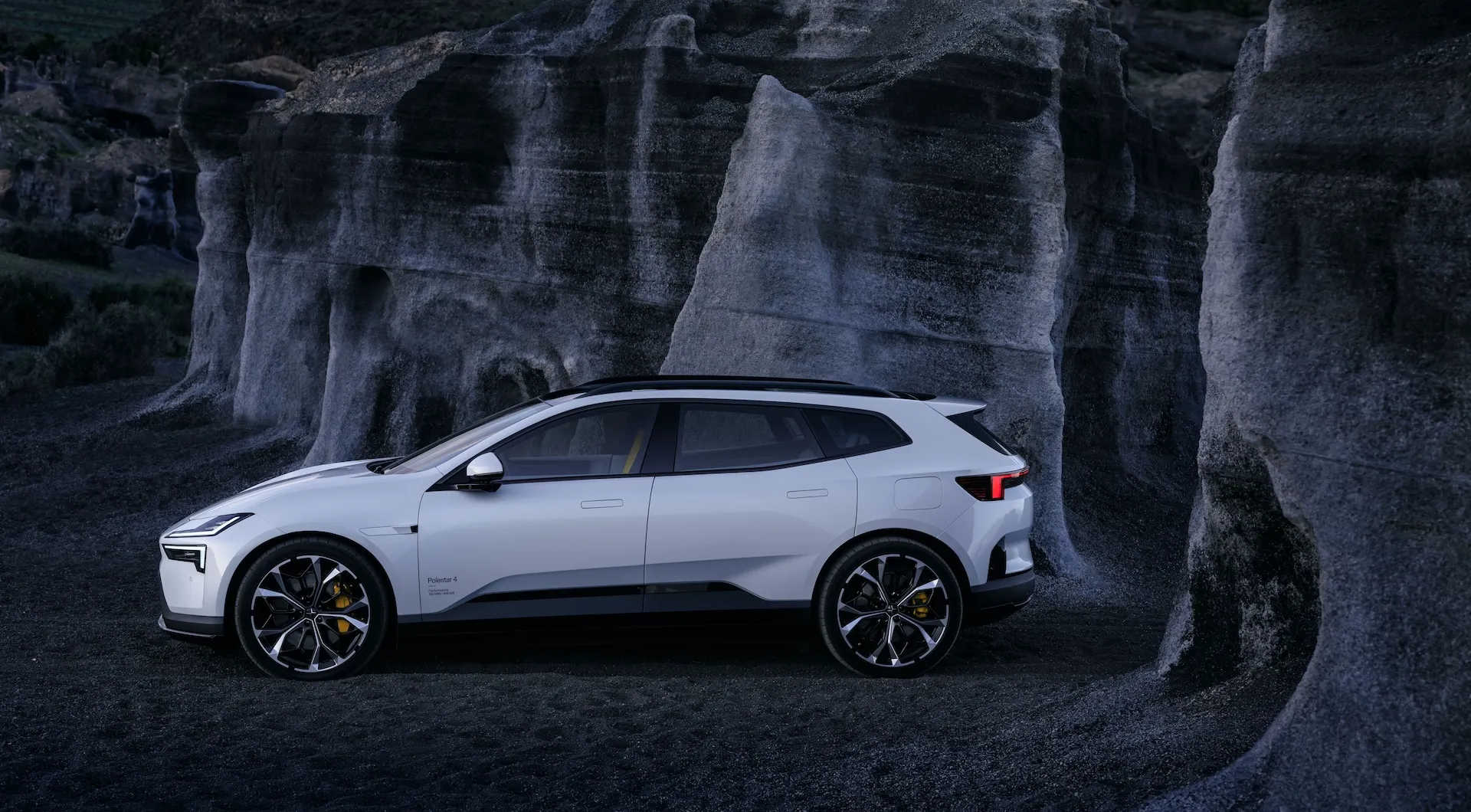
Positioned in what Polestar terms the compact executive SUV segment, the Polestar 4 SUV keeps the dual-blade headlights and illuminated logo of the coupé but adopts a straighter roofline and a more upright tailgate. Full-length roof rails raise dynamic roof load capacity to 220 pounds (100 kg).
Total storage is 59.3 cubic feet (1,680 liters) across the front and rear compartments. The rear holds 18.7 cubic feet (530 liters) to the seatbacks and 23.1 cubic feet (655 liters) to the roof, expanding to 58.8 cubic feet (1,665 liters) with the 60/40 rear seats folded. Second-row passengers gain roughly an inch (2.5 cm) of headroom over the coupé.
Unlike the coupé, the SUV has a rear window and a conventional rear-view mirror as standard. The digital rear-view mirror that debuted on the coupé remains available as a single option. A larger standard panoramic glass roof extends to the tailgate with 99.5% UV protection; an optional electrochromic roof, unique to the SUV, lets occupants dim the laminated glass fully or in sections from the center display.
The exterior palette expands to eight colors, adding Aurora (bright silver green) and Ozone Matte (bright silver purple in matte clear-coat). Inside, the landscape center display gains nine widget shortcuts, up from six, and an optional 12-speaker, 1,400-watt Harman Kardon system has been tuned specifically for the SUV. Standard Bio-attributed MicroTech upholstery uses a 100% recycled PET backing with a 53% bio-attributed PVC surface; optional Tailored Knit is 3D-knitted from 89% recycled PET waste, and Bridge of Weir Nappa leather is chrome-free and traceable to farm.
How Do the Two Powertrains Compare?
Built on the same SEA architecture as the coupé, the SUV shares its chassis specification with the recently updated Polestar 4 coupé, which Polestar confirmed in July alongside the SUV’s on-sale date.
| Variant | Power | Torque | 0–62 mph | WLTP range | UK price |
|---|---|---|---|---|---|
| Rear motor | 272 hp (200 kW) | 253 lb-ft (343 Nm) | 7.3 s | Up to 391 miles | £54,750 (~$73,900) |
| Dual motor AWD | 544 hp (400 kW) | 506 lb-ft (686 Nm) | 3.9 s | Up to 373 miles | £60,750 (~$82,000) |
Range figures are manufacturer WLTP values; EPA-rated range for any US-market version would be lower. The 100 kWh nominal battery is standard across the range, with AC charging up to 22 kW in selected markets and up to 11 kW in the UK, Ireland, Korea, and Canada.
The Performance pack, priced from £68,250 (about $92,100), adds recalibrated ZF active dampers, Brembo brakes with Swedish gold calipers, and new 22-inch Performance wheels on Pirelli P Zero tires. Powertrain variants are distinguished inside by seatbelt and rotary-knob color: all-black on Rear motor, a gold stripe on Dual motor, and full Swedish gold on Performance pack cars.
Joakim Rydholm, Polestar’s Head of Driving Dynamics, says: “Polestar 4 SUV builds on the dynamic foundation of the recently sharpened Polestar 4 coupé. With refined chassis tuning and enhanced steering response, it delivers the confidence, precision and driving engagement that Polestar customers expect, in all driving conditions.”
Vehicle-to-Load and Camping Mode
Vehicle-to-Load lets the high-voltage battery supply AC power to camping equipment, power tools, and consumer electronics at up to 3.3 kW (16 A, single-phase 230 V) through a certified adapter sold separately via Polestar’s Extras web shop. Owners set a minimum battery level from the center display, below which output stops.
A new Camping mode turns the parked vehicle into a climate-controlled space with entertainment, ambient lighting, and vehicle controls accessible from both front and rear displays, supported by V2L, USB-C, and the 12 V outlet. Both features arrive on all Polestar 4 vehicles through a future software update.
Google Gemini Replaces Command-Based Voice Control
Google Gemini replaces Google Assistant across all Polestar markets, supporting context-aware, multi-turn conversation and Gemini Live for brainstorming, trip planning, and real-time translation. Polestar began rolling out Gemini to US drivers earlier this year; the company says it now covers 22 countries in 16 languages.
Carbon Footprint
Polestar reports a cradle-to-gate footprint of 21.1 tCO2e for the Dual motor and 20.2 tCO2e for the Rear motor, among the lowest in its lineup. The company attributes the result to 100% renewable electricity in battery cell production, 34% of aluminum content sourced from smelters running on renewable power, and 23% recycled aluminum.
Michael Lohscheller, Polestar’s CEO, says: “Polestar 4 SUV broadens the appeal of our most successful model and extends our product offering in one of the industry’s most important segments. With more space, more utility and more opportunities for adventure, it stays true to the design, technology and driving experience that define Polestar. Production has started in Busan, South Korea, and the first shipment of cars is on the way to our customers.”
Matt Galvin, Managing Director of Polestar UK, describes the SUV as combining the usability of a wagon, which he calls an estate in UK terms, with the presence of an SUV: “The Polestar 4 SUV combines the usability of an estate with the presence of an SUV, while delivering the design, performance and sustainability drivers expect from a Polestar. It’s about taking the best qualities of both, delivering enhanced practicality for the modern family. And of course, the car has the ‘look back factor’ every time you walk away.”