

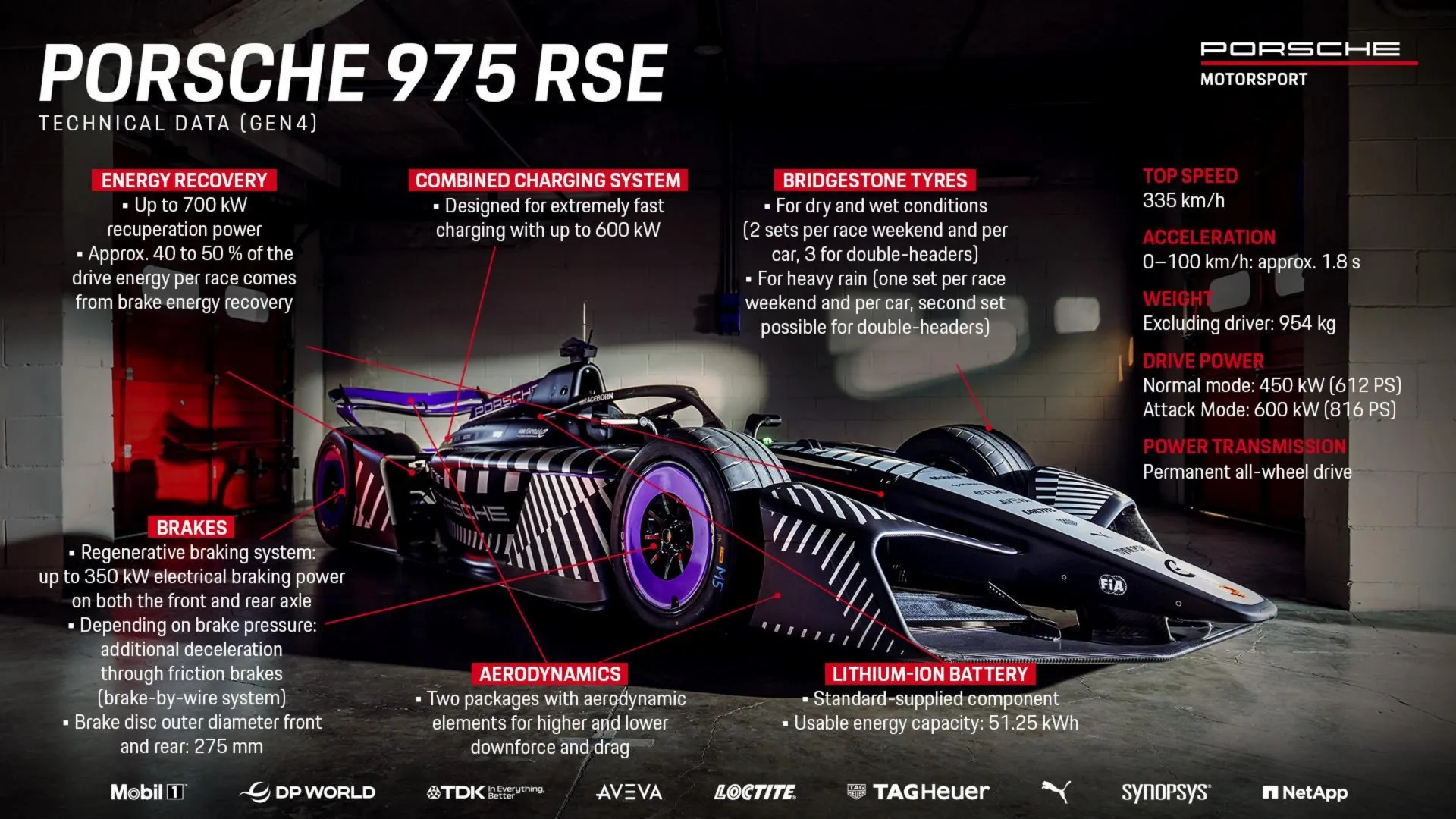
Porsche has detailed the engineering behind the 975 RSE, its GEN4 Formula E race car, whose control units run more than 1.5 million lines of code split across well over a hundred modules. The company says the car delivers a maximum of 600 kW (816 PS), a top speed of 208 mph (335 km/h), and acceleration from zero to 62 mph (100 km/h) in 1.8 seconds. Development of the 975 RSE began with a 2024 concept phase at the Weissach Development Centre and has since moved to on-track testing. The car replaces the 99X Electric and enters the 2026/2027 season.
Highlights
- 600 kW (816 PS) peak power — 71 percent more than the GEN3 Evo predecessor, according to Porsche
- Up to 700 kW recuperation, supplying roughly 50 percent of the energy a car uses across a race
- 51.25 kWh usable battery capacity covering a race distance of more than 45 minutes
- More than 1.5 million lines of in-house code across well over a hundred control modules
What Changes With the GEN4 Porsche 975 RSE?
Porsche presented the 975 RSE earlier this year as the successor to the 99X Electric. That car took both the drivers’ and manufacturers’ world championships in the 2025/2026 season, following Pascal Wehrlein’s 2023/2024 drivers’ title — a first for the factory team. The 975 RSE name marks Porsche Motorsport’s 75th anniversary this year.
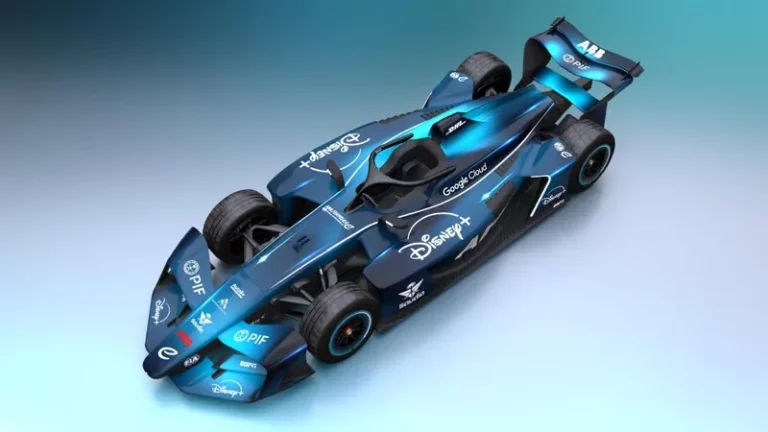
The GEN4 cars carry larger wings and considerably more downforce, a shift Porsche describes as visually closer to Formula 1 but aimed at cornering grip.
“Formula E has become so fast in just around a decade that we now need aerodynamic downforce,” said Olivier Champenois, Technical Project Leader Formula E at Porsche Motorsport. “But there’s no downforce without drag, which increases energy consumption. To further address this topic, we have two aero packages with different body components: a low-downforce package with less drag for racing and a high-downforce package with more downforce for qualifying, where energy consumption doesn’t matter. We’re talking about up to 150 percent more downforce than before.”
Nico Müller, a Porsche Formula E factory driver since 2024, has nicknamed the car “the Beast.”
Why Does a Formula E Car Start With Half a Race in the Battery?
Porsche reports powertrain efficiency above 97 percent for the current GEN3 Evo-generation 99X Electric, against below 55 percent for the last generation of Formula 1 cars. The gap comes from recuperation, where kinetic energy generated under deceleration flows back into the battery instead of dissipating as heat.
Because recuperation operates at up to 700 kW, the 975 RSE covers a race distance of more than 45 minutes on 51.25 kWh of usable battery capacity. At the starting line the pack holds only about half the energy the race demands, with roughly 50 percent of racing energy recovered on track. “The 975 RSE produces 71 percent more peak power than its predecessor,” Champenois said.
Durability Up, Weight and Costs Down
FIA rules standardize much of the car, and that balance changed little from GEN3 to GEN4. Chassis, aerodynamics, tires, and battery are identical across teams. With efficiency approaching its practical ceiling, Porsche says weight reduction, durability, and cost moved up the GEN4 specification sheet — the same pressures shaping road-going electric vehicles. The company capped added weight in its in-house parts package at roughly 11 pounds (5 kg).
“Although we’re developing more components in-house, the overall weight of our parts package could not increase by more than five kilograms,” Champenois said. “But we were able to make many parts lighter.”
Engineers started from the powertrain of the final GEN3 Evo iteration. In-house content covers the rear-axle electric motor, transmission, differentials, driveshafts, other rear-axle powertrain hardware, rear cooling and chassis components, and all operating software. Porsche received its first official data on the new generation in summer 2024.
In-House Software and Direct Oil Cooling
The 975 RSE’s control units hold more than 1.5 million lines of code broken into well over a hundred modules, each handling a specific function. That software governs how much energy returns to the battery under braking — recovering heavily into corners is what allows full power down the next straight.
“This software maximizes the power we have at the wheel,” Champenois said. “And that’s why it’s so important to develop the Formula E software in-house. It allows us to respond faster to changes and new challenges and keep up with short development cycles.” Keeping the work internal, he said, retains knowledge among the staff who run that season’s racing operation. “This in-house expertise is one of the most important performance differentiators for manufacturers in Formula E.”
On the hardware side, the oil-cooled permanent magnet synchronous motor at the rear axle recovers energy on its own at up to 350 kW. Nonconductive oil flows directly along the stator windings, dissipating heat where it is generated. Porsche says a water-jacket-cooled motor of equivalent output would need to be roughly 1.5 times larger. A nearly identical arrangement appears in the Cayenne Turbo Electric, one of several cases of direct oil cooling moving between race car and production model.
In-the-Loop Testing and the Road to December
Components including the steering wheel and chassis and drive sensors are integrated into a digitally simulated vehicle environment that stands in for control units, allowing bench testing before a complete car exists. Porsche says the scope of that work expanded with GEN4, partly because calibrating and controlling the axle differentials now allows more freedom.
“The GEN3 was already complex in its own right, but the GEN4 systems are much more so,” Champenois said.
The bench still falls two to three percent short of reality, which is why Müller and Wehrlein have been running the 975 RSE on track since November 2025 for final system calibration. Champenois expects lap times on a par with Formula 2. The car makes its race debut in December 2026.