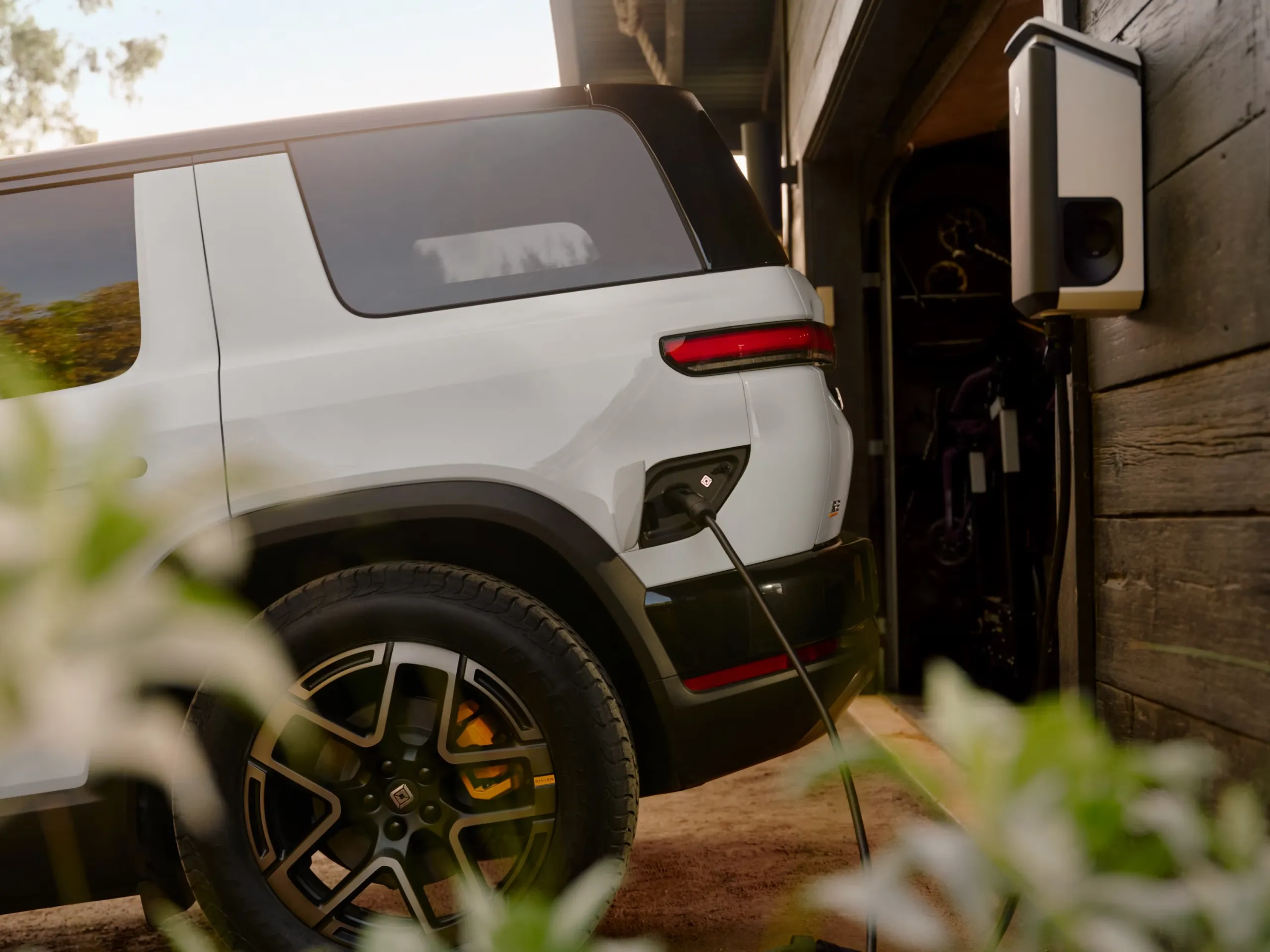

Rivian says the R2 adds up to 38 miles of range per hour on a hardwired Rivian Wall Charger, which delivers 11 kW over a 60-amp circuit. The automaker recently published owner guidance walking through home charging for three living situations: a garage or driveway, a rented or condo parking space, and no dedicated charging access at all. The company cites an independent March 2026 study finding that most EV owners charge at home 80 to 90 percent of the time.
Highlights
- Hardwired Rivian Wall Charger on a 60-amp circuit delivers 11 kW, adding up to 38 miles of range per hour
- A NEMA 14-50 outlet paired with the Rivian Portable Charger charges at roughly 7.6 kW for about 25 miles of range per hour
- R2 moves from 10 to 80 percent state of charge in under 30 minutes on DC fast charging
- Rivian counts approximately 73,000 DC fast chargers across North America
How Fast Does the R2 Charge at Home?
Rivian describes three tiers of home charging hardware, separated by circuit capacity.
| Home setup | Charging power | Range added per hour |
|---|---|---|
| Hardwired Rivian Wall Charger, 60-amp circuit | 11 kW | Up to 38 miles |
| NEMA 14-50 outlet with Portable Charger | Approx. 7.6 kW | Approx. 25 miles |
| Standard 120V household outlet | Not specified | A few miles |
The company positions the hardwired wall unit as the setup most owners select when the goal is a full charge overnight on every cycle. The NEMA 14-50 route uses the same outlet type as an electric dryer or range, which Rivian notes is already installed in many homes, and pairs it with the Rivian Portable Charger. A standard 120V outlet remains viable for short commutes or as a backup after a faster unit is installed.
Rivian qualifies all stated figures, noting that charging speed varies with battery temperature, state of charge, charger capacity, and site conditions, and that the quoted rates reflect optimal conditions. The company advises hiring a licensed electrician and works with installation partners Treehouse and Qmerit to connect owners with one. It also flags local and state incentives, noting that many utilities offer rebates on home charging equipment.
Charging Without a Dedicated Garage
For renters and condo residents, Rivian points to a 120V outlet in a shared carport or assigned parking space as sufficient for modest daily mileage. The company suggests asking a building manager or landlord about existing common-area charging before purchasing a vehicle, and notes that some buildings and condo associations are adding it. Where none exists, Rivian raises the possibility of working with the property to install equipment.
DC Fast Charging as a Fallback
Owners with street parking, a shared lot, or a building without infrastructure can lean on public DC fast charging. Rivian says the R2 covers 10 to 80 percent in under 30 minutes, which the company frames as short enough to fold into a commute or a weekly errand run rather than a dedicated trip. It puts the North American DC fast charging count at roughly 73,000 units, including its own Rivian Adventure Network sites.
App-Managed Scheduling and Charge Limits
The Rivian app handles scheduling once hardware is in place. Its Schedule Recommendation feature reads the owner’s utility rate structure and proposes charging windows automatically, adjusting when those windows shift seasonally. Rivian recommends a 70 to 80 percent charge limit for daily driving and 100 percent for road trips, stating that the practice extends battery life. A separate Energy App displays charging history and vehicle energy consumption.