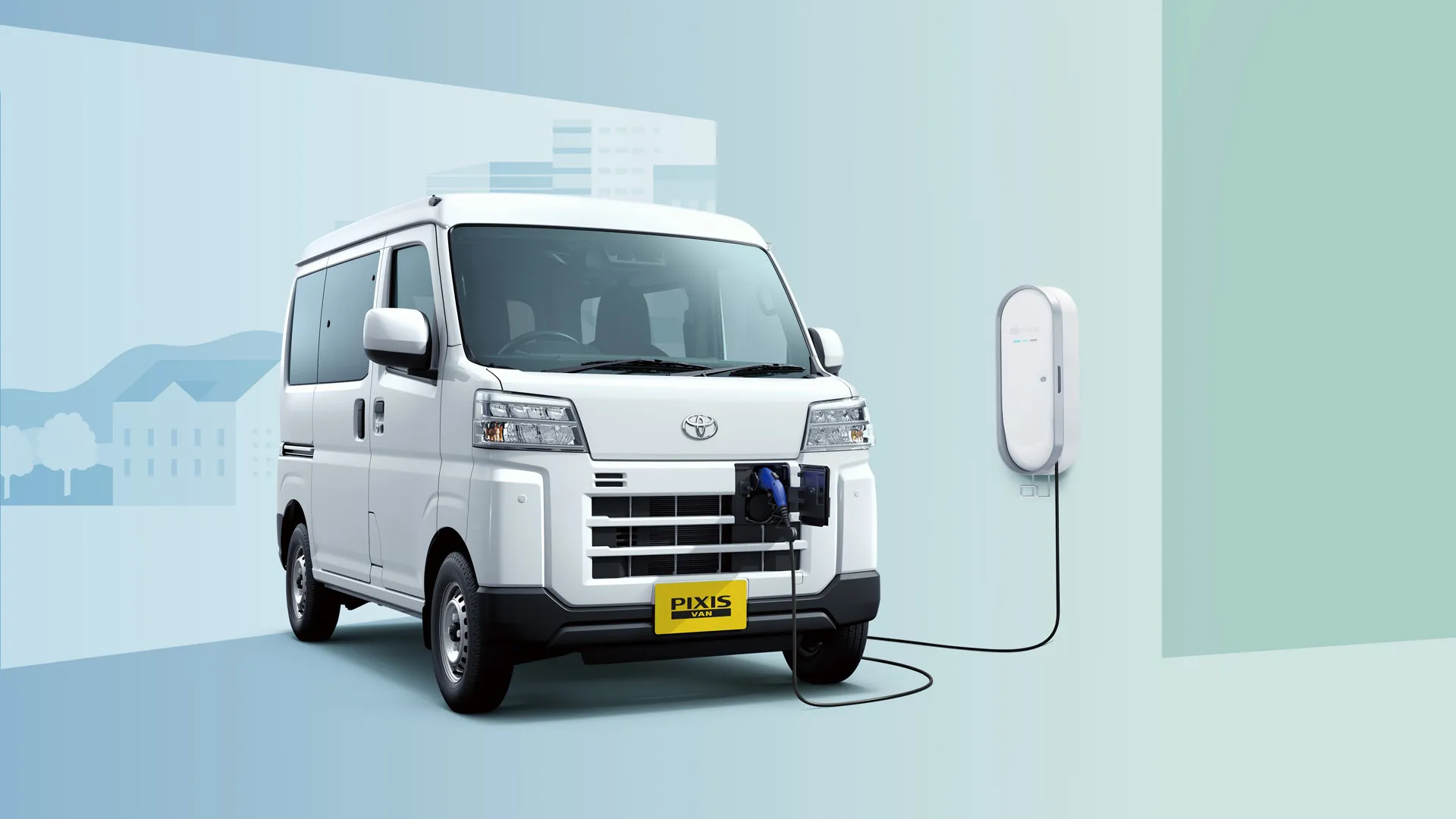

Toyota Motor Corporation has introduced a battery electric version of its Pixis Van kei commercial vehicle in Japan, with sales beginning February 2, 2026. The compact electric van targets last-mile logistics operators with a 257 km cruising range on WLTC testing, the longest among kei commercial van BEVs. The BEV system was jointly developed by Suzuki, Daihatsu, and Toyota, combining kei vehicle manufacturing expertise with Toyota’s electrification technology. Kei commercial vehicles account for roughly 60% of Japan’s total commercial vehicle fleet.
Highlights
- Toyota’s Pixis Van BEV achieves 257 km range from a 36.6 kWh lithium-ion battery, the longest among Japan’s kei commercial van BEVs.
- The BEV powertrain was co-developed by Suzuki, Daihatsu, and Toyota, leveraging each company’s core competencies.
- Cargo capacity matches the gasoline model, with 350 kg maximum load and the largest loading space among kei cab-over vans.
- Standard V2H compatibility and 1,500W power supply position the vehicle as both a delivery tool and emergency power source.
Powertrain and Performance Specifications
The Pixis Van BEV uses the e-SMART ELECTRIC system with a rear-mounted eAxle integrating the motor, inverter, and reduction gear. The AC synchronous motor (designated 1CG) delivers 47 kW maximum output and 126 N·m peak torque from startup, providing strong acceleration in stop-and-go urban conditions.
A thin, high-capacity 36.6 kWh lithium-ion battery sits under the floor, lowering the center of gravity. Toyota enhanced body rigidity with additional crossmembers and employed a newly designed trailing-link rigid-axle rear suspension to reduce unsprung weight and improve road-following performance. The result is a rear-wheel-drive configuration rated for stable handling even under full load.
Charging Capabilities
Rapid charging comes standard, reaching approximately 80% from low battery in about 50 minutes using a 50 kW or higher charger. Standard charging at 6 kW output takes approximately six hours from low to full. An optional Toyota 6kW Charger is available as a dealer accessory, along with a Charger Demand Controller that monitors household electricity usage and adjusts charger output in real time to prevent circuit breaker overload.
Toyota’s TEEMO charging service provides access to chargers at Toyota and Lexus dealerships across Japan, with charging initiated through a dedicated app. The Pixis Van BEV supports a maximum charging power of 50 kW.
Cargo Space and Usability
The BEV variant retains cargo dimensions equivalent to its gasoline counterpart, maintaining the largest loading space among kei cab-over vans:
- Cargo length: 1,920 mm
- Cargo width: 1,270 mm
- Cargo height: 1,250 mm
- Cargo floor height: 630 mm
- Maximum load capacity: 350 kg
Practical features include space-efficient overhead shelving, water-resistant full fabric seat upholstery, energy-efficient seat heaters for both front seats, automatic air conditioning, an active multi-information meter displaying battery level and power usage, and USB outlets for device charging.
Power Supply and V2H Compatibility
The Pixis Van BEV includes a standard 1,500W (AC 100V) external power supply function via an accessory outlet below the instrument panel. This supports high-consumption electric tools, enables power supply while driving, and provides emergency backup during outages or disasters.
Vehicle to Home (V2H) compatibility comes standard, allowing stored battery electricity to be supplied to a household through a separately sold V2H device connected to the rapid charging inlet.
Optional Packages
Two manufacturer option packages are available:
- Labor-saving pack (¥77,000): Keyless entry with request switches, power-retractable mirrors, rear glass pop-up mechanism, easy closer sliding doors, welcome door unlock function, and sliding door rail cover.
- Visibility assistance pack (¥66,000): Smart inner mirror and back monitor.
Safety Technology
The Pixis Van BEV comes equipped with the latest Smart Assist active safety system. The collision warning and collision-avoidance support braking functions recognize oncoming vehicles when turning right at intersections, as well as pedestrians crossing from the opposite direction during right or left turns.
Pricing and Production
The single available grade, Deluxe (2WD, 4-occupant), is priced at ¥3,146,000 including consumption tax. Recycling fees are not included. Toyota projects base monthly sales volume of 50 units in Japan.
Production takes place at Daihatsu Motor Kyushu’s Oita (Nakatsu) Plant. The vehicle is an OEM based on Daihatsu’s Hijet Cargo platform.
Commercial Japan Partnership Technologies Corporation (CJPT), established in April 2021 by Isuzu Motors, Hino Motors, and Toyota (with Suzuki and Daihatsu joining in July 2021), participated in planning to optimize specifications for efficient last-mile transportation.
For more information, visit the Pixis Van webpage or the Toyota Global Newsroom.
Sign up for our popular weekly email to catch all the latest EV news!