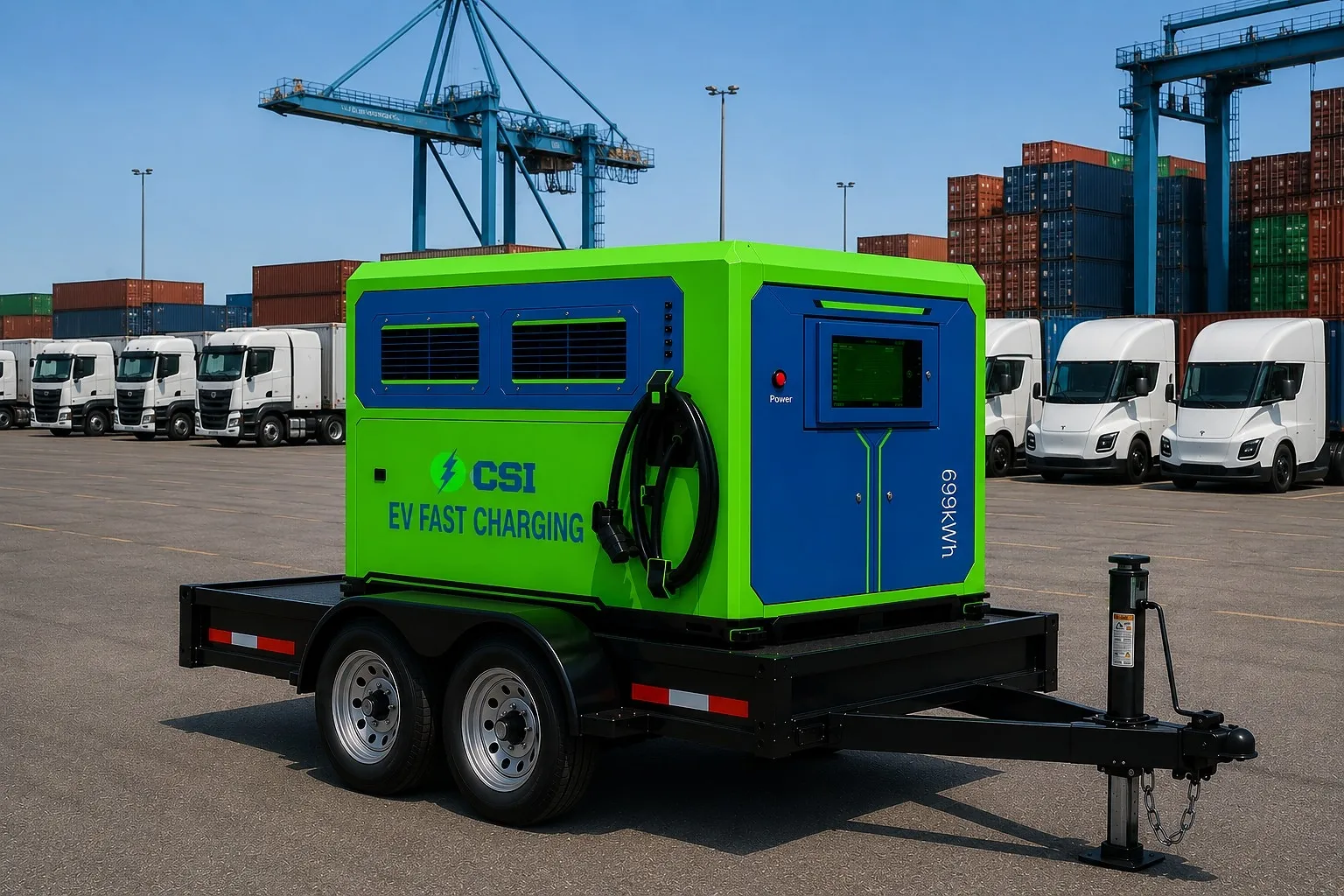

Coulomb Solutions Inc. (CSI) will add bidirectional Megawatt Charging System capability to its newest-generation Mobile Battery Energy Storage Systems, with the 2.3 MWh model rated for up to 1 MW of MCS power on both the recharging input and the charging output. The Livermore, California, company says the architecture allows a mobile battery system to be recharged over an MCS connection and then redeployed in the field to deliver high-power charging directly to compatible commercial electric vehicles. A smaller 699 kWh unit carries a 700 kW MCS rating in each direction. Both retain a standard 480 VAC connection for job sites where MCS is unavailable.
Highlights
- 2.3 MWh Mobile BESS: up to 1 MW MCS recharging input and up to 1 MW MCS charging output
- 699 kWh Mobile BESS: up to 700 kW MCS recharging input and up to 700 kW MCS charging output
- All CSI BESS units include a bidirectional 480 VAC connection that can also support building loads, shave demand peaks, and shift energy from peak to off-peak periods
- Both systems are eligible for up to $300,000 in point-of-purchase rebate under the 2026 CORE Voucher Funding program
MCS on Both Sides of the Battery
The distinguishing element of the option is symmetry. CSI states that its architecture places MCS on the input and the output of the 699 kWh and 2.3 MWh platforms, a departure from conventional Level 2 mobile and DC fast-charging systems, which handle recharging and dispensing through different and slower interfaces. The result, according to the company, is a storage unit capable of both receiving and delivering up to one megawatt of charging power wherever it is positioned.
CSI says the systems can charge Class 8 trucks equipped with MCS, citing the Tesla Semi as an example of a compatible vehicle.
“CSI’s approach completely changes how fleets can think about megawatt charging,” said David Mazaika, CEO of CSI. “This allows CSI’s BESS systems to take advantage of the substantial megawatt-charging infrastructure being installed everywhere to charge very quickly and then transport the energy to a fleet depot to charge EVs as needed. The MCS charging capability will enable CSI’s BESS system to be charged very quickly, minimizing non-money-making time and maximizing its time charging vehicles.”
Two Configurations for Different Job Sites
The MCS option is offered across two capacities, each aimed at a different deployment profile:
| System | MCS Recharging Input | MCS Charging Output | Intended Applications |
|---|---|---|---|
| 699 kWh Mobile BESS | Up to 700 kW | Up to 700 kW | Mobile fleet charging, temporary deployment, vehicle testing, infrastructure-constrained locations |
| 2.3 MWh Mobile BESS | Up to 1 MW | Up to 1 MW | Heavy-duty fleet, Class 8 truck, bus, ports, industrial and large-scale temporary charging, eVTOL, marine, construction, and agricultural applications |
Where MCS is not available at a site, the standard 480 VAC connection handles recharging. That connection is bidirectional, and CSI says it can also support building loads, shave peaks to reduce demand charges, and shift energy between peak and off-peak periods when the unit is not charging vehicles.
Charging Where the Grid Isn’t Ready
The company positions the transportable megawatt-hour capacity as an alternative to installing permanent high-power charging infrastructure at every operating location. Listed applications include Class 8 electric trucks, transit and school buses, ports and drayage operations, construction and mining equipment, fleet depots, rental equipment, vehicle demonstration and validation programs, temporary charging sites, emergency charging, and locations awaiting permanent utility upgrades.
CSI also frames the platforms as an infrastructure bridge, allowing fleets to put next-generation electric vehicles into service while permanent charging facilities, utility interconnections, and grid upgrades remain in the approval or construction stage.
“Commercial electrification cannot always wait for the grid,” said Greg Laudermilch, vice president of sales and marketing. “Mobile energy storage allows the charging infrastructure to move with the demand. Adding MCS capability takes that concept to an entirely new power level.”
Where Do Megawatt Charging Standards Stand?
CSI ties the timing of the option to standardization progress in the megawatt charging ecosystem. In February 2026, the International Electrotechnical Commission published IEC TS 63379, which defines connectors, vehicle inlets, and cable assemblies for conductive DC charging at megawatt power levels.
SAE International has separately issued SAE J3271, covering charging couplers, communications and controls, cable systems, bidirectional power transfer, and interoperability testing. Taken together, the company says, the two documents establish the foundation for MCS to become a common high-power charging interface for heavy-duty transportation.