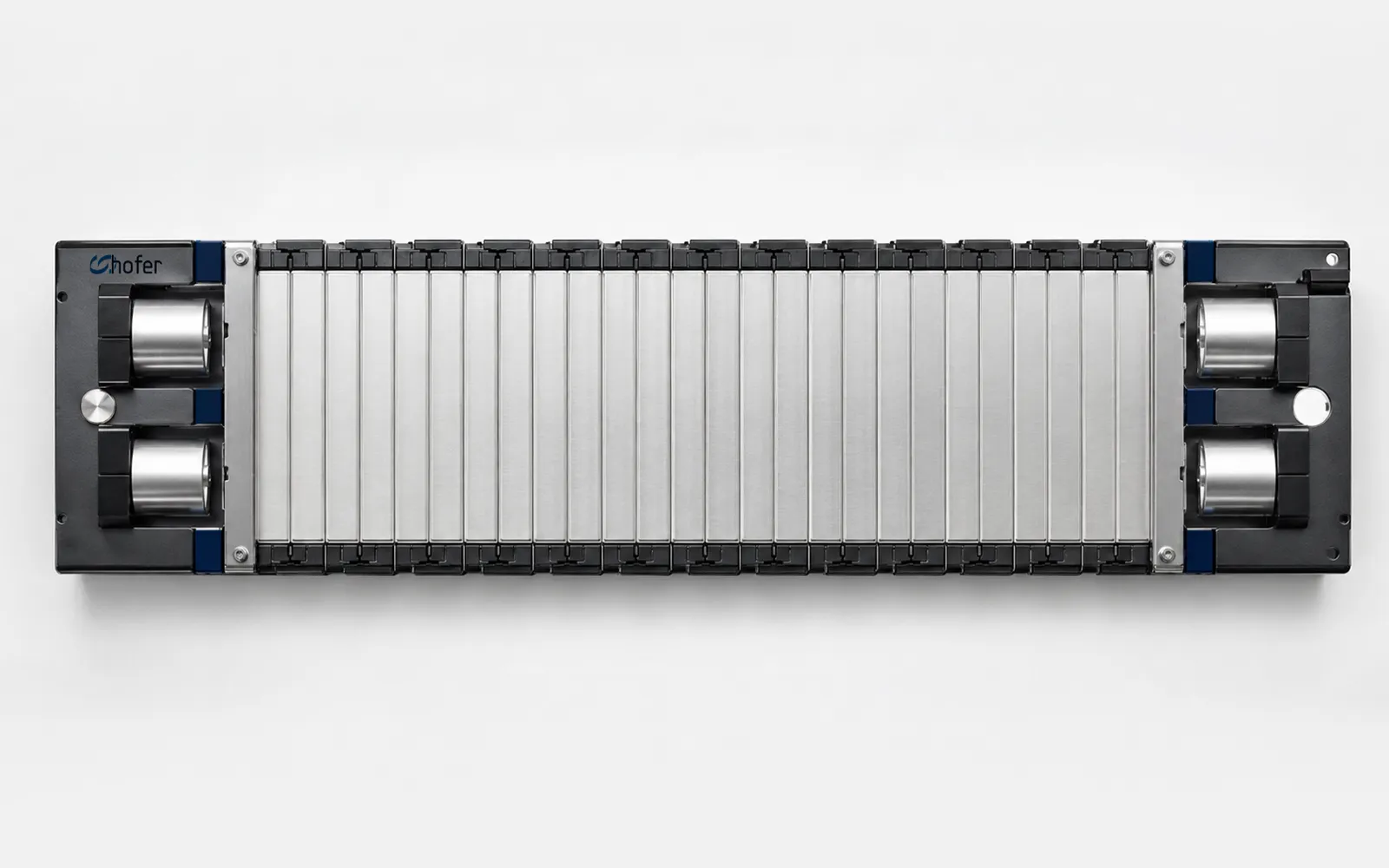

hofer technology has introduced a battery module built around programmable cell pressure control, a design the company says can deliver up to double the cycle life at double the energy density. The German engineering group, based in Nuertingen, has spent more than five years studying how mechanical conditions inside a module affect cell aging, and has now carried that work into a production-oriented module design. hofer technology frames the assessment as based on current NMC cell technologies as well as current solid-state cell technologies.
Highlights
- A freely programmable force map allows applied cell pressure to be adjusted by operating condition, converting a traditionally fixed mechanical design parameter into an actively controlled one.
- The company says the approach supports up to double the cycle life at double the energy density, based on current NMC and solid-state cell technologies.
- The test methodology is already in use across cell chemistries from NMC and LFP through next-generation solid-state cells.
- Test equipment records cell deformation, temperature, voltage, capacity and impedance during defined charge and load profiles.
How Does Cell Pressure Affect Battery Life?
Battery durability is usually discussed in terms of cell chemistry, temperature and state of charge. hofer technology argues that the mechanical conditions inside the module belong in that list, because the pressure applied to an individual cell influences how quickly it ages.
The company points to recent University of Cambridge research, which it says has drawn attention to the topic. According to hofer technology’s account of those studies, carefully controlled mechanical loading can significantly reduce the aging of lithium-ion cells, with the service life of tested cells extended under certain test conditions.
Test Methods Behind the Module
Across a range of customer projects, hofer technology has examined how cell preload, breathing, swelling and mechanical deformation affect cycle life and performance in different cells. The stated objective is not to measure how fast a cell degrades but to identify the mechanical conditions under which it holds performance longest.
Supporting that work required proprietary test methods and fully programmable test equipment. During defined charge and load profiles, the rigs capture cell deformation, temperature, voltage, capacity and impedance, which the company says makes it possible to identify suitable mechanical constraints early in a program. Hagman Media has previously covered the company’s expansion of its battery testing and development space in Nuertingen.
There is no single optimum pressure that works across all cells, according to the company. Both insufficient and excessive mechanical force can accelerate degradation, so cell chemistry, cell format, state of charge, temperature and operating profile have to be treated as one integrated system.
A Programmable Force Map
Smart pressure control is the defining feature of the new module generation. The freely programmable force map adjusts pressure on the cells according to operating condition, which the company describes as turning a fixed mechanical design parameter into an actively controllable one within the battery system. hofer technology says the development maturity already reached allows customers to move toward series application on a short timeline.
The scale of the benefit varies with cell technology, operating profile and initial system design. Longer service life also carries an economic argument: replacement and recycling can be deferred, with potential effects on residual value, total cost of ownership and resource use.
Where Longer Cycle Life Matters Most
The company positions the module beyond conventional passenger electric vehicles, citing commercial vehicles, stationary energy storage, marine applications and future aviation and aerospace systems as areas where high cycle life matters.
Economics tighten further for storage systems built on solid-state cells, where cycle count feeds directly into system-level viability. hofer technology also notes that future vehicle battery systems will need to support Vehicle-to-Home (V2H) and Vehicle-to-Grid (V2G) operation, and that V2G duty in particular can demand several times as many charge and discharge cycles — an additional load case for solid-state-based storage. Smart pressure control, the company says, helps hold cell performance stable across a high cycle count.